
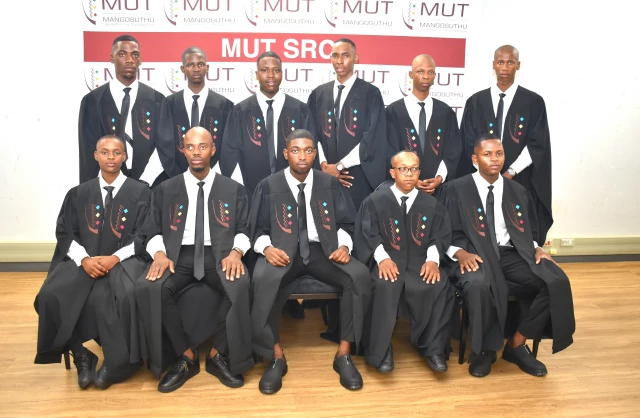
In an address marking the start of the 2026/2027 student leadership term, newly inaugurated Student Representative Council (SRC) President Siphiwesihle Mzila affirmed his commitment to unity, student welfare, and institutional stability at the official SRC inauguration ceremony on 12 October 2026 at the MUT Student Centre.
Speaking before senior University leadership, including the Vice-Chancellor and Principal, Professor Rushiella Songca, Dean of Students Dr Xolile Ngubane, members of the Executive Management Committee (EMC), staff, and fellow student representatives, Mzila emphasised that the democratic outcome of the elections that took place on 1 October 2026 reflects the clear voice and mandate of the student body. “We are gathered here today to witness and respect one of the most fundamental rights of our student population, the right to choose their own leadership,” Mzila declared. “Nobody understands the experiences, challenges, and aspirations of MUT students better than the students themselves. The voice and will of our students must be heard and adhered to,” he said.
Outlining the key pillars of the incoming administration’s vision, Mzila detailed five critical commitments aimed at directly improving student life and academic success at MUT. The SRC President called for changes to the current NSFAS accommodation models, saying university-led accreditation and residence management should continue to guarantee quality and safety for students.
Mzila called for the immediate progression of key university-owned housing developments, specifically Block A, the Executive Hotel, and the long-promised 500-bed residence. These developments are intended to ease severe accommodation shortages affecting both self-funded students and NSFAS beneficiaries.
Highlighting a major gap in institutional support, Mzila noted that while over 300 students on campus live with disabilities, only two residence floors are allocated for their needs. He called for expanded accessibility and demanded the immediate restoration of the campus disability laboratory, which had reportedly been converted into a storage room. According to Mzila, to alleviate financial exclusion, the SRC will work closely with the Dean of Students to expand the SRC Trust Fund, extending financial aid to more needy students.
Addressing broader institutional challenges, Mzila called on the Vice-Chancellor and Principal, Professor Rushiella Songca and executive management to partner with student leadership under the framework of the Higher Education Act 101 of 1997, ensuring that external pressures, whether from the Department of Higher Education and Training (DHET), NSFAS, parliamentary committees, or donors, do not undermine the University’s internal unity.
Concluding his address, he promised an inclusive, non-partisan approach to governance, pledging to represent every student, regardless of political affiliation, background, or religious belief. “I make this solemn commitment. I will serve as the President of all MUT students, not only those who voted for me or share my political views,” Mzila concluded.
Mzila was an independent candidate; he got 1643 votes, which gave him one seat, and then joined forces with SASCO, which got 1669 votes, giving them five seats. Another independent candidate, Athandile Mpungose, got 1627 votes, which gave him a seat. He also aligned himself with SASCO. Together, as SASCO, they now have seven of the 11 seats. The other seats went to the Economic Freedom Fighters Youth Command (EFFYC), which got 1613 votes. The SRC leadership tenure is one year.
Handing over the reins to the new leadership, outgoing SRC President Mdumiseni Chonco delivered a mature, balanced message. He outlined the challenges of the role and how he and his team managed them.