
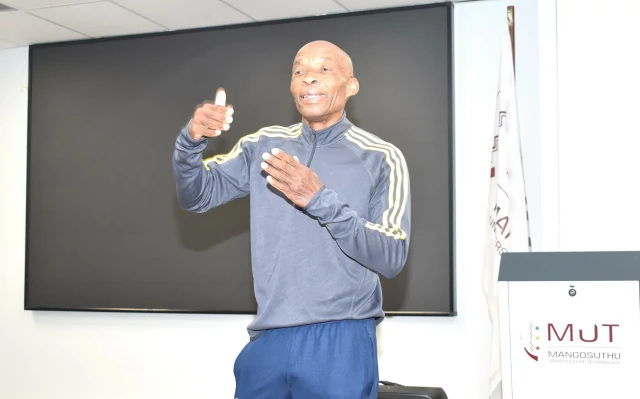
Speaking on the final day of the sports coach induction workshop on 21 July 2026, Thabo Dladla, whose decorated background includes 22 years at the University of KwaZulu-Natal, seven years within the South African national team setup, and elite coaching qualifications including CAF A, Euro A (Germany), a Euro Diploma (Holland), and a Brazilian Diploma, urged coaches to rethink their approach on and off the field.
Drawing heavily on his background as a former teacher, Dladla reframed the essence of sports coaching around pedagogy, keen observation, communication, and cultural development. “A coach is a teacher. Like teaching, coaching is transmitting knowledge to people. Your goal is to have people become knowledgeable until it becomes automated in their long-term memory,” Dladla explained.
Dladla cautioned coaches against over-explaining during training sessions, reminding them that students want action, not lectures. Instead of interrupting play constantly, Dladla advised letting sessions flow, preparing realistically for player struggles, and dedicating ample time to training, noting that an hour-long match ideally requires three hours of preparation.
A central theme of Dladla’s presentation was the critical role of a coach’s observation skills. He stressed that a coach’s ability to make effective decisions relies entirely on seeing accurately and understanding what is unfolding on the field. Dladla urged coaches to take written notes during training and matches, rather than relying on mental data or shouting instructions endlessly. “Tone, body language, and individual player management are vital. Screaming vague directives like “phasa kahle” (pass well) yields little benefit if the player does not understand the technical context,” Dladla said.
For Dladla, matchday is for reminding, not teaching. Also, before the match, a coach needs to limit instructions to one or two key points. “You are not a good coach because you talk too much, but because you say important things,” he noted.
Dladla also drew attention to ‘age’ and its importance. He also tackled South Africa’s systemic delay in youth development. Pointing out a historically skewed perception of age in local sports, he highlighted how global football thrusts teenagers into major roles early, citing Pele winning the 1958 World Cup at 17, as well as two 19-year-olds who recently led Spain to World Cup victory in the United States on 19 July 2026. “Kids must start early to get involved in sport. The older generation has let down our youth,” Dladla asserted, calling on coaches to build better habits and start practising under calm conditions.
Finally, Dladla emphasised establishing a healthy, growth-oriented team environment built on psychological safety. “I will encourage you to develop a culture of safety and error. Your players must not fear making mistakes. They are not going to learn if they don’t try,” he said. “At lower levels, progress should not be judged purely by the score.”