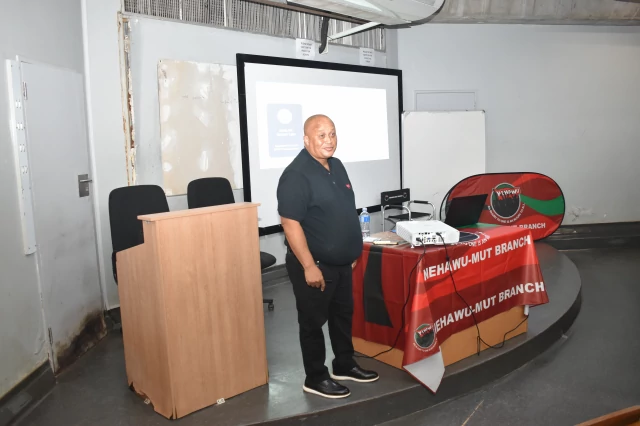
The National Education, Health and Allied Workers’ Union (NEHAWU) at MUT, in partnership with the University’s Human Resources and Development department, hosted a critical two-day financial awareness workshop from 19 to 20 November 2026 to help employees safeguard their families’ financial futures. The initiative was designed to address recurring administrative challenges and delays faced by grieving families when claiming death benefits, complications that often stem from outdated employee records.
NEHAWU MUT Fulltime Shop Steward, Linda Nzama, explained that while employees work hard to provide for their dependents, failing to update beneficiary forms after major life changes can leave families stranded. “NEHAWU MUT is a caring union for its employees and members. When our members pass away, we experienced a lot of challenges in terms of their families not receiving what is due to them. One of the main issues is when an employee is not up to date with their beneficiary forms or wish lists. You might have a wish, but it becomes outdated as changes happen in your life,” Nzama said.
Mziwethu Kuboni, a facilitator from Limise Human Capacity Developers who addressed the staff during the workshop, echoed this sentiment. He emphasised that accurate documentation is central to protecting loved ones when a breadwinner can no longer speak for themselves. Both speakers stressed that during times of bereavement, families are often overwhelmed and rely heavily on MUT’s HR department to guide them through the claims process. Because HR can only act on the official records in its possession, any discrepancy between a member’s intentions and their paperwork creates severe bottlenecks.
The workshop focused on demystifying the legal and administrative differences between a last will and testament, the National Tertiary Retirement Fund (NTRF), and Sanlam policies. Nzama warned against the common misconception that simply having a valid will covers all aspects of an estate. “Knowledge is power. Many members are not quite familiar with how a will, the NTRF, and Sanlam rules operate, because they do not do the same thing,” Nzama said. “A will covers your personal assets, whereas the NTRF is governed by Section 37C of the Pension Funds Act, and Sanlam is defined by its own policy rules. A will might say one thing, while the beneficiary nomination form required by the NTRF says another. If you only have a will, you are not fully covered,” said Nzama.
By bringing HR and financial facilitators directly to the staff, NEHAWU aimed to ensure that employees’ wills, retirement fund nominations, and insurance policies are properly aligned.