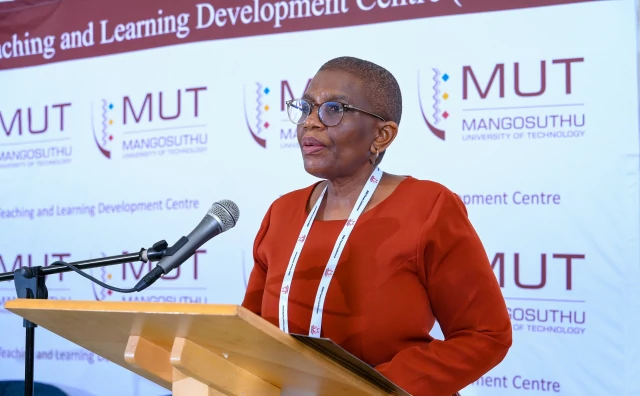
MUT’s interim Vice-Chancellor and Principal, Professor Rushiella Songca, delivered a compelling keynote address at the 13th Focus Conference on 19 August 2026 at the Royal Majestic Hotel in Durban. Organised by MUT’s Learning and Teaching Development Centre (LTDC), the three-day flagship gathering brings together local and international scholars, researchers, policymakers, and practitioners. This year’s conference centres on the theme: “Responsive Universities: Reimagining Higher Education for Global Relevance and Human Advancement.”
Professor Rushiella Songca called for strategic challenges in the education sector. Addressing delegates during her opening address, Professor Songca challenged universities to interrogate what it truly means to be “responsive” in an era marked by rapid technological change, economic uncertainty, and evolving societal needs. Professor cautioned that true responsiveness requires intellectual capacity and agility, grounded in a clear institutional mission, rather than reactionary shifts or short-term trends. “A responsive university must be a university that listens,” Professor Songca stated. “It listens to its students, to communities, to industry, and to society, while retaining the courage to question existing systems and imagine better futures.”
Reflecting on the South African higher education context, Professor Songca underscored that access to university education must be matched with clear pathways to success. She called for continuous reflection on curricula, assessment practices, and student support systems to ensure that graduates emerge not only as employable professionals but also as ethical leaders and active contributors to society.
A key focal point of the conference programme is the impact of Artificial Intelligence (AI) on teaching, learning, and governance. Professor Songca urged delegates to reject both uncritical adoption and reflexive resistance to emerging technologies. “The question before us is not whether higher education will be affected by Artificial Intelligence; it already is,” Professor Songca noted. “The question is whether we will engage with these developments thoughtfully, ethically, and responsibly to advance equity, innovation, and human development.”
In her concluding remarks, Professor Songca emphasised that global relevance must extend beyond rankings and technological sophistication to embrace human dignity, inclusive development, and the reduction of social inequality. Professor Songca encouraged delegates to engage in active, collaborative dialogue throughout the conference to build actionable frameworks for the future of higher education.
Professor Songca also took part in the panel discussion, where she emphasised that a professional working relationship among the Chair of the University Council, the Vice-Chancellor, and the Registrar was essential to the university’s stability. A large part of the discussion was the state of South Africa’s universities, with a special focus on governance matters.