
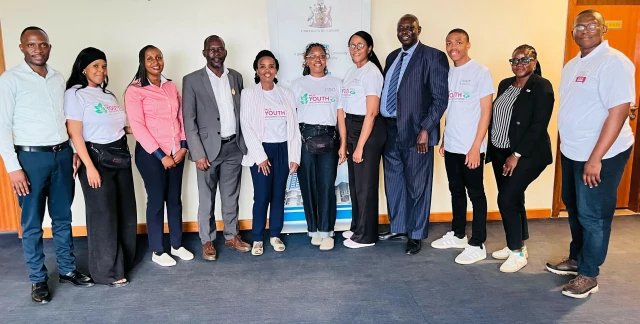
Four students from MUT, accompanied by Professor Xolile Mkhize of the Department of Agricultural Extension and Sustainable Food Systems, and Dr Sithembile Nkosi, a Lecturer in the Department of Nature Conservation, departed for Kenya on an academic exchange programme at the University of Nairobi. The delegation, comprising students drawn from the three faculties, arrived in Nairobi on the evening of 17 November and will return to South Africa on 21 November 2026. These students are Nkule Malunga, and Lungelo Majoka, both from the Faculty of Applied and Health Sciences; Lwanele Khumalo, from the Faculty of Engineering; and Samkelisiwe Kheswa, from the Faculty of Management Sciences. While logistical constraints meant only four representatives could travel for the in-person leg, the selected students will represent their broader cohort, present their collaborative work, and share insights from their online engagements. Proceedings began on 18 November 2026, when the MUT delegation met with University of Nairobi management and their Kenyan student counterparts to formally kick off the on-campus programme.
Professor Mkhize stated that the visit forms part of a Collaborative Online International Learning (COIL) project, supported through the National Research Foundation (NRF) and Department of Science, Technology and Innovation (DSTI/DSI) Africa University Twinning Programme. The initiative aims to foster intra-African academic collaboration, expose students to diverse regional contexts, and build multicultural competence.
“It is part of exposing the students to the African region, connecting Southern and East Africa,” said Professor Mkhize, adding that they were reaching out and collaborating on multicultural competencies. The exchange builds on ongoing climate change conversations that began internally at MUT, where youth across various faculties engaged in discussions about how climate change impacts their communities and academic disciplines. Because Professor Mkhize’s core research focuses on food systems and their vulnerability to climate change, the project evolved into a cross-continental dialogue comparing how South African and Kenyan students experience and study these challenges within their respective curricula.
Professor Mkhize noted that Kenya’s equatorial latitude and distinct climatic and environmental conditions offer a critical comparative perspective for students from Southern Africa. Prior to the trip, a group of 20 MUT and University of Nairobi students collaborated virtually through COIL, working together on multidisciplinary tasks.