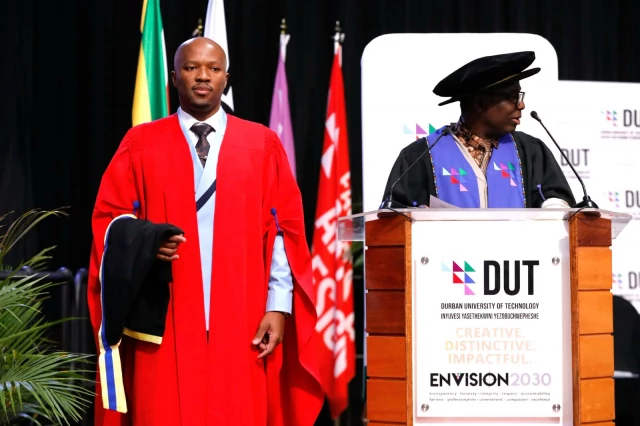
In a remarkable achievement that underscores dedication to institutional growth and scholarly excellence, Mzwakhe Ellen Shange, a secretary in the Department of Construction Management & Quantity Surveying at Mangosuthu University of Technology (MUT) has graduated with a Doctor of Philosophy (PhD). Dr Shange’s doctoral research, titled “An Integrated Business Process Management Framework for Job Improvement and Satisfaction of Academics at Selected Universities of Technology,” addresses the mounting pressures facing higher education staff across South Africa.
According to Dr Shange, South African Universities of Technology (UoTs) have faced unprecedented challenges in recent years, including escalating teaching workloads, heavier administrative responsibilities, and the rapid pace of digital transformation. Dr Shange’s study explored how business process management (BPM) could streamline operations to restore balance, enhance academic productivity, and protect staff well-being.
Utilising a mixed-methods approach, Dr Shange surveyed 223 academics and conducted semi-structured interviews with 11 academic leaders across selected UoTs. The findings revealed that while BPM practices exist within these institutions, their application remains largely inconsistent. The research demonstrated that efficient institutional processes directly reduce administrative burdens, support digital innovation, and elevate job satisfaction. Conversely, fragmented or ineffective processes lead to burnout, presenteeism, and reduced overall morale among academic personnel.
The core output of Dr Shange’s study is an original, integrated business process management framework designed specifically for the South African UoT landscape. The framework balances workplace demands with appropriate institutional resources by aligning three core pillars: people, institutional processes, and technology.
The key beneficiaries of the research are academics, who will gain relief from burdensome administrative tasks, allowing more focus on core teaching and research responsibilities, university leaders and administrators. These professionals will receive practical, actionable guidance to optimise decision-making and operational structures. Also, the students, who will experience enhanced learning support from more productive, motivated, and engaged academic staff. And lastly, the policymakers and other Out. These will have access to an evidence-based blueprint for human-centred, sustainable digital transformation in higher education.
Dr Shange’s scholarly contribution has already gained significant recognition within the scientific community. A paper stemming from the study has been published in a Department of Higher Education and Training (DHET)-accredited journal, with three additional papers currently undergoing peer review. Furthermore, the findings have been presented at two national conferences and one international conference.
With the completion of his PhD, Dr Shange plans to transition fully into academia, where he aims to contribute directly through teaching, research, and postgraduate supervision. Moving forward, he intends to advocate for the practical adoption of his framework to foster resilient, human-centred academic environments across South Africa.