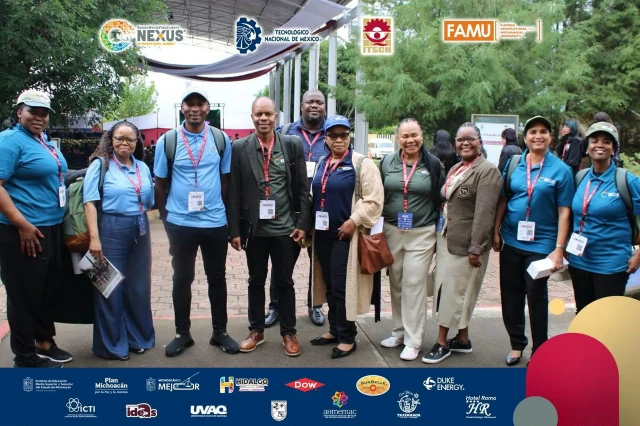
Mangosuthu University of Technology (MUT) strengthened its international research footprint when a delegation led by Deputy Vice-Chancellor for Research, Innovation and Engagement, Professor Mncedisi Maphalala, represented the University at the EnergyWaterFoodClimate Nexus Summit at the Tecnológico Nacional de México, Instituto Tecnológico Superior de Ciudad Hidalgo (TecNM-ITSCH) in Ciudad Hidalgo, Michoacán, from 25 to 28 August 2026. The summit was held under the theme: “Let a New Science Enterprise Lead the Way.”
The conference brought together academics, researchers, innovators, students, and sustainability practitioners to explore new scientific approaches to the interconnected challenges of energy security, water sustainability, food systems and climate change.
MUT made a significant contribution to the summit, presenting seven of the more than 38 papers delivered during the four-day programme. The University’s strong presence demonstrated the depth and diversity of its research and its commitment to developing solutions that respond to real societal challenges.
Professor Maphalala presented a paper titled “Reimagining Higher Education: Curriculum Innovation, Research Excellence, and Community Impact.” His presentation positioned higher education institutions as critical drivers of innovation, sustainable development and meaningful community transformation.
The following MUT colleagues also presented papers:
- Dr Xolile Ngubane: Science Enterprise in the Energy-Water-Food-Climate Nexus: A Phenomenological Study of Technology Business Incubation for Small Enterprise.
- Mbali Mkhize: Advancing Internationalisation Through COIL in the Energy-Water-Food-Climate Nexus for Africa’s Sustainable Future.
- Gugulethu Ngcobo: Optimization of Chitosan Biosorbent Derived from Marine Waste for the Treatment of Industrial Oily Wastewater.
- Dr Kavita Behara and Professor Ramesh Kumar Behara: An Intelligent AI-Based Framework for Greenhouse Gas Emission Forecasting and Net-Zero Carbon.
- Professor Busisiwe Nkonki-Mandleni: Transformative Climate Adaptation Through Participatory Action Learning and Research: Addressing Epistemic Injustices Through Knowledge Co-Production and Collective Learning.
- Professor Xolile Mkhize: Transforming Food Systems through Agricultural Extension and Advisory Services and Indigenous Knowledge: A South African Energy-Water-Food Nexus Perspective.
The papers reflected MUT’s multidisciplinary approach, spanning curriculum innovation, community engagement, artificial intelligence, climate adaptation, indigenous knowledge systems, wastewater treatment, entrepreneurship and internationalisation through Collaborative Online International Learning (COIL).
The MUT delegation was recognised throughout the conference for its substantial academic contribution and visible participation. Presenting seven papers at an international summit of this scale affirmed the University’s growing capacity to contribute African scholarship and locally grounded solutions to global sustainability debates.
The delegation’s presence in rural Mexico further underscored an important message of the summit: the new science enterprise must extend beyond traditional academic and geographical boundaries. It must connect universities and communities, integrate indigenous and scientific knowledge, develop emerging researchers and translate scholarship into sustainable societal impact.