
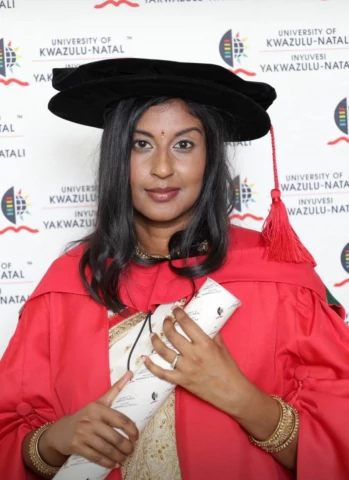
Dr Roxanne Pillay, a lecturer in the Department of Biomedical Sciences at Mangosuthu University of Technology (MUT), officially graduated with her PhD in Medical Microbiology from the University of KwaZulu-Natal (UKZN) on 13 May 2026.
Her pioneering doctoral research marks a major milestone for women’s health in sub-Saharan Africa. The research provides the first-ever transcriptomic evidence showing how common parasitic worm infections can alter immune responses in the female genital tract, potentially driving the development of cervical cancer.
Dr Pillay’s study investigated the complex interplay between Nippostrongylus brasiliensis (a laboratory model for human hookworm) and Herpes Simplex Virus Type 2 (HSV-2). While HSV-2 is globally recognised for causing chronic inflammation and increasing vulnerability to HIV and Human Papillomavirus (HPV), it frequently overlaps with soil-transmitted helminths (STHs), intestinal parasitic worms, in low-income and poorly sanitised regions.
“Parasitic worms are known to suppress and modulate the host’s immune system to ensure their own survival,” Dr. Pillay explained. “The study looked at how this worm-induced immune dampening affects the female reproductive tract, which has historically been a largely under-studied area.”
Using advanced molecular and bioinformatics approaches, Dr Pillay mapped out how co-infection suppresses critical microRNA (miRNA) and messenger RNA (mRNA) expression profiles. The study revealed that these genetic shifts fundamentally alter local immune defences and “enrich” molecular pathways directly associated with cancer progression.
The study of the complete set of RNA transcripts produced by the genome under specific circumstances. By analyzing these transcripts, researchers can see exactly which genes are switched “on” or “off” by an infection.
The findings carry profound implications for healthcare strategies across sub-Saharan Africa, where women are disproportionately affected by overlapping parasitic and sexually transmitted infections. Rather than continuing the traditional medical approach of treating these diseases in isolation, Dr Pillay advocates for an integrated public health model. She proposes: a combined screening. “Merging HSV-2 prevention and screening programmes with robust community deworming and parasite control strategies,” said Dr Pillay. Also, Biomarker Diagnostics, which are utilizing molecular biomarkers like miRNAs to identify early immune vulnerabilities and track disease progression before cancer develops. Dr Pillay also recommends ‘targeted therapies’. “Opening new doors for vaccine development and specialised treatment strategies for women in high-risk, co-endemic zones,” Dr Pillay said.
Dr Pillay’s doctoral journey was completed under the guidance of her main supervisor, Professor Zilungile Mkhize-Kwitshana, a distinguished professor at UNISA and former HoD of Biomedical Sciences at MUT, and co-supervisor Dr Pragalathan Naidoo (UKZN). The experimental model was made possible through a collaborative partnership with the University of Cape Town.
The impact of Dr Pillay’s work has already resonated through the global scientific community. Supported by funding from the South African Medical Research Council (SAMRC) Staff Development Programme and the MUT nGAP initiative, Dr Pillay’s research has already generated five scientific publications. Her findings have earned prominent accolades, including first prize for Oral Presentation at the SAMRC KZN Regional Meeting and the Best Poster Presentation award at the International Conference on Public Health in Bangkok, Thailand.
“Our work directly impacts patients’ lives through research that helps shape better treatment interventions,” said Dr Pillay, reflecting on her graduation. “Behind every sample is a human being whose life we are trying to improve. That is what makes this work so purposeful.”