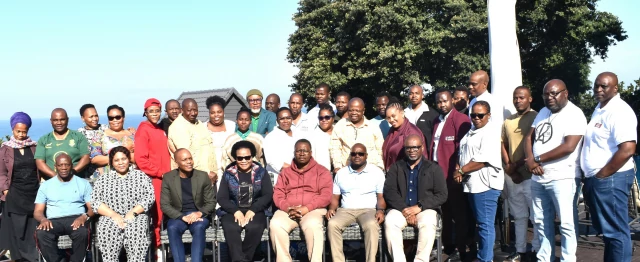
MUT has officially launched its first-ever Research, Innovation and Engagement (RIE) Research Writing Retreat, signalling a decisive, collective effort to elevate the Institution’s national research standing and foster a robust scholarly culture. The three-day intensive retreat was attended by 34 staff members, cutting across both academic and support divisions.
Delivering the opening remarks, the Deputy Vice-Chancellor: RIE, Professor Mncedisi Maphalala, did not shy away from the institutional challenges highlighted by recent academic data. “The latest national research output data tells us that MUT is currently positioned at the lower end of the sector in terms of research output performance,” Professor Maphalala stated. “This reality may be uncomfortable, but it is one we must confront honestly.”
Rather than dwelling on past shortcomings, Professor Maphalala challenged the attendees to focus on actionable solutions, asking a fundamental question: “What are we going to do about it?”
The retreat represents a deliberate institutional response to create space, support, and momentum for heightened research productivity. However, MUT leadership cautioned that building a vibrant research culture requires long-term dedication. The dedication will be underpinned by sustained effort. This will require knowing that improving performance will not happen overnight; it requires patience, consistency, discipline, and commitment. The transformation will rely on the collective contributions of academic staff, support divisions, administrators, postgraduate students, and institutional leaders. Professor Maphalala committed to leading from the front, pledging to continue contributing to the University’s research agenda through his scholarly publications.
Professor Maphalala appealed to staff to “contribute their stone” toward building a stronger, more impactful university.
A key focus area highlighted during the address is the need to expand MUT’s doctoral capacity. Currently, approximately 29% of MUT’s academic staff hold PhDs. PhD studies equip staff to conduct independent, high-quality research. A PhD also enables effective supervision of postgraduate students.
To help steer this transformation, MUT assembled a team of exceptional facilitators and mentors. These were Emeritus Professor Azwidohwi Kutame from the University of Venda, and Professor Nontobeko Khumalo, from the Curriculum and Instruction Studies Department at Unisa. Professor Kutame echoed the sentiment that impactful research must directly respond to the needs of society.
Professor Maphalala emphasised that MUT’s current positioning is by no means permanent, pointing out that numerous universities across South Africa and globally have successfully transformed their research profiles through focused leadership and strategic capacity development.
The primary objective of the three-day retreat was to provide a dedicated, structured, and conducive scholarly environment to accelerate tangible research outputs. Participants were expected to make measurable progress toward the completion and submission of journal articles, book chapters, conference papers, and research proposals.
“Let us use this opportunity wisely,” Professor Maphalala concluded. “Let us write, reflect, collaborate, and produce. Let this retreat mark the beginning of a renewed research culture at MUT; one built on excellence, collaboration, persistence, and impact,” Professor Maphalala said.