
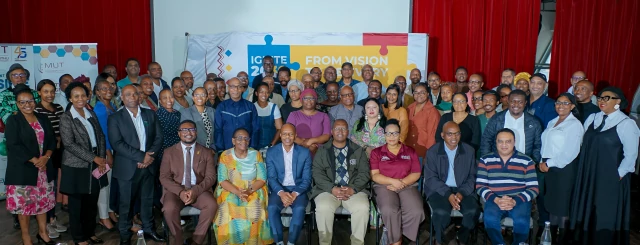
Mangosuthu University of Technology (MUT) has officially taken a major decision which indicates a change in how the University approaches institutional excellence. It has decentralised quality management across all faculties and support divisions. This strategic milestone was the focus of the University’s inaugural two-day Quality Indaba, held off campus from 18 to 19 November 2026.
The overarching message from the Indaba was that quality is no longer the sole responsibility of the Quality Management Directorate (QMD), nor is it limited to academic departments. Moving forward, every staff member plays a vital role in upholding MUT’s quality standards.
To bring this vision to life, colleagues from across all faculties delivered presentations. Dr Manyane Makua, Senior Director: LTDC; Professor Busisiwe Nkonki-Mandleni, Director: CEAD; Thabo Zwane, Director: Cooperative Education; and Ayanda Nongogo, Director: Monitoring, Evaluation and Reporting (MER), shared practical insights on how evidence-based teaching, community engagement, work-integrated learning, and institutional data are actively driving student success and graduate employability.
QMD Director Dr Phiwayinkosi Gumede explained that the Indaba, which will now serve as an annual fixture on the University calendar, was established to break down institutional silos following insights from a Council on Higher Education (CHE) audit. “Quality doesn’t reside at the Quality Management Directorate; quality is a shared responsibility,” Dr Gumede said.
To support staff through this transition, MUT has approved a new Integrated Quality Management System (IQMS) Framework and Quality Strategy, which will be rolled out across the institution. Additionally, dedicated Quality Assurance Officers have been assigned to specific faculties to provide hands-on support, shifting the QMD’s focus from compliance to proactive quality promotion and enhancement.
The event also featured external expertise from Louis Mapatagane, Director of Institutional Research and Planning at Walter Sisulu University, who presented on leveraging quality assurance monitoring data for evidence-based decision-making and institutional effectiveness.
Guest speaker, Mapatagane, challenged attendees with a pointed question: “What happens when a university has all the necessary quality assurance structures, produces comprehensive monitoring reports, completes programme reviews, conducts student surveys, and submits quality improvement plans, yet the same institutional problems keep recurring?” Arguing that routine box-ticking is insufficient to achieve desired outcomes, Mapatagane emphasised the need for actionable insights.
“My central argument today is that the value of quality assurance monitoring data lies in the decisions it informs and the institutional improvements we can demonstrate. Evidence must lead to understanding. Understanding must inform decisions. Decisions must translate into action. And action must produce demonstrable improvement,” Mapatagane said.