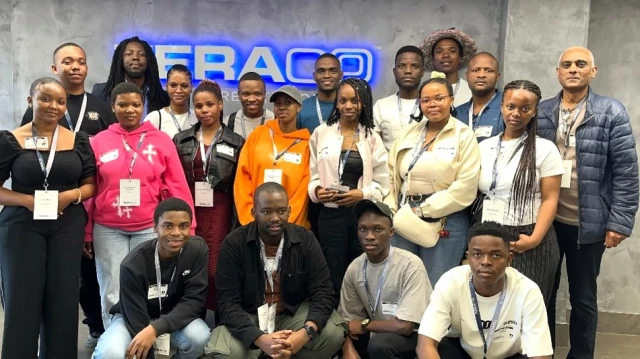
 In a major move to bridge the gap between academic theory and real-world industrial application, 17 third-year Information Technology students from MUT recently embarked on an educational excursion to the highly secure Teraco Data Centre in Durban. The student delegation was accompanied by Dr Vikash Jugoo, Head of the Department of Information and Communication Technology, and Dr bethel Mutanga, Senior Lecturer, for an immersive look into one of South Africa’s leading data centre ecosystems.
Teraco Data Centre is a digital backbone, a high-security infrastructure. This is a data centre that serves as the physical backbone of today’s digital era. It is a highly secure facility built to house critical server infrastructure, networking systems, and storage units that manage massive streams of global digital information. Without them, modern conveniences like cloud computing, enterprise-scale internet connectivity, and seamless business operations would not exist.
Due to the critical sensitivity of the data handled on-site, Teraco operates under strict enterprise security protocols. Ahead of the tour, students underwent rigorous background screening and experienced the site’s multi-layered access control systems firsthand, highlighting the paramount importance of cybersecurity in physical tech environments.
The excursion was hosted by Nilesh Basdeo, Teraco’s Durban Data Centre Manager, who led the students through the inner workings of a modern, multi-megawatt facility. During the guided walkthrough, students got an up-close look at Enterprise Server Infrastructure and Networking, where the students got to know how high-density hardware stacks operate; Power Redundancy and Cooling; the students learned about the complex engineering required to maintain uninterrupted operations and optimal temperatures; and Disaster Recovery, which is understanding the operational strategies that ensure continuous data availability even during municipal outages.
In addition to technical insights, Basdeo outlined the evolving career pathways within the data centre sector. He mapped out the essential academic qualifications, certifications, and technical competencies students need to stand out to global tech employers.
Reflecting on the visit, Dr Jugoo emphasized how critical these industrial touchpoints are for shaping job-ready graduates. “Visits such as these provide our students with invaluable exposure to industry environments that cannot be fully replicated in the classroom. Seeing enterprise-scale technologies in operation helps students appreciate how the theoretical concepts they learn are applied in practice. Experiences like this inspire our students and better prepare them for successful careers in the ICT sector.”
Dr Mutanga echoed this sentiment, noting that such partnerships are vital to aligning academic curricula with modern industry expectations. “This visit enabled our students to interact with professionals, gain first-hand knowledge of modern ICT infrastructure, and better understand the skills and professional standards expected by employers.”
The hands-on experience left a lasting impression on the final-year students, many of whom are preparing to enter the job market. “The visit was truly enlightening,” shared one student. “It was fascinating to see how a large-scale data centre operates and the level of planning, security, and technology involved. It has motivated me to learn more about cloud computing and infrastructure management.”
Another student noted how seeing the hardware demystified complex concepts: “Seeing the equipment and systems we have studied in class operating in a real environment made the concepts much easier to understand. The experience has broadened my perspective on the many career opportunities available in IT.”
It would be remiss not to acknowledge Jay Roopsunker, whose stakeholder had prior engagements with him to make this a success. This speaks to collective collaborations at institutional levels.