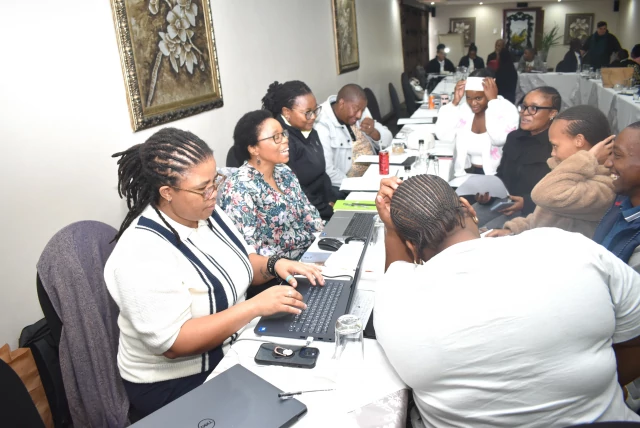
As part of its 2026 Mandela Month commemorations, MUT Community Engagement and Development Directorate (CEAD) hosted a high-impact, three-day University Capacity Development Programme (UCDP) Contact Week. Running from 28 to 30 July 2026, the event focused on Engaged Learning and Teaching (EL&T) and Engaged Research (ER).
The collaborative programme brought together academics, university leadership, and visiting facilitators from MUT, Rhodes University, the University of Venda, and Eduvos. Professor Busisiwe Nkonki-Mandleni, CEAD Director, said the primary purpose of the meeting was to formally introduce the UCDP Orientation Week, welcome institutional collaborators, and strategically position the initiative within MUT’s proposed decentralisation of Community Engagement.
The UCDP contact week was designed as a pivotal capacity-development intervention to support MUT’s structural shift toward embedding community engagement directly into academic faculties. The key objectives of the meeting included establishing a clear framework for the UCDP Orientation Week and its long-term institutional benefits; discussing the critical role faculties play in embedding engaged scholarship within teaching, learning, research, and innovation; bolstering institutional commitment and leadership backing for the successful implementation of the decentralised Community Engagement model; and providing a robust platform for engagement and discussion between University leadership and partnering institutions.
Aligned with the social justice, active citizenship, and collaborative knowledge production values of Mandela Month, the three-day programme featured institutional presentations, interactive discussions, practical workshops, and reflective dialogue.
Professor Nkonki-Mandleni said that participants explored multiple facets of engaged scholarship. These included the historical evolution of Community Engagement in higher education; the Service-Learning and curriculum integration; the Engaged Research and Community-Based Participatory Research (CBPR); and the collaborative design of engaged learning activities and research projects. “These sessions challenged academics to critically evaluate how teaching, learning, and research can be rendered more responsive to pressing community needs and societal transformation,” said Professor Nkonki-Mandleni. Also, the sessions gave some students from different departments a chance learn about service learning and community engagement.
The Contact Week achieved its core outcome, which is generating a shared understanding among University leadership of the strategic purpose of the orientation week and its contribution to institutional capacity building. Furthermore, the event facilitated the piloting of first-generation EL&T and ER modules, gathering vital participant feedback to inform future curriculum refinements. By reinforcing reciprocal partnerships, relationship-building, and the co-production of knowledge, the programme marked a critical milestone in MUT’s journey toward a more socially responsive, community-integrated higher education framework.