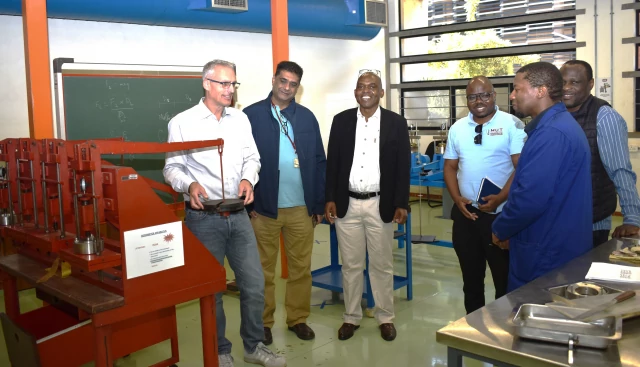
Building on the momentum of a Memorandum of Understanding (MOU) signed on 27 January 2026, Mangosuthu University of Technology (MUT) recently hosted Professor Björn Elsche from Germany’s Ostfalia University of Applied Sciences. The three-day visit, which took place from 24 to 26 August 2026, focused on accelerating academic collaboration between the two institutions.
The engagement specifically targeted synergies between MUT’s Faculty of Engineering, focusing on Civil & Survey Engineering, as well as Construction Management, and Quantity Surveying, and its counterparts at Ostfalia.
Dr Richard Chidzonga, Dean of the Faculty of Engineering at MUT, described the visit as an exploratory milestone aimed at establishing robust cooperation in teaching, joint research, laboratory demonstrations, and curriculum development.
Sharing his initial impressions, Professor Elsche, who also oversees international affairs at Ostfalia, praised MUT’s modern infrastructure and warm academic community. “My first impression of Mangosuthu University of Technology is very positive. MUT is a modern university, and during our discussions, I identified many similarities between our curricula and study programmes. I believe these similarities provide an excellent basis for student exchange and further academic cooperation,” Professor Elsche noted, highlighting that MUT’s engineering laboratories compare exceptionally well with theirs. He further lauded the hospital culture on campus, adding: “Everyone has been very friendly, open-minded, and helpful. I particularly appreciate the welcoming atmosphere and the willingness to discuss ideas and possibilities for future cooperation.”
A major highlight of the visit occurred on day two, when Professor Elsche conducted a joint virtual lecture, uniting MUT and Ostfalia students in a single digital classroom. The successful practical test showcased how technology can bridge geographical distances and enhance international learning environments. “We already have many of the tools that allow students from different locations to work together in the same virtual learning environment, communicate, and interact with shared models,” explained Professor Elsche.
Highlighting the pedagogical benefits for technical disciplines, Professor Elsche emphasized how immersive, interactive technology overcomes linguistic challenges: “In an international setting, language can sometimes be a barrier. Virtual and visual teaching methods help reduce this barrier. If students can see a structural system, a building, a load path, or a deformation directly in a three-dimensional environment, understanding becomes much less dependent on language alone. The virtual environment becomes a kind of common language between students.”
Professor Elsche believes these joint lectures lay the groundwork for a broader, multi-tiered international partnership. By working on common tasks, students from both universities can compare engineering approaches, gain international perspectives, and learn collaboratively without immediate travel costs.
However, he stressed that virtual collaboration should enrich, rather than replace, face-to-face mobility. “Virtual teaching can complement physical exchange very well,” Professor Elsche said. “It can be a first step towards international cooperation, allowing students to get to know each other and work together before participating in an exchange programme or joint project.”
Looking to the future, both institutions aim to expand beyond single lectures into joint workshops, collaborative exercises, and project-based courses featuring mixed student teams, paving the way for a dynamic, global learning ecosystem at MUT.