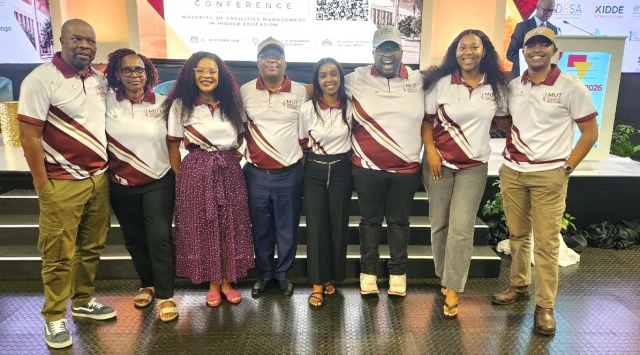
From 12 to 15 October 2026, eight members of MUT’s Operations Directorate were away on a very important mission, sharing their expertise and knowledge with like-minded professionals in the sector. These MUT staff members attended the Higher Education Facilities Management Association (HEFMA) Annual Conference at the University of Botswana, joining universities and higher education institutions to exchange knowledge, share experiences, and explore innovative approaches to facilities and infrastructure management. The delegation comprised of Kabelo Mocwane, Interim Senior Director: Operations; Lubabalo Ngcaweni, Director: Infrastructure Development; Mthulisi Msimang, Infrastructure Project Manager; Gugulethu Lushozi, Head of Facilities; Zukiswa Mtulu, Infrastructure Project Administrator; Thembelihle Mthembu, Intern; Fanelesibonge Myeza, Candidate Construction Project Manager; and Lungani Nzama, Candidate Construction Project Manager.
Ngcaweni said MUT staff presented two papers at this meeting. “These contributions reflect the University’s commitment to professional engagement, knowledge sharing and advancing facilities and infrastructure management within the higher education sector,” Ngcaweni said, adding that the conference reinforced the importance of effective asset management, infrastructure planning, and collaboration in building sustainable, resilient, and student-centred campuses. “Through engagements with fellow institutions, the MUT delegation is gaining valuable insights into practices that can be adapted to strengthen institutional operations and service delivery,” he said.
An exciting outcome of the Botswana visit is the University of Johannesburg’s invitation to MUT to participate in a two-day learning and knowledge-exchange visit. This will provide an opportunity to learn from their experiences, explore practical solutions and strengthen inter-university collaboration.
The key takeaway is that collaboration must translate into action. By learning from peers, sharing expertise and addressing institutional bottlenecks, MUT can continue working towards more efficient operations, improved infrastructure delivery and better campus experiences for students and staff. Through participation, contribution and collaboration, MUT continues to strengthen its engagement with the higher education community and identify opportunities to turn shared learning into institutional progress.