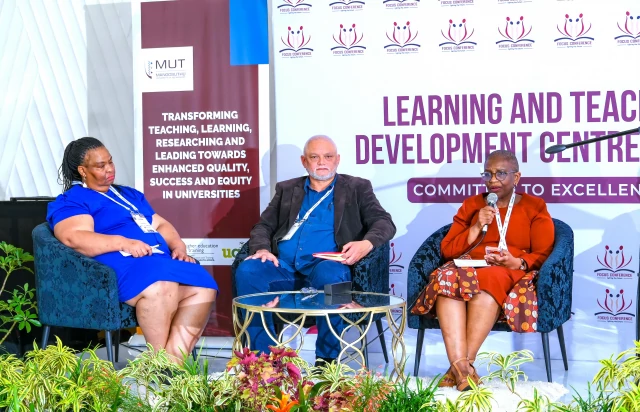
As more South African universities experience governance instability and, in some cases, are placed under administration, a crucial question confronts the sector: where should governance end and executive management begin? This challenging question formed the basis of one of the highlights of the opening day of Mangosuthu University of Technology’s 13th Focus Conference, a compelling panel discussion on leadership and governance in higher education.
Members of the panel discussion, who were Dr Whitfield Green, Chief Executive Officer of the Council on Higher Education (CHE); Dr Phumzile Dlamini of the CHE; Professor Rushiella Songca, Interim Vice-Chancellor and Principal of MUT; and Professor Lesley Le Grange of Stellenbosch University, offered very informative responses to an important topic: Navigating the minefield of leadership and governance in higher education.
One of the sub-themes of the discussion was governance challenges revealed through institutional audits. Drawing on themes emerging from recent institutional audits, Dr Green identified several governance weaknesses that continue to affect universities. Among these was a disconnect between institutional strategies and the day-to-day work of universities. In some institutions, he observed, strategy existed largely at a symbolic level and was not always translated into practical decisions, resource allocation or measurable action.
Dr Green also highlighted confusion and misalignment regarding the roles of council members. When councils move too deeply into operational matters, or executives enter spaces reserved for governance, the distinction between oversight and management becomes increasingly difficult to maintain.
Other concerns included inadequate leadership capacity, outdated policies that had not kept pace with institutional realities, and environments characterised by fear and mistrust. Such conditions make it difficult for staff and leaders to raise concerns, challenge poor decisions or engage honestly with institutional problems.
The academic project must remain at the centre was also another theme on which a spotlight was shone. Dr Dlamini proposed systems thinking as a way of responding to the complexity of university governance. Rather than viewing governance problems as isolated incidents or attributing them to a single individual or structure, institutions should consider how their different systems, relationships and decisions interact. At the centre of this system, she argued, must be the academic project.
Teaching, learning, research, student development and societal impact should remain the reason behind every governance and management decision. Governance structures should not become consumed by internal power struggles while losing sight of the students and communities they are meant to serve.
Dr Dlamini also stressed the importance of mutual accountability. Councils, executives, academics, professional staff and students all have responsibilities towards the institution and should be willing to hold one another accountable, she said.
Professor Le Grange cautioned against overreach by both governance structures and institutional leaders. When councils become involved in operational management, or when executive leaders exercise authority without sufficient accountability, universities risk departing from their missions.
Unchecked overreach can also create an excessively autocratic institutional culture in which power becomes concentrated, alternative perspectives are silenced and decision-making becomes disconnected from the academic community.
Professor Songca brought the discussion back to the human relationships at the heart of governance. She emphasised the need to maintain an appropriate balance between the roles and responsibilities of councils, executives and other university stakeholders. Although each structure has a distinct mandate, all should work towards the same objective: protecting and advancing the academic project.
For Professor Songca, effective governance also requires humility. Leaders must be able to respect institutional boundaries, listen to others and place the interests of the university above personal ambition.
Egos, she cautioned, can quickly turn legitimate differences of opinion into damaging conflict. When personalities and power struggles take precedence, students, staff and the academic project ultimately suffer the consequences.
Professor Songca’s contribution served as a reminder that leadership in a university is not about winning control. It is about exercising authority responsibly, remaining accountable and creating an environment in which the institution can fulfil its mandate. Professor Songca also highlighted the importance of the profession relationship between the Vice-Chancellor, the Registrar, and the Chair of Council.
Although the panel approached the subject from different perspectives, a common message emerged: there can be no sustainable university without ethical leadership, clearly defined roles, mutual accountability and an unwavering commitment to the academic project.
Governance and executive management do not have to operate as competing centres of power. When their respective mandates are understood and respected, they can complement one another, council providing strategic oversight and accountability, and management leading the institution’s operations and implementing its approved strategy.
The discussion encouraged the sector to confront uncomfortable realities, strengthen leadership capacity and rebuild institutional cultures founded on trust, accountability and shared purpose.
The discussion was moderated by Dr Manyane Makua, Senior Director of MUT’s Learning and Teaching Development Centre (LTDC).