
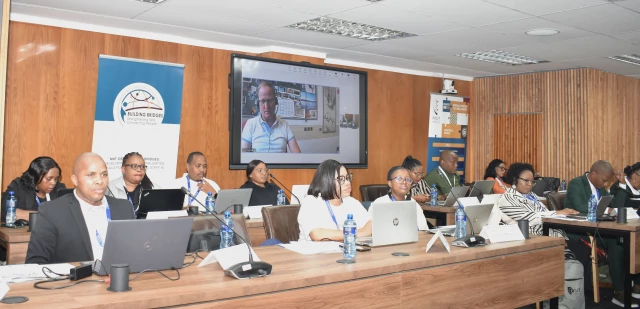
The delegates that attended the ‘Building Bridges: Developing Internationalisation Skills for Professional Staff in Universities’ initiative, held at MUT from 2 to 4 September 2026, also benefited from online presentations from Dr Marina Casals, a higher education internationalisation professional based in Spain; and Marcus Hoppe, Head of International Collaborations, Deputy Director, International Office at Leibniz Universität Hannover, Germany.
According to Marcus Hoppe, navigating international higher education has evolved into a complex landscape of global geopolitical shifts, intricate legal frameworks, and high-stakes compliance demands. Speaking on the critical role of risk management in higher education, Hoppe, highlighted the multifaceted challenges universities face today, and how robust governance can mitigate them.
According to Hoppe, university leaders and international managers must maintain constant awareness of global developments. From active conflicts and ecological crises to complex legal and ethical dilemmas. “International offices operate at the cross-sections of a rapidly changing world. Managing cross-border teaching, maintaining academic standards, protecting institutional reputation, and navigating data privacy are central to higher education strategy,” said Hoppe.
Hoppe also emphasized the demands of compliance. “Compliance in the context of internationalisation is very demanding,” Hoppe explained, emphasizing that institutions must navigate stacked regulatory frameworks imposed by the European Union, national governments, and host countries abroad.
Among the key operational burdens are visa regulations and legal agreements. When forming global partnerships, institutions sign Memorandums of Understanding (MOUs) and formal contracts to ensure shared standards, ethical practices, and proper accreditation. “You have to monitor that you comply with all the regulations,” Hoppe stressed. “There must be clear responsibility. It must be transparent who is in charge and who is accountable.” Achieving this level of oversight requires significant flexibility from all partners involved, alongside staff who possess both deep expertise and intercultural competence.
Hoppe also pointed out that data privacy remains a major compliance hurdle, particularly within Europe and Germany, where strict regulations like the GDPR (General Data Protection Regulation) govern operations. Simple actions, such as publishing a photograph of an international student without explicit written consent, can expose a university to legal liability and lawsuits.
Beyond data protection, Hoppe outlined several other critical dimensions of compliance, such as information and cyber security, which is about safeguarding sensitive academic networks and intellectual property against global threats; research ethics and export control, to ensure joint research aligns with institutional values and legal guidelines.
Other critical dimensions of compliance that Hoppe mentioned were transnational education and financial due diligence to ensure that partner institutions are reliable and compliant with anti-bribery, anti-corruption, tax, and anti-money laundering laws; and student health, safety, and welfare to protecting students participating in study-abroad programmes.
Hoppe also urged that institutional knowledge around international compliance should be centralized into functional hubs that benefit the entire university community, and that institutions must foster a “Speak-Up” culture. “Institutions need clear incident response mechanisms, continuous auditing, and transparent reporting channels where staff and students feel empowered to flag compliance risks,” he said.
While compliance requires significant resources and vigilance, Hoppe maintained that a structured approach to risk management protects student welfare, preserves institutional trustworthiness, and ensures that international collaborations remain resilient and sustainable in an unpredictable world.