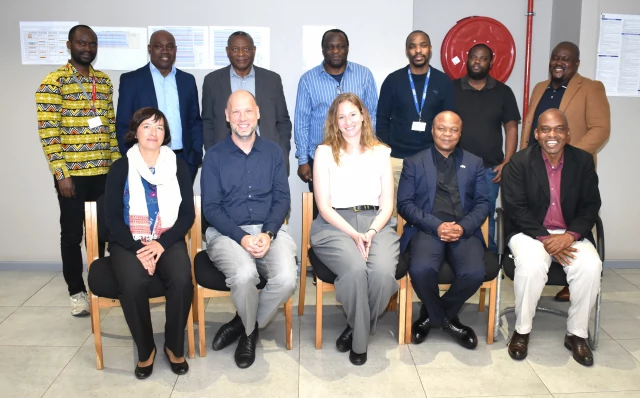
On 18 September 2026, representatives associated with the German Federal Ministry for Economic Cooperation and Development (BMZ), the South African National Energy Development Institute (SANEDI), and Mangosuthu University of Technology (MUT) convened in the Electrical Engineering Board Room for a high-level evaluation visit. The stakeholders met to review the long-term impact, relevance, and sustainability of the Germany-supported laboratory established at MUT in 2022. The specialised facility was established in 2022 to strengthen MUT’s operational and academic capabilities in climate protection, climate change monitoring, and air-quality tracking. The initial international investment delivered specialised measurement equipment, tailored curriculum development, and technical training for academic staff and students.
Since its inception, the climate change laboratory has become a vital nexus for technical skills development, short courses, applied research, and specialised teaching in climate- and energy-related fields. The Dean of the Faculty of Engineering, Dr Richard Chidzonga, said that the foundation built by this facility “directly paved the way for subsequent strategic institutional developments, including MUT’s Climate Change Centre of Excellence and its ongoing partnership with SANEDI”.
The evaluation visit marked the formal conclusion of the original project period, providing key stakeholders with an opportunity to assess how effectively the infrastructure has been integrated into MUT’s institutional ecosystem.
As an external partner, SANEDI played a central role in the review, providing concrete evidence that the technical capabilities developed through the German funding continue to generate value beyond the initial investment horizon. The SANEDI–MUT alliance reinforces the laboratory’s sustainability, while aligning University research directly with national climate and environmental priorities.
The primary focus remains on maintaining active utilisation of the laboratory as an innovation hub for environmental monitoring, such as ongoing air-quality and climate measurement projects; postgraduate development, which will be expanding applied research and strengthening the academic pipeline; community and industry training, which will seek to deliver high-value short courses and technical skills workshops; strategic collaboration which will broaden ties with SANEDI, government departments, and industrial partners; and financial sustainability, which will unlock third-stream income opportunities and attract new international funding.
“As MUT works toward expanding its Programme Qualification Mix (PQM), this niche facility offers a distinct competitive edge, directly supporting the accreditation and rollout of higher-level postgraduate qualifications in engineering and environmental sciences,” said Dr Chidzonga.