
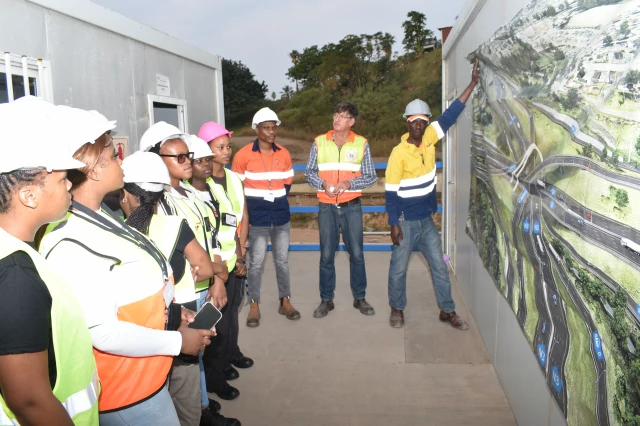
First-year Civil Engineering students received a massive dose of career inspiration this week, trading their standard classroom drafting tables for the roaring engines of a R4 billion mega-project. On Wednesday, 3 June 2026, Drawing Lecturer Sthembiso Makhathini took his second-semester (S2) students out to the N2/N3 interchange construction site in Durban. The sprawling, 63-month initiative is designed to completely overhaul one of the region’s most congested traffic arteries, which accommodates more than a million vehicles every 24 hours.
For the students, the site visit served as a powerful reminder of exactly what they are working toward. According to Makhathini, the field trip was not just a day out of the classroom; it was a critical step in their professional development. Makhathini outlined three primary objectives for the visit. The trip offered the students real-world exposure. It gave the students firsthand experience of major engineering challenges, aligned with the stringent standards set by the Engineering Council of South Africa (ECSA). Also, the students got a chance to relate what they had learnt in class to what they saw in construction site. According to Makhathini, the trip “bridged the gap between the theoretical concepts taught in lectures and their physical, practical applications on site to boost cognitive understanding”.
Lastly, the trip introduced the students to the vast array of career paths waiting for them upon graduation. This fact was mentioned a few times at the construction headquarters before going the construction site.
While touring the immense junction, the S2 students were introduced to several specialised technical fields, including geotechnical engineering, transportation engineering, surveying, and the mechanics of materials.
The sheer scale of the engineering feat left a lasting impression on the class. Student Iviwe Qasha described the trip as an “exciting experience” that offered a comprehensive look at modern project management from start to finish. “What caught my attention was the strategy of widening the roadway and demolishing the old bridge to create vast space once the current bridge is constructed,” Qasha noted, pointing out the strategic phasing of “starting inside the road then finishing with the outermost parts.”
Qasha also highlighted a crucial, non-technical lesson: public safety. “One of the most important things I learned was to prioritize the safety of the public during construction. It was shared that opening the roadway has affected nearby residents in the informal settlement, which shows how carefully these matters must be handled,” Qasha added. The construction teams had to find the affected informal settlement resident alternative places to stay.
For other students, the trip was deeply personal, cutting through the self-doubt that often plagues intense, first-year engineering programmes. Snothile Dlamini admitted to feeling “speechless” after standing on the active construction site, noting that the experience completely affirmed her career choice. “I have been very doubtful of my belonging in the Civil department,” Dlamini shared. “But having to touch the grounds of the future job gave me hope. I am inspired, I am excited, and I am looking forward to putting all my strength into reaching that goal and dream.”
Armed with a fresh perspective on how their early drawing modules translate into monumental infrastructure, Durban’s future engineers returned to their studies with a renewed drive to forge ahead toward graduation.