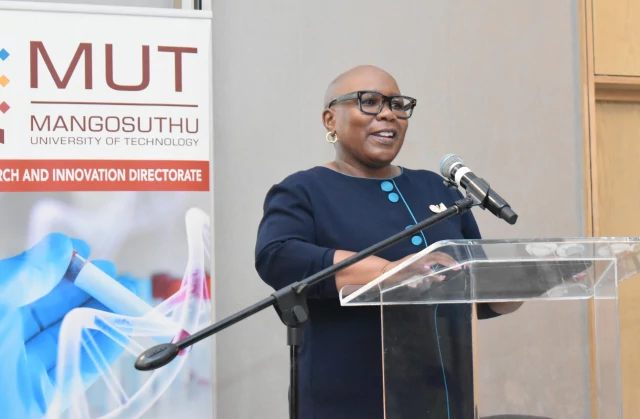
Delivering a powerful address at the Radisson Blu Hotel, Durban, during the launch of Mangosuthu University of Technology’s (MUT) Women in Research Initiative for Growth and Transformation (WRIGHT), Deputy Minister of Science, Technology and Innovation Dr Nomalungelo Gina underscored the critical role women play in shaping global scientific innovation. The launch event, held on 28 October 2026, marks a major institutional milestone for MUT as it joins national efforts to dismantle persistent barriers in research and higher education.
Dr Gina shared comprehensive insights into South Africa’s current research landscape, noting that women make up 47.7% of the nation’s research workforce and 52% of the academic workforce. Furthermore, data from the National Research Foundation (NRF) shows significant strides. The share of female NRF-funded researchers grew from 17% to 47% between 1999 and 2025, while female postgraduate recipients rose from 40% to 60%.
However, the Deputy Minister cautioned that numerical representation does not automatically equate to institutional influence or senior leadership. She highlighted five enduring structural hurdles facing female academics. “Women remain underrepresented in research management and senior executive roles. And, while near-parity has been achieved in Health and Life Sciences, women remain underrepresented in Engineering, Computer Science, and Mathematics,” said the Deputy Minister. Dr Gina also pointed out that early career women must deal with heavy teaching loads, administrative burdens, and growing supervision responsibilities. And that a significant portion of national research and development funding and NRF support continues to concentrate in resource-heavy universities; and that there are commercialisation gaps. “Female-owned technology enterprises still face severe venture capital deviations,” she said. Adding that “no nation can reach its true potential if it excludes its women and girls from opportunities in science, technology, and innovation.”
To ensure WRIGHT becomes a lasting engine of transformation, the Department of Science, Technology and Innovation (DSTI) proposed a collaborative framework resting on four core pillars, which are alignment, which seeks to connect MUT’s research ambitions with national human capital frameworks and NRF support structures at every career stage; evidence-based tracking that will utilise a structured framework of recognition, representation, and retention to monitor progress and refine institutional policies. The other two pillars are linking MUT’s female researchers to national networks, such as the Organization for Women in Science for the Developing World, and international mobility platforms like Horizon Europe; and ensuring that research transitions successfully from the laboratory into industry, public services, and local communities via agencies like the Technology Innovation Agency (TIA).
Dr Gina emphasised that sustainable transformation requires shared responsibility. While government agencies provide funding pipelines and fellowship programmes, such as the DSTI-HSRC internship initiative and postgraduate bursaries, universities must foster internal environments equipped with fair workloads, protected research time, and transparent promotion pathways.
Concluding her address, Dr Gina commended MUT leadership and the WRIGHT steering committee, urging them to make inclusivity a core pillar of the university’s daily operations.