
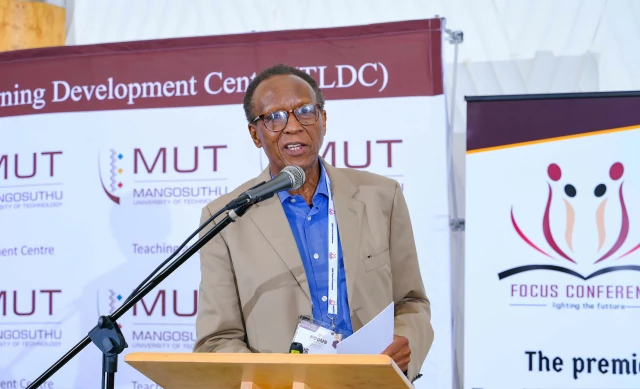
Professor Isaac Ntshoe, a distinguished scholar in higher education policy, curriculum transformation and the Scholarship of Teaching and Learning from the Central University of Technology (CUT) has called on universities to move beyond merely reacting to change and become active agents in shaping society.
Delivering the opening keynote address at Mangosuthu University of Technology’s 13th Focus Conference on 19 August 2026, Professor Ntshoe set the intellectual tone for three days of critical engagement on the future of higher education. The conference was organised by MUT’s Learning and Teaching Development Centre. The three-day conference brought together local and international scholars, researchers, policymakers and practitioners under the theme, “Responsive Universities: Reimagining Higher Education for Global Relevance and Human Advancement.”
At the centre of Professor Ntshoe’s address was a deceptively simple yet profound question: What does it mean for a university to be truly responsive in a society marked by constant change? “I challenge universities to reconsider what it means to remain relevant in a world characterised by rapid technological advancement, shifting labour-market demands and increasingly complex social challenges”, he said.
Professor Ntshoe argued that responsiveness should not simply be understood as an institution’s ability to react to external pressures. “A truly responsive university must be able to interpret its environment, anticipate emerging needs and actively shape the communities and sectors it serves”, he said, and added that “this requires universities to continuously examine their curricula, teaching methods, assessment practices, research priorities and relationships with communities, government and industry. A responsive university must understand its students – who they are, their backgrounds, the challenges they face and the futures they aspire to create”.
Professor Ntshoe emphasised that “institutions cannot develop relevant academic programmes and student-support systems without understanding the lived realities of the students they serve. Responsiveness must therefore begin with a deliberate commitment to access, inclusion, student success and human advancement.”
Professor Ntshoe also highlighted the importance of balancing global relevance with local responsiveness. He cautioned that the pursuit of international recognition should not lead universities to overlook the particular social, cultural and economic environments in which they operate.
Instead, institutions should consider how global knowledge, emerging technologies and international practices can be adapted to produce meaningful solutions for their local contexts.
The rapid expansion of artificial intelligence, digitalisation and other emerging technologies featured prominently in his address. While universities face increasing pressure to embrace these developments, Professor Ntshoe cautioned that technology could serve as both an enabler and a barrier.
Professor Ntshoe’s keynote established a compelling foundation for the conference: universities cannot prepare students for an uncertain future by relying on systems, curricula and approaches designed exclusively for the past.