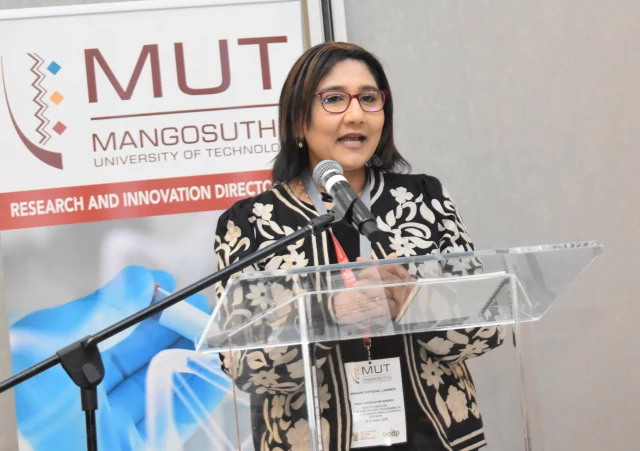
The launch of Women in Research Initiative for Growth and Transformation (WRIGHT) on 28 October 2026 brought together distinguished leaders from government and academia to provide guidance and momentum for the initiative. Delivering a presentation, Professor Kogieleum Naidoo, Deputy Director of the Centre for the AIDS Programme of Research in South Africa (CAPRISA), shared her personal trajectory to demonstrate how women can excel in global science despite formidable odds.
Reflecting on her career beginnings as a medical graduate from the University of KwaZulu-Natal in 1993, Professor Naidoo recounted how early exposure to undergraduate research altered her path. Coming from an underprivileged background, research opportunities enabled her to address critical public health crises in South Africa.
Professor Naidoo highlighted her pioneering work in reducing mother-to-child HIV transmission from an alarming 33% to under 2%, alongside her groundbreaking PhD research on HIV/TB co-infection management. Her evidence-based findings, published in top-tier medical journals like the New England Journal of Medicine, directly reshaped World Health Organization (WHO) clinical guidelines and saved an estimated 15,000 lives in South Africa alone. “You do not need permission to be the best version of yourself,” Professor Naidoo told attendees. “You need technical knowledge and drive to move you forward, and you find your seat at that table. You earned it.”
Professor Naidoo had a request for senior leaders. “Senior leaders need to enable growth by design… It is about elevating and being a sponsor for the growth of another individual.”
Addressing the researchers and PhD candidates in attendance, Professor Naidoo outlined key principles for achieving scientific excellence and driving transformative leadership. She said researchers should emphasise depth over breadth. “Young scholars should hyper-focus on a singular, high-impact research question rather than spreading themselves thin across multiple areas,” she said, adding that researchers have a moral obligation to publish high-quality findings in reputable journals to advance scientific understanding and influence public policy.
Professor Naidoo also appealed to higher education institutions to provide support for re-entry of women that have been away. “Institutions need concrete, inclusive policies that support women returning to academic research after taking breaks for caregiving and maternity,” she said.
By establishing the WRIGHT initiative, MUT aims to build an ecosystem where female researchers receive the tools, cloud access, international networks, and institutional sponsorship required to secure competitive global grants and publish groundbreaking work.
As higher education transforms across South Africa, initiatives like WRIGHT ensure that women are no longer sidelined, but are instead positioned as key architects of scientific and societal progress.