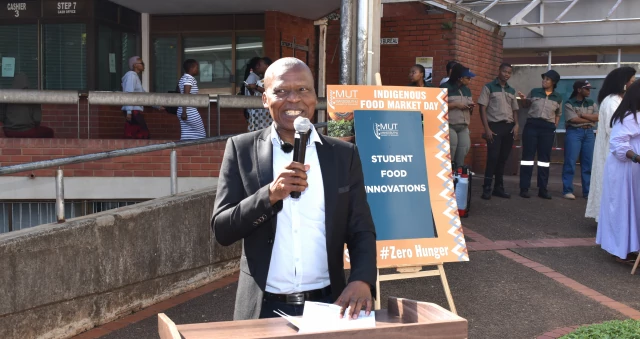
The annual Indigenous Food Market Day, held on 16 July 2026, has received a resounding endorsement from MUT management and government partners, with academic leaders calling for an urgent return to traditional farming to combat modern food insecurity. The second edition of the landmark event was held under the theme: “Accelerating Food System Transformation in South Africa through Indigenous Food Promotion.” The event saw strong backing from high-ranking University figures, including Professor Alfred Msomi, the Dean of the Faculty of Applied and Health Sciences, and Dr Eric Mthembu, Head of the Department of Agricultural Extension and Sustainable Food Systems. Both leaders championed indigenous food not just as a healthy dietary choice, but as a viable path to sustainable livelihoods.
Dr Mthembu, a man with vast knowledge of the region’s colonial history, expressed his delight at the diverse crowd of staff, students, and members of the public who gathered to purchase local produce, noting a significant cultural shift in how traditional food is perceived. “I am happy to see everyone buying indigenous food here,” said Dr Mthembu. “Even educated people, who are historically known for distancing themselves from indigenous food, are now buying it. The attitude is changing.”
Addressing attendees, Dr Mthembu delivered a powerful history lesson on how traditional farming methods originally safeguarded African communities against starvation. He highlighted how indigenous farmers utilised highly effective techniques, such as double cropping, which naturally kept the soil fertile and productive. Dr Mthembu pointed out that these resilient agricultural practices allowed forebears to survive even after their lands were seized by the British following the 1906 Zulu-British War. He urged a return to these roots, emphasising that indigenous seeds are naturally superior to modern alternatives. “We need to continue using our indigenous seeds, which ensure continuity for the following year. These seeds are healthy, drought-resistant, and superior to modified seeds.”
Dr Mthembu called for the reversal of the post-colonial food crisis. He did not mince words when discussing the modern food landscape, attributing widespread food scarcity directly to the legacy of colonisation and globalised market structures. “Now we have to buy food always. We are part of a UN food system that is uneven,” Dr. Mthembu argued, pointing out the irony that communities which once easily produced enough food to feed their families are now entirely dependent on commercial retail stores. “We are trying to reverse that trend,” Dr Mthembu concluded. “We need to have some form of intervention, and this market day is part of that solution.”
For his part, Professor Msomi described the event as a “vibrant celebration of heritage, health, and community. We have gathered here to do more than just shop. We are here to reconnect with the wisdom of our ancestors. The food we celebrate today—the amadumbe, ubhathatha, imifino, amathanga, inkukhu yesiZulu, ubhontshisi, ummbila, amasi, amahewu, and amaqanda. This is not just sustenance; it is living history. It is the genetic memory of our land”.
Professor Msomi reminded the audience that his faculty was deeply rooted in science. “I know that the connection between what we eat and how we live is undeniable,” he said.