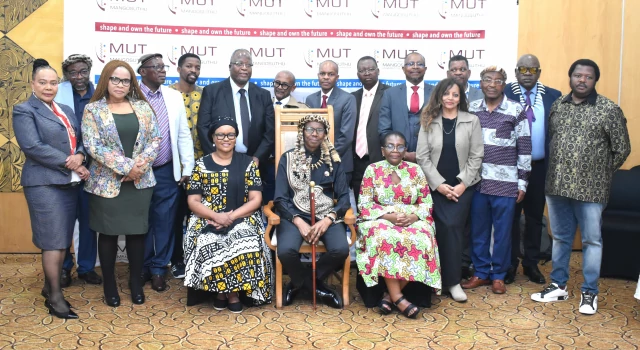
Following the historic meeting between Mangosuthu University of Technology (MUT) management and the family of the late Prince Mangosuthu Buthelezi, the University’s executive team has laid out a comprehensive roadmap to radically transform the Institution by 2030.
Presented at the historical seat of Ulundi in northern KwaZulu-Natal, the strategies presented by MUT’s Deputy Vice-Chancellors (DVCs) expand on Interim Vice-Chancellor Professor Rushiella Songca’s vision to reposition the University globally while staying anchored in its community roots.
Professor Marcus Ramogale, Deputy Vice-Chancellor (DVC): Teaching and Learning, presented an academic growth plan titled “IGNITE 2030, Future-fit learning.” Under this strategy, MUT is aiming to grow its total student enrolment from 14,312 students in 2023 to 17,252 by the year 2030. This represents a steady annual institutional growth rate of 2.7%. The push for postgraduate education is even more aggressive.
MUT aims to grow the University’s postgraduate student body to 698 by 2030. “This is the fastest-growing field of study, alongside sustained science and engineering strength,” remarked Professor Ramogale, highlighting a massive +5.7% annual growth spike specifically targeted for the Business and Management division.
To accommodate this growth, a wave of new qualifications will be rolled out across all three faculties over the next few years. The Faculty of Engineering will launch Postgraduate Diplomas in both Chemical Engineering and Mechanical Engineering starting in 2029; the Faculty of Management Sciences will roll out Postgraduate Diplomas in Accounting, Public Administration, and Office Management, alongside a new Masters degree in Business Management between 2028 and 2029, and Faculty of Applied and Health Sciences will introduce 13 brand new programmes spanning from postgraduate diplomas up to the Doctorate level.
Turning to the Institution’s research capabilities, Professor Mncedisi Maphalala, DVC for Research, Innovation, and Engagement (RIE), outlined core strategic priorities to secure the University’s academic standing. He noted that MUT will focus heavily on strengthening research productivity, improving postgraduate throughput (graduation rates), upgrading student supervision, and building robust innovation and entrepreneurship ecosystems to cultivate the next pipeline of future researchers.
Addressing modern technological shifts, Professor Bhekisipho Twala, Interim DVC for Resources and Planning, gave a sobering perspective on Artificial Intelligence in higher education. He noted that the universities that succeed in the future will not simply be those that adopt AI the fastest, but rather those that adopt it legitimately and ethically into their core infrastructure.