
In 1974 the Chief Minister of KwaZulu, Dr Mangosuthu Buthelezi, began discussing the idea of a dedicated tertiary educational institution specialising in technical subjects for black students, to meet the urgent and growing demand for expertise in these subjects.
Anglo American and De Beers Consolidated Mines pledged R5 million to start building the initial facility, and later they were joined by Mobil Oil, AECI, the S.A. Sugar Millers’ Association, the Rembrandt and Distillers Corporation, LTA Limited, Sasol and other sponsors, who pledged more funds to establish the Schools for Chemical Engineering, Mechanical Engineering, Electrical Engineering, Civil Engineering and Building, and Business and Secretarial Studies.
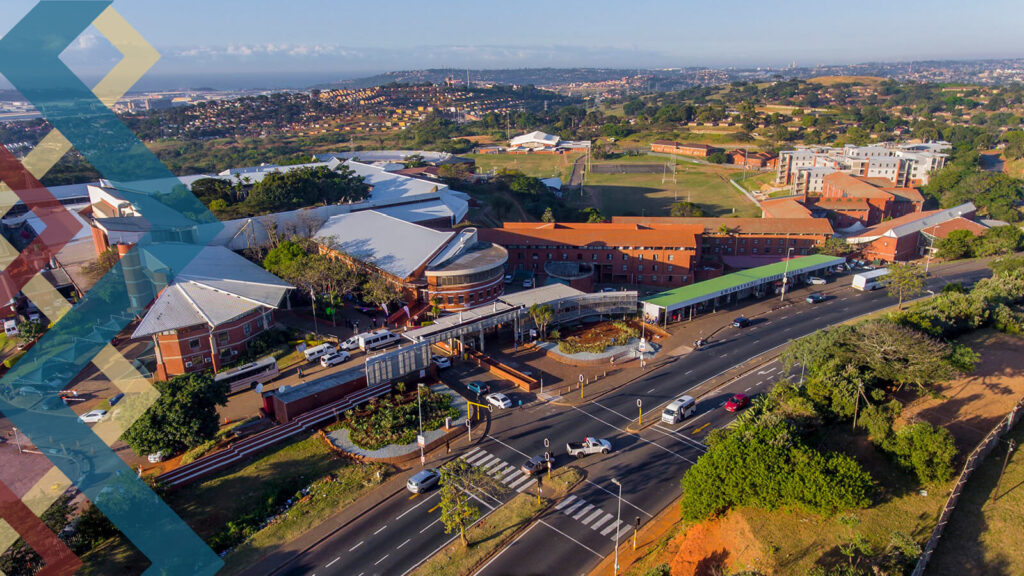
By mid-1977 the project could go ahead. The KwaZulu Cabinet decided to site the Technikon in Umlazi which, while part of KwaZulu, is also part of the Durban Metropolitan area. Given the urgency of the demand for technicians, and the need to build up the institution in an orderly fashion, it was decided to open its doors as soon as possible. Hence preliminary but permanent buildings were designed and built, and teaching began in 1979. The Technikon moved into its main buildings on their completion in September 1981.
In November 2007, Mangosuthu Technikon was renamed Mangosuthu University of Technology (MUT).
To be a leading University of Technology advancing transformative education, pioneering research and innovation, and inclusive development.
We empower society through innovative learning, applied research, entrepreneurial graduates, and collaborative partnerships.
The MY MUT values build on our core principles from the previous cycle, Accountability, Respect, Integrity, and Excellence, while expanding them with aspirational, contextually relevant ideals like Ubuntu and Mastery. This evolution affirms MUT’s identity as a values-driven university, rooted in tradition and responsive to transformation.
Excellence in applied learning, teaching, research, community engagement, leadership, and innovation.
Commitment to lifelong learning, entrepreneurial thinking, and continuous development.
Fostering inclusivity, diversity, dignity, respect, and ethical partnerships within and beyond the university.
Social responsibility, collaboration, and impact-driven community engagement grounded in shared humanity.
Commitment to trust, integrity, accountability, and ethical leadership.
UBUNTU: To embed these values into daily practice, MUT has developed a Values-in-Practice Framework (Annexure 3), which defines expected behaviours and provides institutional indicators and monitoring mechanisms to guide culture, performance, leadership, and student engagement.
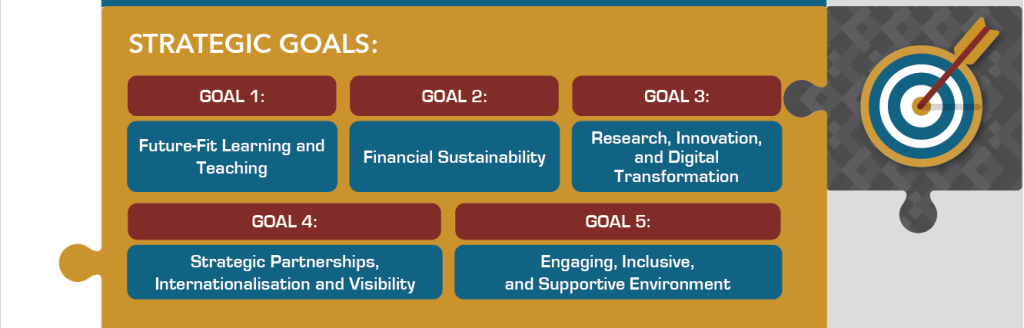
The Mangosuthu University of Technology (MUT) Strategy 2026–2030 affirms the institution’s commitment to shaping and owning its future through a focused and integrated approach to academic excellence, innovation, digital transformation, and social impact. It marks a shift from broad institutional ambition to targeted, measurable transformation aligned with MUT’s identity as a University of Technology (UoT). Rooted in Umlazi, Durban, South Africa, MUT’s strategic posture is defined by its dual commitment to academic excellence and socio-economic transformation. The strategy is structured around five strategic goals that consolidate institutional priorities. It integrates digitalisation into research and innovation, embeds entrepreneurship across academic programmes, and repositions broader sustainability and institutional development imperatives within a set of eight cross-cutting strategic enablers. These enablers represent MUT’s foundational capabilities such as ethical governance and financial stewardship, essential for achieving institutional transformation. The strategy is structured around five strategic goals that consolidate institutional priorities. The strategy is structured around five strategic goals that consolidate institutional priorities.
It integrates digitalisation into research and innovation, embeds entrepreneurship across academic programmes, and repositions broader sustainability and institutional development imperatives within a set of eight cross-cutting strategic enablers.

These enablers represent MUT’s foundational capabilities such as ethical governance and financial stewardship, essential for achieving institutional transformation. This strategy repositions MUT from a transactional model of programme delivery toward an integrated framework that foregrounds entrepreneurship, digital fluency, and developmental impact while reaffirming its core mission to develop skilled technicians and technologists. The plan introduces five Strategic Goals, 20 Strategic Objectives (SOs) and 23 Key Performance Indicators (KPIs), each aligned with annual targets from 2026 to 2030. Importantly, the strategy builds on the recommendations and lessons of the Administrator’s Close-Out Report (2024). The 2026–2030 Strategy is therefore not only a roadmap for future growth, but also a platform for consolidating institutional recovery and renewal. It positions MUT as a resilient, valuesdriven, and responsive university committed to national development, technological advancement, and inclusive transformation
Currently the fourth-largest township in South Africa, Umlazi got its name, according to legend, from a time when Shaka passed through the area. He apparently refused to drink from the local stream, saying the water tasted like ‘umlaze’ – the acid taste from fermented milk.
Originally known as the Umlazi Mission Reserve and owned by the Anglican Church, it was earmarked by the government in 1940 as a relocation point for Cato Manor residents. This was contentious and was one of the causes of the Cato Manor riots of 1959. In 1967 Umlazi was declared a township, divided into 26 sections named for letters of the alphabet. It is the only township in South Africa with its own vehicle registration number: NUZ.
