
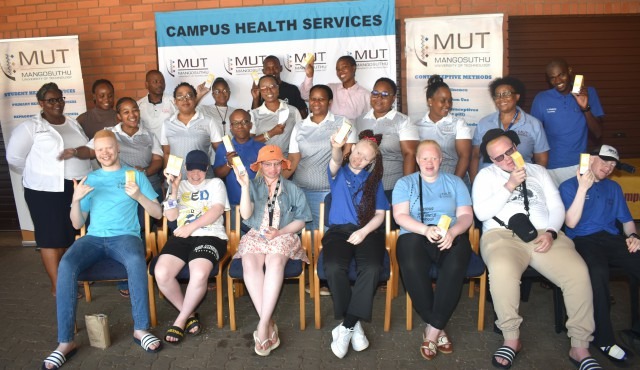
On 4 February 2026, the University Clinic and the Student Affairs’ Disability Support Unit (DSU) of the Student Counselling department had a ‘Sun Smart’ talk with students living with albinism. Sister Ntombenhle Mazibuko, a Professional Nurse at the Clinic, talked about the dangers of UVA and UVB rays. Sister Mazibuko said the sun’s rays damage the skin. UVA (Ageing) refers to Ultraviolet rays that have a deep wavelength and penetrate deep into the layers of the skin, into the dermis and cause skin damage, such as photoaging, wrinkles, dark spots, and skin sagging; while UVB (Burning) refers to UV rays that primarily cause skin burning and its reddening. It has varying intensity, peaking at noon. It has short wavelengths, primarily acts on the skin surface, and is a major driver of DNA mutations that cause skin cancer. “Our ozone layer is damaged, and with climate change comes the changing weather patterns with harsh weather conditions. This means the natural protective layer, which bars the harmful sun rays are now able to affect us directly,” Sister Mazibuko said.
South Africa has a high UV Index, even when it is overcast. Sister Mazibuko advised the students to take the following steps to protect their skin. “Avoid direct sun exposure as much as possible; wear long-sleeved clothing, and cover your legs,” she said. She also advised students to wear sunglasses to protect their eyes and to wear a wide-brimmed hat. “Apply sunscreen adequately, preferably with a 30 SPF minimum. The students were given sunscreens with this said measurement. The higher the SPF, the better,” she said. Sister Mazibuko also dismissed the myth that African or dark-skinned people are safe in the sun. She also advised that people should drink “a lot of water to maintain good hydration”.