
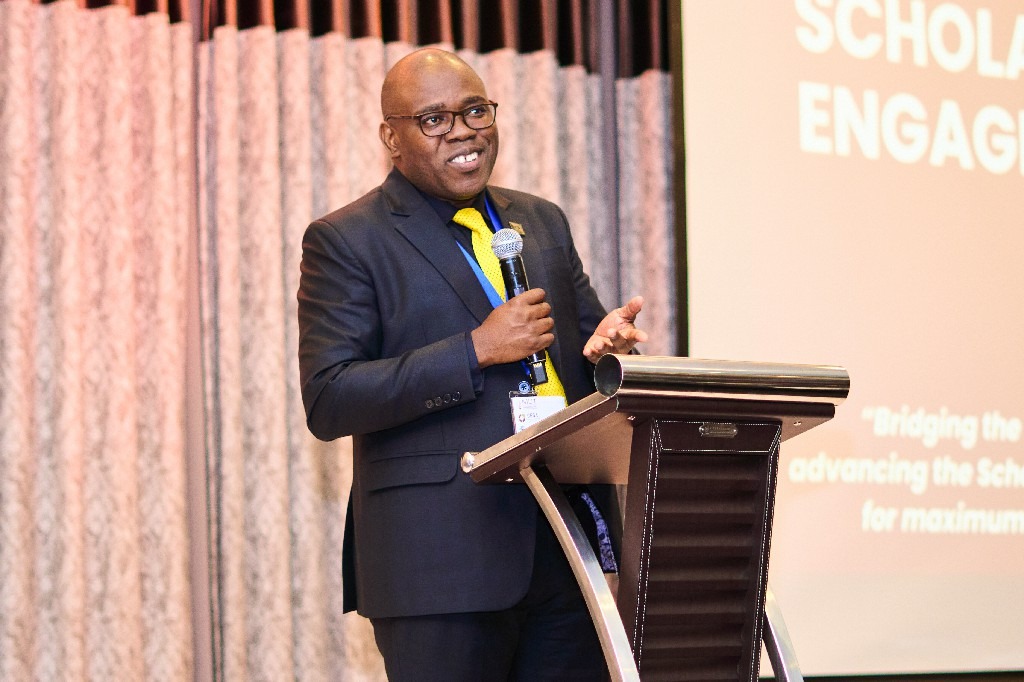
The University of Johannesburg (UJ) Vice-Chancellor, Professor Letlhokwa George Mpedi delivered a compelling address that resonated deeply with universities attending the Scholarship of Engagement Conference on 19 November 2025, hosted by MUT’s Community Engagement Directorate. Professor Mpedi called for a shift toward equity, community connection, and the recognition of excellence in all its diverse forms. His speech reflected not only institutional introspection but an urgent appeal to reimagine the purpose of universities in South Africa.
Professor Mpedi began by acknowledging that he was present because he had listened closely when he attended the inaugural address of the MUT Vice-Chancellor, Professor Nokuthula Sibiya, in November 2024. Professor Mpedi said that it was essential for all in a sector to hear one another if it hopes to move forward collectively.
In his moving speech, Professor Mpedi tackled a long-standing criticism head-on: the perception of universities as “ivory towers.” This characterisation, he argued, must be challenged. “A university is a place for the pursuit of knowledge,” he said, noting that while the nature of that pursuit has evolved over time, its importance has not. “Universities cannot die now during our time,” he said.
Professor Mpedi emphasised that this pursuit of knowledge does not exist in isolation. The country’s worsening unemployment, inequality and social fragmentation, he warned, demand that universities rethink who they serve and how they serve them. “We can no longer be proud of serving only small groups,” he said. “A university is for all, as long as they are academically excellent.”
He challenged harmful stereotypes about NSFAS-funded students, describing these stereotypes as rooted in prejudice rather than evidence. “People speak about NSFAS students as if they are dumb. Access and excellence are not mutually exclusive. Excellence and quantity are not mutually exclusive,” he said.
The Vice-Chancellor highlighted the untapped potential lying within communities marked by poverty and marginalisation, a potential that is too often overlooked because of background, not ability. He noted that universities themselves have contributed to this disconnect by creating a “moral distance” from the very communities they are meant to uplift. “People look up to us,” he warned. “Let us not repel them but attract them.”
Professor Mpedi used the phrase “educated fools” to caution universities against producing graduates with academic credentials but lacking humanity, insight, or purpose. Students, he said, should not emerge from university detached from their roots. “Students without any community engagement risk becoming distanced from their communities,” he said. “They come seeking not just credentials but purpose. We must not shortchange their potential for impact.”
Professor Mpedi went on to describe UJ’s shift toward a strategy centred on societal impact, reflecting a broader institutional responsibility. He shared the story of UJ’s community engagements, including the adoption of three villages where unemployment was so severe that only one man had a job. Out of this work emerged Africa’s first smart village, a project made possible by the remarkable commitment of residents and by the partnership among the university, communities, and its students.
“Students say things must work,” he said, noting how their expectations have pushed the university toward practical, sustainable interventions. He stressed that every community engagement initiative should meaningfully include students, because students and communities grow together when they solve problems side by side.
The message of his speech was unmistakable: South Africa’s universities cannot afford to remain emotionally or institutionally distant from society. They must refocus on impact, inclusion, and excellence, and tap into the deep reservoirs of talent in every corner of the country.