
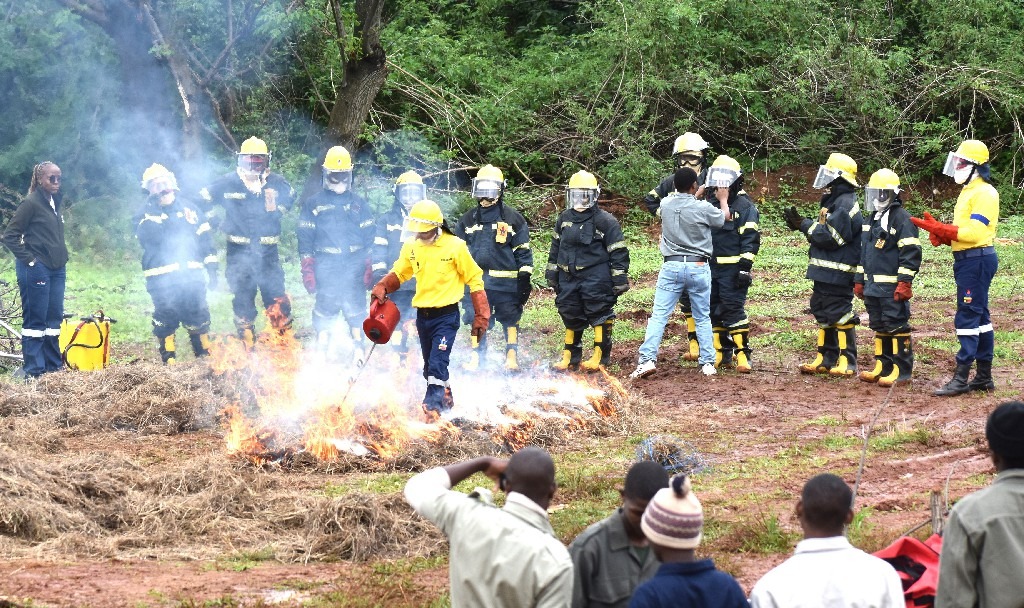
The Department of Nature Conservation has taken its student empowerment to the next level. On 3 October 2025, the S4 students got training from a company that the Lecturer in the department, Sthembile Nkosi, described as “one of South Africa’s leading institutions in wildland firefighting and safety training”. Kishugu Training Academy provided students with practical exposure to fire behaviour, suppression tools, fire line safety, and teamwork in real field conditions. All activities were conducted under the strict supervision of the trainers and the University’s Safety, Health, and Environmental (SHE) Officer, Lizwi Masondo, who ensured that all participants wore appropriate personal protection equipment (PPE) and used standard fire suppression tools. The students will be going
Nkosi said that training was highly interactive, combining both theoretical learning and live demonstrations. Nkosi said that the students learned how to establish fire lines, assess fire danger ratings, manage equipment, and understand the ecological dynamics of fire. “Importantly, the exercise also reinforced discipline, teamwork, and communication under pressure, skills that are essential for field-based conservation professionals,” she said, adding that feedback from students has been “overwhelmingly positive, with many expressing newfound confidence and understanding of veld fire management principles”.
The students also learnt the safety protocols under the guidance of professional instructors from Kishugu Training Academy. The training exposed them to the correct use and maintenance of firefighting equipment such as fire beaters, knapsacks, and drip torches, while reinforcing the principles of teamwork, discipline, and communication essential for field operations. Nkosi stated that concepts previously discussed in class were applied to real-world situations. Some of these concepts are fire ecology, veld management, and resource conservation. “Most importantly, the exercise allowed students to integrate theoretical knowledge of veld management and fire ecology into real-world practice, building confidence and readiness for their upcoming work-integrated learning placements in 2026,” said Nkosi, according to whom the facilitators were equally impressed by the enthusiasm, discipline, and preparedness displayed by her students.
This training was at no cost to the University. Nkosi said she was currently in discussions to formalise this partnership through a Memorandum of Understanding (MoU), “which has the potential to extend significant benefits to other departments across the University through future collaborative training and capacity-building initiatives”.
In their own words, this is what some of the students are saying about the training: Luyanda Mhlongo: “Fire training requires physical fitness, as this enables individuals on the line to withstand the demands of activities such as beating fuel loads with fire beaters, running, and crawling. The protective gear is essential for this practice, although it is heavy. This session was a great experience and is invaluable for individuals who will soon be working in the field. We also experienced the concept of fire intensity, which we previously learned about in class, and seeing it up close made the theory more practical.”
Philile Mbanjwa: “I got to understand how fire behaves under different conditions, including how it spreads, depending on fuel, wind, and slope. I also learned a little about controlling fire using fire beaters and the importance of teamwork, as firefighting requires everyone to act uniformly, and coordinate their actions carefully to manage the fire safely and effectively.”