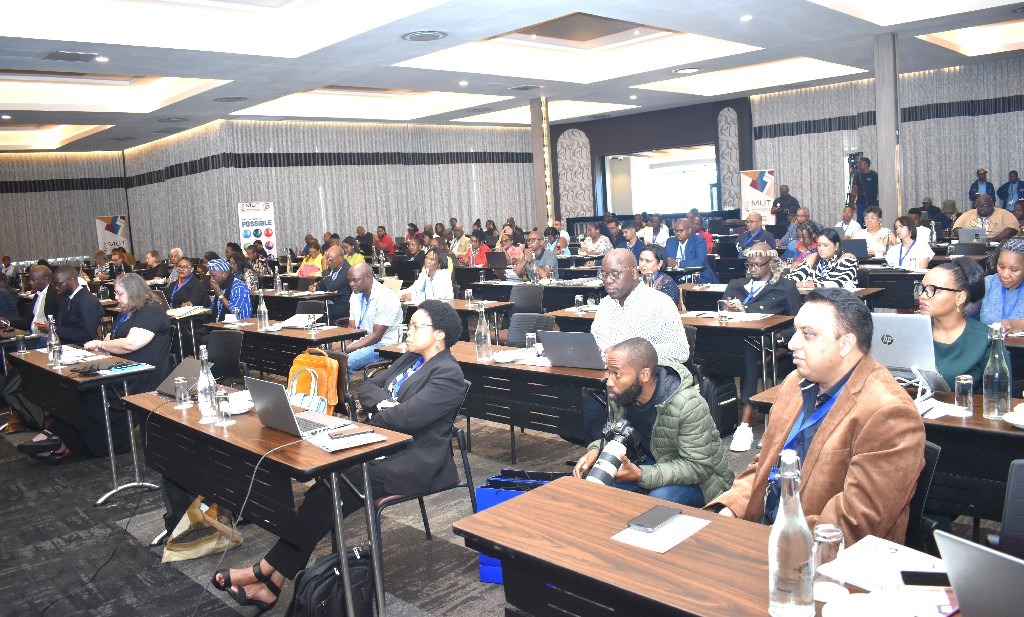
Mangosuthu University of Technology (MUT) hosted its inaugural Scholarship of Engagement (SoE) Conference from 18 to 20 November 2025, creating a dynamic platform for knowledge exchange and societal impact. Themed “Bridging the Knowledge Gap in Advancing the Scholarship of Engagement for Maximum Societal Impact,” the event brought together academics and community stakeholders to reimagine the role of universities in addressing real-world challenges. MUT Vice-Chancellor and Principal, Professor Nokuthula Sibiya, said the conference provided a crucial platform to reflect on, interrogate, and advance the integration of scholarship and community engagement within the mission of our university. Taking a dig at the ‘ivory tower’ notion, Professor Sibiya said that “universities today occupy a strategic position in society as hubs of convergence. They are centres of learning and research, as well as catalysts for social transformation, spaces where knowledge from multiple disciplines intersects to address complex societal challenges.”
Professor Busisiwe Nkonki-Mandleni, the Director of CEAD, which conceptualised the conference, said there was a growing call for universities to renew their historical commitment to the scholarship of engagement (SoE), which emphasises making universities more relevant and rigorous in addressing societal challenges. Community engagement reconnects the universities with broader social purposes. Professor Nkonki-Mandleni said that one of the scholars said that academics do not work effectively in isolation, “emphasising the need to bring academic institutions together to promote the sharing of ideas and the development of a community of scholars”. Professor Nkonki-Mandleni also said that the University’s new Strategic Plan 2026 to 2030 has made community engagement (CE) an enabler for teaching and for research. “Therefore, our aims are to assist the University community to integrate community engagement into their teaching and learning and research and encourage research that is locally relevant and globally recognised by magnifying community voices”.
The SoE Conference aimed to provide a platform for multi, inter-, and transdisciplinary knowledge exchange, as well as community-society engagement, to address and close knowledge gaps in the ongoing efforts to adopt SoE.