
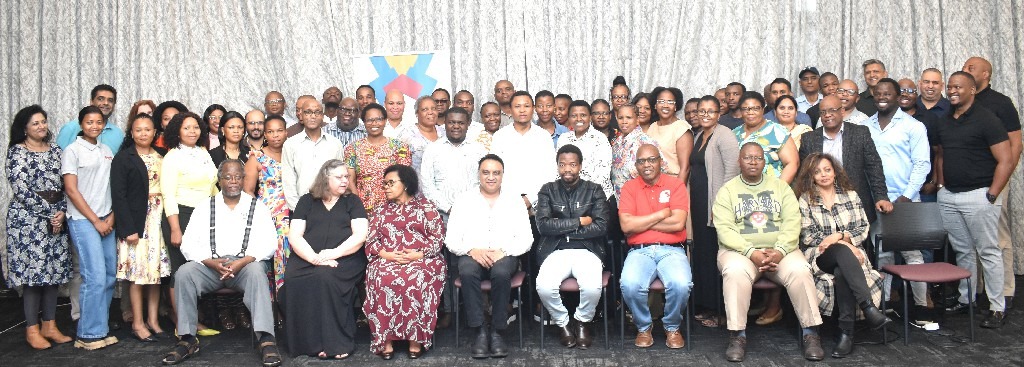
On 16 September 2025, the University took a giant step towards formally introducing entrepreneurial studies to all three of its faculties. Led by the Deputy Vice-Chancellor: Teaching and Learning, Professor Marcus Ramogale, some members of the Executive Management Committee (EMC), and leaders of the departments, and other relevant staff members, met off campus and discussed how the entrepreneurial programme would be incorporated into the three faculties’ programmes. As articulated by Ntombifuthi Mthembu, a lecturer in the Department of Human Resources and Management and the Coordinator of the Entrepreneurship programme at the University, the purpose of the workshop was to encourage faculties to investigate strategies of embedding entrepreneurship education across all levels of undergraduate studies through experiential learning, innovation challenges, and interdisciplinary collaboration. Each programme should embed entrepreneurship into at least one module so that every student who graduates from the Institution is empowered with entrepreneurial skills.
This is one of the steps that MUT has taken to provide its students with the business skills that will enable them to be job creators. Not for the first time, Professor Ramogale, during his presentation to his colleagues and DUT staff members who came to give support to the effort, reminded everyone that “we only produce job seekers. No one produces job creators”. The existence of this gap, and the general mindset that institutions of higher education are to churn out graduates who will be job seekers, is one reason for the high unemployment rate. In his presentation, Professor Ramogale pointed out that it was important for people, particularly the graduates, to change the way they consider life as it relates to the economic essentials. “The current system makes most of us be on the left-hand side of the quadrant. We need to try to be on the right-hand side of the quadrant, which is composed of job creators who are investors and owners of businesses. These people take other people’s money, invest it, and increase their working hours beyond the normal 24 hours of the day by hiring others to work for them. This allows them to do away with the usual limitations of time and wages that employees earn,” said Professor Ramogale.
Professor Ramogale’s philosophical approach was supported by the practical approach of a number of presenters. In the presentation, Mthembu zoomed in on the finer details of the current situation, which MUT and others like DUT see as an opportunity, rather than an obstacle. “In a fast-changing global economy, entrepreneurship skills such as innovation, problem-solving, and opportunity recognition are essential for employability and sustainable development. Universities serve as engines of employability and innovation and through entrepreneurship education and activism, students can consider entrepreneurship as a first-choice career or alternative, especially if they find it difficult to secure employment,” said Mthembu.
Professor Ramogale then asked the deans of the three faculties to put together plans explaining how they are going to incorporate entrepreneurship into their faculty programmes. Including of the entrepreneurial programmes will follow the required process, with the necessary authorities approving along the way; all this will happen from now and in 2026. The following year is when the programmes with this addition will be rolled out. Professor Ramogale also said that they would invite DUT staff to work with their MUT counterparts in the process.
The DUT staff were at the meeting for a very specific reason, to share their experiences. DUT has a well-established department that deals with entrepreneurship. Mthembu said they learnt from these DUT academics. “Lessons learnt from their presentation is that the delivery of entrepreneurship as a module can take different forms. Off importance is the instilling of an entrepreneurial mindset for students. Successful entrepreneurial delivery must include out of the classroom activities,” said mthembu.