
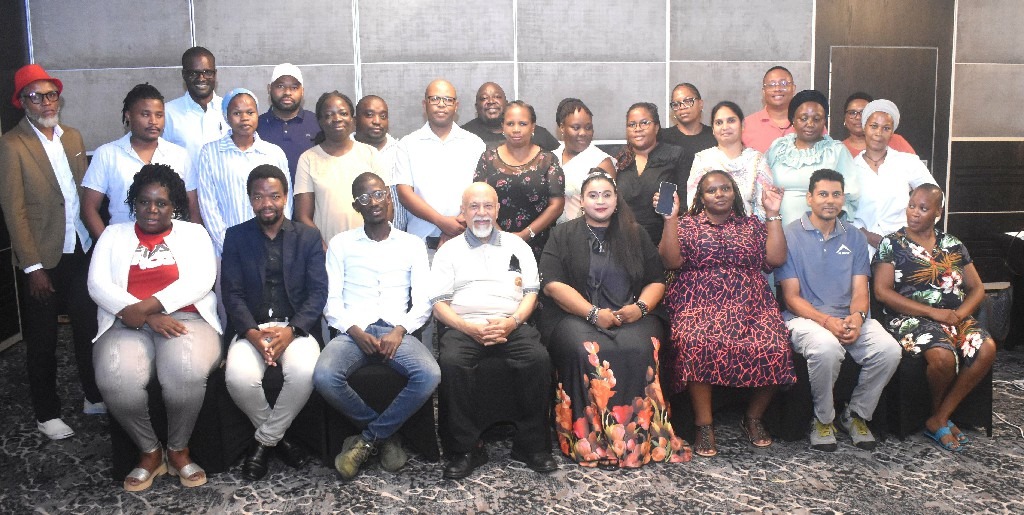
The University continues to empower its staff with research-related matters so they will continue to make an impact. On 28 January 2026, the Research directorate had a workshop off campus where staff – both academic and support staff had a chance to listen to an expert from the National Research Foundation (NRF) who gave them a lecture on how to apply for an NRF rating. NRF’s Jelka Monyela went to town, explaining how staff can apply for a rating.
Monyela gave the reasons why the ratings are important. It is to gauge the strength of the South African Science. Monyela said that rating gives researchers a chance to benchmark the quality of their work against international peers and to measure the strength of the SA Science system. Also, some higher education institutions use the NRF Rating as a proxy for performance and research excellence when recruiting, selecting and appointing staff. While rating is voluntary, it also confers prestige on the researchers and signals the value placed on them.
Supporting what Monyela said, Mthobeli Myeza, NRF and Pre-Grant Administrator at the Research directorate, said the NRF rating is an important milestone in the career development of researchers. “The number of NRF-rated researchers also contributes significantly to the reputation of universities. It also improves the research publications that are focused on the area of specialisation, thereby encouraging researchers to produce outputs that are strategically focused within clearly defined areas of specialisation,” said Myeza.
Approximately 30 staff members attended the workshop. Myeza said some support staff have expressed growing interest in pursuing NRF ratings, signalling an expanding institutional research culture. One of the staff members who was at the workshop was Dr Kavita Behara. Dr Behara said she attended the workshop to gain a clear, practical understanding of the NRF rating system, including expectations, evaluation criteria, and the strategic considerations involved in preparing a successful rating application.
Dr Behara said the NRF rating workshop was directly relevant as it clarified how sustained research programmes, peer-reviewed publications, postgraduate supervision, and research leadership are evaluated within the NRF framework. Dr Behara’s current research focuses on applying artificial intelligence and machine learning techniques in health-related contexts, with particular emphasis on AI-based approaches for skin cancer detection and medical decision support. This work integrates methodological innovation, interdisciplinary collaboration, and applied research with potential societal impact.