
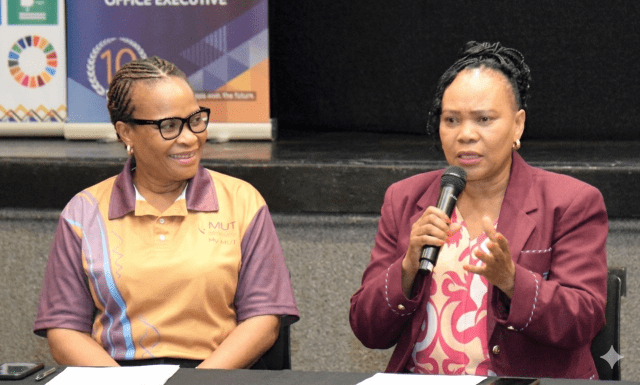
In a strategic move to advance her 100-Day engagement plan, Mangosuthu University of Technology (MUT) Interim Vice-Chancellor and Principal, Professor Rushiella Songca, dispatched two senior directors to a crucial national workshop on international cooperation in higher education. Due to a demanding schedule during MUT’s graduation week, Professor Songca entrusted Dr Xolile Ngubane, Senior Director in the Office of the Vice-Chancellor, and Mbali Mkhize, Senior Director of Marketing and Communications, to represent the University. The two staff members attended the Post-School Education and Training (PSET) International Cooperation workshop, convened by the Department of Higher Education and Training (DHET) at the University of Pretoria from 23 to 24 April 2026.
The landmark workshop gathered delegates representing vice-chancellors from all South African universities, alongside rectors and principals from Technical and Vocational Education and Training (TVET) colleges, and leadership from Sector Education and Training Authorities (SETAs).
A central focus of the two-day summit was a comprehensive audit of international partnerships within the PSET sector. Leading up to the event, MUT submitted details of its 28 active international partnerships spanning Africa, Asia, Europe, and the United States, which served as a key foundation for the resulting discussions. The national dialogue tackled critical challenges affecting educational partnerships across the sector, including duplication of efforts, inequity, misalignment with national goals, and weak governance.
Dr Ngubane noted that the workshop heavily validated the strategic direction currently being taken by MUT’s leadership. “Attending this workshop has enlightened me, as many discussions echoed the Interim Vice-Chancellor and Principal’s vision to expand our research,” said Dr Ngubane. “DHET places a strong emphasis on internationalisation, and it is clear we must intensify our collaborations globally to boost our research output. I was proud that, despite not having a dedicated international office, MUT outperformed several universities that do.” However, Dr Ngubane emphasized that the focus must now shift to implementation. “The challenge now lies in ensuring that these partnerships actively contribute to both research and the learning and teaching agenda, as recommended by many speakers.”
Mkhize described the workshop as a “dress rehearsal” for aligning MUT’s internationalisation targets with South Africa’s national priorities. Mkhize highlighted the value of the geopolitical data shared by DHET regarding where South African universities currently stand on the global stage.
According to DHET’s sector analysis, South African university partnerships are heavily concentrated in the Global North, with 10.9% of partners based in Germany, 8.8% in the USA, and 7.2% in the Netherlands. China and France account for 4.6% and 4.7%, respectively. “Given the current global geopolitical landscape, this data is invaluable for guiding where we need to strengthen collaborations,” Mkhize explained. “Interestingly, Africa remains one of the least exploited continents for partnerships, despite strong support from DHET and the National Research Foundation (NRF).”
The summit also provided a broader context for these global ties, revealing that 36% of all South African educational partnerships stem from Asia, 23% from Europe, and only 16% from Africa, largely established through bilateral agreements. The discussions further acknowledged the role of international treaties supporting regional cooperation, such as those with UNESCO, the African Union, the Pan African University, and the SADC Protocol on Education and Training.
As Professor Songca’s delegation returns to MUT, they bring back crucial insights to effectively cascade her 100-Day Plan. Armed with a renewed strategic focus on leveraging international partnerships, MUT aims to elevate its research capabilities, address historical misalignments, and champion sustainable global collaboration aligned with both national and continental priorities.