
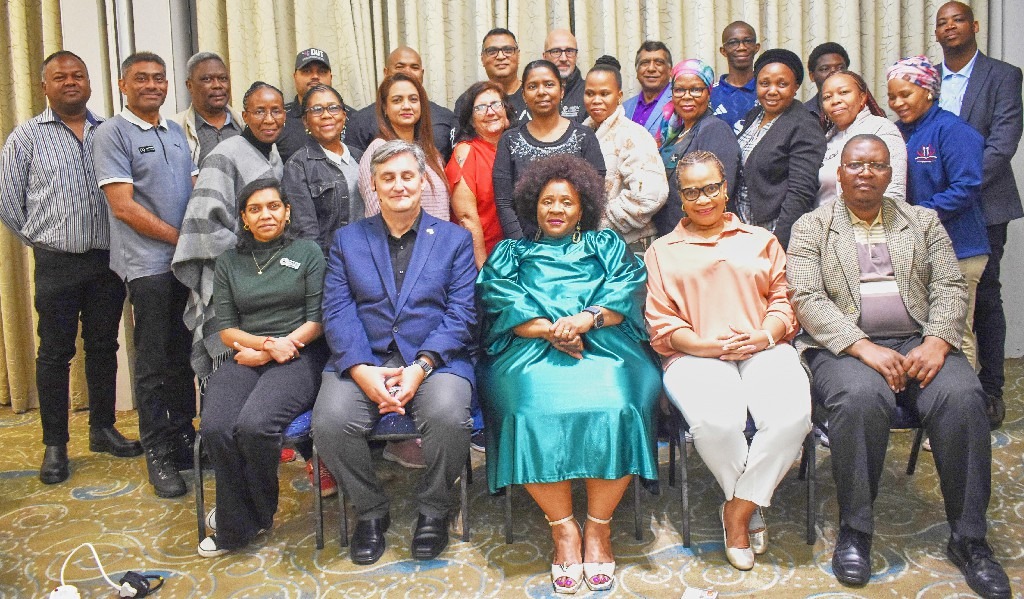
Being aware that times are changing – we are well into the Fifth Industrial Revolution, which is spearheaded by artificial intelligence (AI), which comes with both good and challenges, which some may define as ‘bad’, the University is quickly adjusting its processes to prepare for the near and distant futures.
Noting the power of AI, and what could be gained from AI, MUT has crafted a plan to deal with the issue. The University, in conjunction with THENSA, organised a workshop on how AI should be used at higher education. The workshop was on campus on 23 September 2025. The University’s Vice-Chancellor and Principal, Professor Nokuthula Sibiya described AI as an “essential issue” at higher education. The workshop, which Professor Sibiya said was “forward-thinking, and was a “collective engagement” of staff members from Durban University of Technology (DUT), University of KwaZulu-Natal (UKZN), and the University of Zululand, was facilitated by Professor George Dimitoglou, “who is bringing a wealth of knowledge and experience”. Professor Sibiya said “the AI discussion represents the advent of a new era, the one characterised by vision, courage and an openness to embrace the future and the unknowns of AI”.
Professor Sibiya laid bare the realities of the advent of AI, describing AI as a topical topic that dominates the higher education sector. “This session is addressing the issues that require our concerted effort in debating and engaging with.” Professor Sibiya said AI was an imperative and essential dialogue that needed to be undertaken to restore and maintain the integrity, credibility and sustainability of the education and training environment. “These issues include the impact of AI in higher education. The reality of the education and training sector is that AI does not wait to be invited in; it has made a grand entrance. It is now up to the institutions of higher learning how they will adapt their operations against this reality,” Professor Sibiya said.
Professor Dimitoglou’s focus was on the ethical use of AI in higher education. His main message was that higher education institutions should make informed decisions about how to integrate AI into their processes. Professor Dimitoglou, a Fulbright Scholar from the University of Maryland, USA, stated that to some extent, the “adults” allowed the younger generation to lead the way, yet the younger generation lacks the ability to validate the information they were working with.
Professor Dimitoglou emphasised the need to develop effective guidelines that will enable higher education institutions to navigate this era. He said it was important that these be communicated properly to all concerned.
Professor Alfred Msomi, Dean of the Faculty of Applied and Health Sciences, stated that, among other updates, they were revising their academic integrity guidelines to include specific rules on AI usage, such as requiring the disclosure of AI assistance in submissions. They are placing strong emphasis on ethical implementation, faculty development, and student empowerment. “We have prioritised comprehensive training initiatives,” he said.