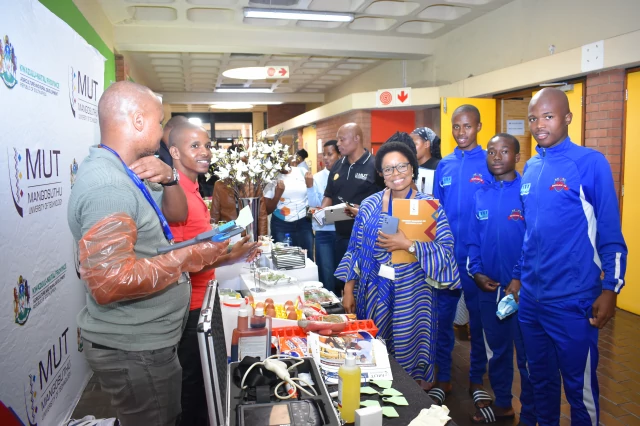
Mangosuthu University of Technology’s (MUT) strategic drive to elevate Community Engagement and Development (CEAD) alongside teaching and research received a major boost this week at the Institution’s annual Community Engagement Day. Held at the North Campus on 21 May 2026, the event brought together University staff, students, community project managers, and external partners under the theme: “Knowledge, Inclusion, Transformation: MUT in Community Partnership.”
Delivering the keynote address, Dr Thulile Mofokeng from the Durban University of Technology (DUT) impressed upon the audience that community engagement is an absolute necessity for modern universities. Dr Mofokeng challenged the traditional academic hierarchy, advocating for a model where university staff and students work alongside community members as equal partners. “A good practice of community engagement is when the university staff and students work with members of the community as equal partners whose main goal is to share knowledge,” Dr Mofokeng stated. Dr Mofokeng emphasised that this symbiotic relationship should simultaneously transform the community for the better and empower the University’s academics and students, who are expected to produce accessible literature so that everyone benefits.
Professor Busisiwe Nkonki-Mandleni, Director of CEAD, the directorate hosting the event, echoed these sentiments, noting that the gathering represents far more than a routine date on the institutional calendar. “As a university of technology, MUT continues to demonstrate that knowledge achieves its greatest value when it extends beyond the classroom and becomes a catalyst for meaningful social impact and sustainable development,” Professor Nkonki-Mandleni said. “Community engagement is not an additional responsibility; it is central to MUT’s institutional identity and purpose.”
At a macro level, MUT’s community engagement agenda is anchored in broader socioeconomic strategies. Professor Nkonki-Mandleni highlighted that the University’s initiatives directly support South Africa’s National Development Plan (NDP) 2030, which targets inequality reduction through education, active citizenship, and economic participation. Furthermore, the University’s alignment with the KwaZulu-Natal Provincial Growth and Development Framework ensures that local projects feed directly into inclusive economic growth, job creation, innovation, and the building of resilient communities.
Acknowledging that sustainable development cannot happen in isolation, Professor Nkonki-Mandleni expressed deep gratitude to the key partners who make MUT’s community work possible. She recognised the vital contributions of the following collaborators: Shuter & Shooter Publishers, Dexter and Matu Zama Agricultural Academy, Azibuyelemasisweni Digital Technologies, Moses Kotane Research Institute, Sivisisizwe Boyz to Men Africa Initiative, Heartlines, Inkonjane, Small Enterprise Development and Finance Agency (SEDFA), The Centre for Community Development South Africa (CCDSA), and Shumayela Secondary School.