
For a student, there are two main areas to consider when planning their studies and, subsequently, their lives. These are what to study and what will happen after the student graduates. Starting with the last area – after graduation, it will be to find a job, or, as MUT recommends, ‘start your business’.
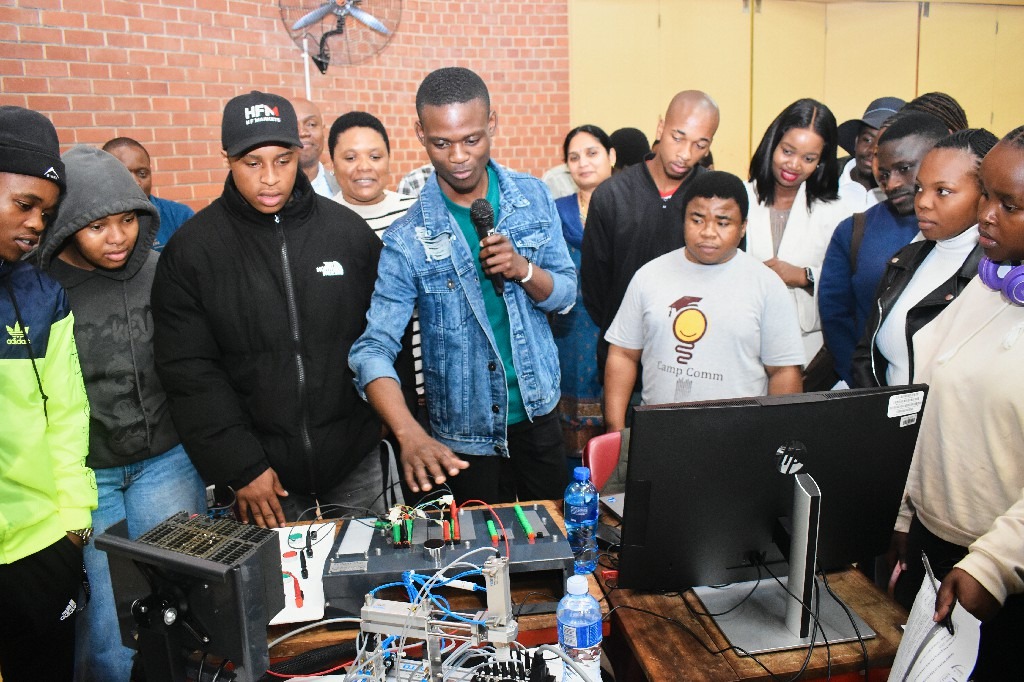
The Department of Electrical Engineering, aware of the importance of these areas, has given first-semester students a clear picture of how they need to progress from their first level to the next level of their studies. In the first semester, students learn foundational subjects across the streams, enabling them to make informed choices based on interest, performance, and career aspirations. On 28 October 2025, the department held an event where first-semester students were given the opportunity to choose their streams after the first semester.
Cyncol Sibiya, a lecturer in the department, said they decided to gather the first-semester students and give them information about the four streams they could choose from after their first semester. Sibiya said that choosing a stream is one of the most important academic decisions a student makes, as it directly influences their future learning pathway, career options, and personal development.
Sibongiseni Masondo, a technician in the department, assisted the students in choosing the relevant streams. He guided them through the APP that he and his colleague, Rogerant Tshibangu, created. The department invited industry experts to emphasise the importance of making a good choice.
The available streams in the electrical engineering department are Power Engineering, also known as Heavy Current. Power Engineering focuses on the generation, transmission, distribution, and utilisation of electrical energy. It covers power systems, machines, protection, renewable energy integration, and industrial power applications. The career opportunities in this area include power utilities, renewable energy (such as solar, wind, and hydro), industrial plants and manufacturing facilities, consulting and design engineering, and electrical maintenance and energy management.
There is also Process Instrumentation Engineering, which deals with the measurement, control, and automation of industrial processes. It ensures systems operate efficiently, safely, and reliably. The career opportunities here are petrochemical, food, and pharmaceutical industries; manufacturing and process automation; control system design and integration firms; maintenance and calibration services; and industrial system monitoring and optimisation.
Telecommunications Engineering is another option students can choose. Telecommunications Engineering focuses on communication technologies for enabling data, voice, and video transmission across networks. It incorporates both hardware and digital communication systems, with career opportunities from mobile network providers and ISPs; broadcasting and communication infrastructure; network design and maintenance firms; and the ICT and cyber-infrastructure sectors.
The last option for students was Mechatronics Engineering.
Mechatronics integrates mechanical, electrical, and computer engineering to design and develop smart systems and automation technologies. It bridges the gap between hardware and software. Some of the career opportunities here include robotics and manufacturing automation, as well as the automotive and aerospace sectors.
Sibiya said that if enrolment numbers across streams are uneven, the department would “conduct academic advising and career guidance sessions to assist undecided students and also promote less-subscribed streams by highlighting their industry demand and career prospects”.