
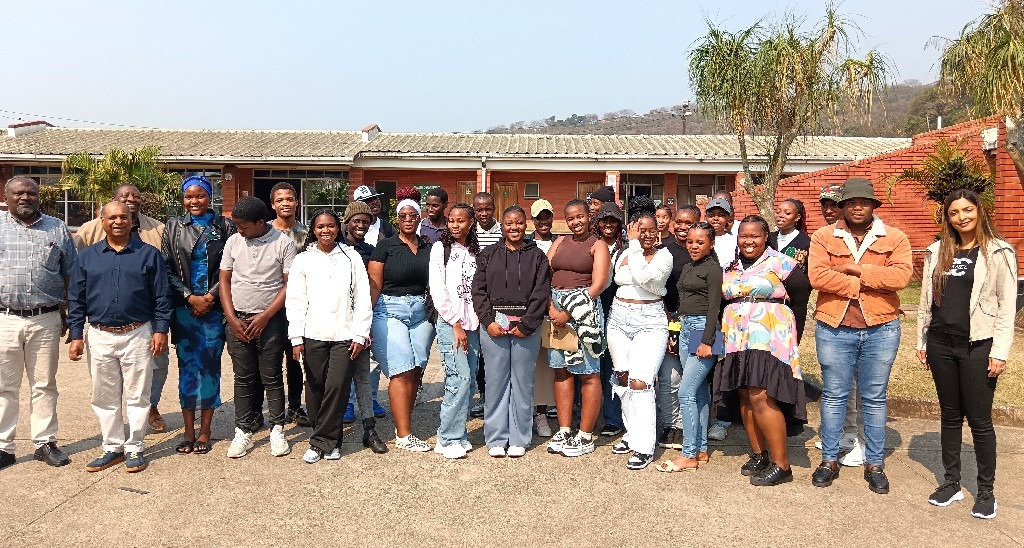
While the problems associated with vectors are still an issue, it is pleasing to report to that the Department of Environmental Health, in the Faculty of Applied and Health Sciences, is doing something to mitigate what these small animals do. Vectors, also commonly known as pests such as mosquitoes, flies, cockroaches, and rodents, have been implicated in various diseases, including Malaria, Dengue fever, Bubonic plague, and food-borne illness. The control of vectors requires a range of interventions, including environmental management, biological control, and chemical control through the use of pesticides. On 29 August 2025, the BSc Environmental Health Vector control second-level students attended a field trip at the eThekwini Vector control depot in Springfield, Durban.
Dr Trishka Govender, a Lecturer in the department, said that during the visit, the students received training on vector behaviour and vector control methods from Bala Moodley, Environmental Health Practitioner, and Sagren Moodley, Environmental Health Manager. This was followed by a session on the safe use of pesticides, facilitated by Zinhle Xulu, an Inspector from the Department of Agriculture, Land Reform and Rural Development (DALRRD). The training included interactive discussions on practical solutions to vector control challenges, pesticide safety, and the risks associated with the use of unregistered pesticides, particularly in informal settlements and among informal food traders. The students also had the opportunity to view various pesticides and pest control equipment available on-site.
This training initiative forms part of the Food Safety and Informal Food Traders Community Engagement Project, led by Dr Mpou Manyatsa and Dr Trishka Pillay at the department. The training aimed at equipping students with the knowledge and skills to educate and empower informal food traders in Umlazi on effective vector control and the prevention of pesticide contamination in food.
Dr Govender said that on 10 September 2025, the students, together with relevant stakeholders from the eThekwini Vector Control Unit and the Department of Agriculture, Land Reform, and Rural Development, will attend a community outreach at the V-section hall in Umlazi. During this session, informal food traders will be educated by stakeholders on vector control and pesticide safety. The levels 2 and 3 BSc Environmental Health students will distribute educational pamphlets and visit informal food trader sites to conduct a vector control survey as part of both the project and work-integrated learning (WIL). The department is working with informal traders of ready-to-eat foods around Umlazi Township’s Mshiyeni, KwaMnyandu, and around MUT.