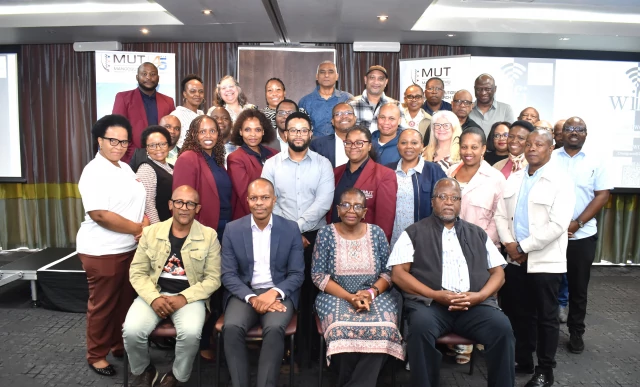
On 9 June 2026, interim Vice-Chancellor and Principal, Professor Rushiella Songca, at the Senate Colloquium, outlined a sweeping vision for institutional renewal, emphasising a need for a shift move toward strict accountability, evidence-based decision-making, and structural stability. The Senate colloquium was organised by the Directorate of Institutional Planning and Research (DIPR) and the Office of the Registrar.
The address followed critical discussions between MUT management and the Council on Higher Education (CHE). Sharing feedback received on 8 June 2026, Professor Songca made it clear that the University is entering an era of rigorous self-examination. “Now we are under a microscope,” Professor Songca warned. “Things at MUT should change; I want results.”
Frankly assessing the University’s current administrative challenges, Professor Songca urged staff to look past quick fixes and commit to the hard work of long-term restructuring. Drawing a vivid comparison, she noted that transforming an institution takes time and collective dedication. “MUT is not a Rolls-Royce,” she stated. “We are still busy trying to put things in place. We are driving a coughing car. We need to talk to each other and ask how we can make this car a Rolls-Royce. We can’t be told we will be fired all the time. We have to be realistic.”
Professor Songca pointed to her previous successful turnaround strategy at Walter Sisulu University (WSU), which rose to number 15 in national rankings under her guidance, as proof that consistency and systemic overhaul yield tangible rewards.
A central mandate from the CHE feedback is the urgent harmonisation and updating of institutional policies. The interim Vice-Chancellor issued a strict directive to all departments to audit and submit their policies ahead of the upcoming MUT Council meeting in July 2026.
The call to reform extends heavily into human resources and institutional governance. Professor Songca questioned the frequent reliance on staff suspensions without clear justification, emphasising her grounding in human rights and the need for prima facie (clear, initial) evidence before taking drastic disciplinary actions.
To bridge perceived tensions between MUT management and the MUT Council, she proposed a collaborative workshop focused on interpersonal relations and institutional cohesion. “Everybody must coalesce. We need to talk politely to each other,” she urged.
In a major operational shift, Professor Songca announced that MUT will transition entirely to online registration starting next year. Signalling a zero-tolerance policy for operational disruption or systemic interference, she warned that security and compliance are paramount. “The only time I fired someone was when that individual sabotaged the online system,” she remarked.
The colloquium anchors the implementation of the University’s Strategy 2026–2030, championing the use of verified institutional data to drive academic and financial planning. To support this data-first culture, Deputy Vice-Chancellor for Teaching and Learning, Professor Marcus Ramogale, proposed creating two vital new roles: a Chief Data Officer and a Data Officer. These positions will ensure that University data is reliably generated, securely stored, and accurately interpreted.
Professor Ramogale also reminded staff of the fundamental order of operations in academic reporting: “You cannot submit a report if you have not done your job. The first step is to do the job and then generate a report.”
One of the most pressing debates at the colloquium centred on shifting demographics, specifically the declining enrolment, lower success rates, and higher dropout patterns among young male students.
Responding to concerns raised by Senate members, Professor Songca emphasised that addressing the male dropout rate is not about reversing the excellent gains made by female students, but about ensuring equitable opportunities for all. She highlighted a troubling concern regarding male student mental health and suicide rates, proposing a holistic, data-led intervention.
For all that MUT must do, there must be a targeted response framework to guide it. This must include granular data analysis, examining student tracking data beyond broad institutional trends, down to specific faculties, modules, and gateway courses to identify where students get stuck. There should also be extracurricular and cultural activities. This will require introducing targeted health, wellness, and mentorship programmes that focus on men’s health and foster a culture of mutual respect. And lastly, the guide must advocate for shared institutional ownership, which will unite faculty leaders, Student Affairs, Financial Aid, and Academic Support under early-warning systems to catch at-risk students before they drop out.
The active debate sparked a call from Professor Mncedisi Maphalala, a Deputy Vice-Chancellor: Research, Innovation and Engagement (RIE), for dedicated academic research into these student success patterns. Expressing her enthusiasm for the scholarly engagement, Professor Songca noted that moving from merely observing administrative statistics to actively researching them is exactly how MUT will transform data into real, life-changing outcomes.