
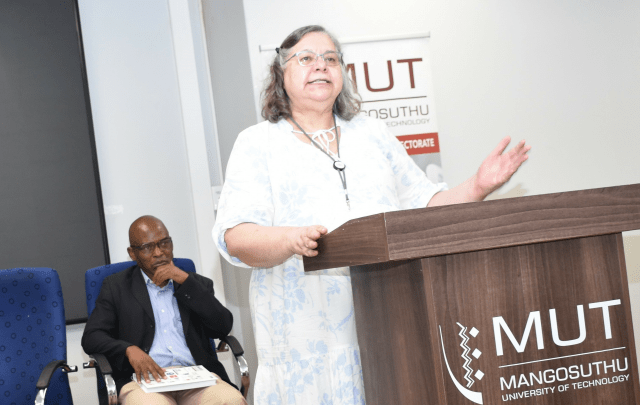
The University has taken a decisive step toward strengthening its research capacity, with the Director of the Research Directorate, Dr Anette Mienie, unveiling a comprehensive funding strategy to support both emerging and established scholars.
Addressing researchers and staff on 14 April 2026, Dr Mienie outlined a multi-stream funding roadmap designed to expand the Institution’s academic footprint and enable high-impact research. Her address echoed the broader vision articulated earlier by Professor Rushiella Songca, reinforcing a unified institutional commitment to research excellence and innovation.
Central to the strategy is a dual-stream funding model that draws on both internal and external resources. “There are two sources of funding, internal and external,” Dr Mienie emphasised, highlighting the importance of leveraging diverse funding opportunities to sustain and grow the University’s research output.
The approach is intended to provide a supportive financial ecosystem that caters to researchers at different stages of their careers—offering foundational support for early-career academics while enabling experienced researchers to scale up their projects and pursue competitive external grants.
By strengthening access to funding and aligning it with institutional priorities, the Research Directorate aims to accelerate knowledge production, enhance research quality, and position the University as a competitive player in the national and global research landscape.
This strategic focus on diversified funding signals a broader institutional shift toward building a resilient and future-ready research environment, one that not only advances academic inquiry but also contributes meaningfully to societal development.
The University’s internal funding structure is becoming more decentralised, placing greater power and responsibility into the hands of faculty leadership. Dr Mienie highlighted three primary internal avenues. The Block Grant, which is managed by the Research and Innovation Committee (RIC). This fund serves as a central hub for applications. Once the RIC approves a staff member’s proposal, the Research Directorate oversees its implementation. There is also Personal Research Accounts: These accounts reward individual productivity. Linked directly to the Department of Higher Education and Training (DHET), funding is allocated based on approved publications and research outputs.
Dr Mienie also talked about the Faculty-Administered Funds: In a new development, deans of faculties will now directly manage specific research funds. This shift ensures that funding is tied to real-time performance. “The Deans will report to the RIC on a quarterly basis on how the money was spent,” Dr Mienie noted, emphasising that the previous year’s performance will dictate future allocations.
Beyond the University’s internal coffers, external grants play a vital role in fostering a robust research culture. A cornerstone of this external support is the University Capacity Development Grant (UCDG). This grant is specifically earmarked to develop the Office of Higher Degrees, support and fund women in research, and empower emerging researchers through specialised capacity-building workshops.
Additionally, Dr Mienie mentioned the major national funding organisations, such as the National Research Foundation (NRF) and the Medical Research Council (MRC).
This multifaceted funding model signals a clear intent by university leadership to create a sustainable, performance-driven environment in which research can thrive at every level.