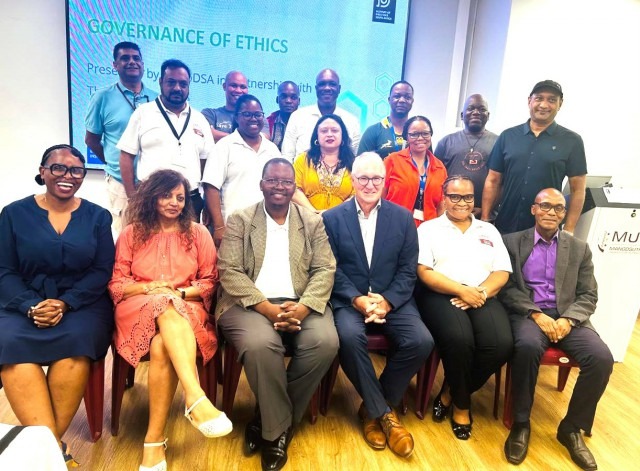
The Office of the Registrar at Mangosuthu University of Technology (MUT) reaffirmed this week its commitment to working with the MUT Council to lay a foundation for ethical leadership and good governance. Senior and middle managers participated in an engaging and reflective ethics training workshop facilitated by globally respected ethics expert Professor Deon Rossouw.
Professor Rossouw, CEO of The Ethics Institute (Pretoria), Governance Associate, Extraordinary Professor of Philosophy at Stellenbosch University, and Chairperson of the International Banknote Ethics Initiative, on 30 March 2026, brought both depth and practical relevance to the session, positioning ethics as a critical enabler of institutional excellence.
Anchoring the workshop in the timeless golden rule, ‘do unto others as you would have them do unto you’, Professor Rossouw emphasised that ethics is not theoretical, but lived daily through decisions, conduct, and relationships. He further unpacked how King V elevates ethical leadership as a cornerstone of governance, shaping how organisations use resources, exercise authority, and build trust.
Through practical scenarios, Professor Rossouw challenged participants to confront real ethical dilemmas. One example, deciding how to respond when a friend causes an accident while speeding, highlighted a key insight: individuals are often inclined to respond based on what they perceive as right, rather than what is objectively ethical. This sparked meaningful reflection on integrity, honesty, and accountability in leadership.
Central to the discussion was Principle 1 of King V – that leaders must act in the best interest of the organisation by cultivating an ethical culture and ensuring responsible corporate citizenship.
To guide this, Professor Rossouw introduced the ICRAFT model of ethical leadership, encouraging leaders to embody the following principles:
- I – Integrity: Acting consistently with honesty and strong moral principles;
- C – Competence: Ensuring the necessary skills and knowledge to make sound decisions;
- R – Responsibility: Being accountable for decisions and their consequences;
- A – Accountability: Being answerable to stakeholders and open to scrutiny;
- F – Fairness: Treating all stakeholders equitably and justly; and
- T – Transparency: Communicating openly and truthfully, fostering trust
The interactive nature of the workshop enabled participants to engage critically with these principles, reflect on their leadership practices, and openly discuss ethical challenges within their roles. It reinforced the understanding that ethical leadership is not an individual responsibility alone, but a collective institutional commitment.