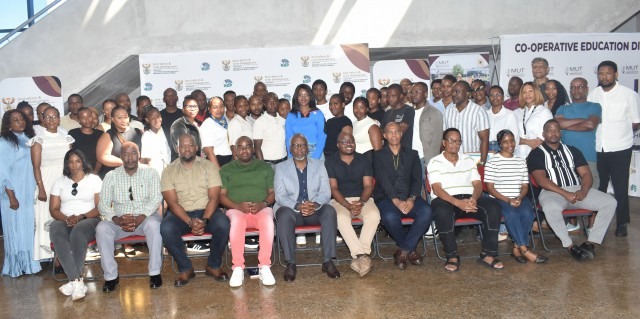
The National Department of Land Reform and Rural Development (DLRRD) has officially signalled a new chapter for aspiring geomatics professionals. On 25 February 2026, the Office of the Chief Surveyor-General launched the 2026 Work Integrated Learning (WIL) programme at Mangosuthu University of Technology (MUT). The initiative underscores the department’s commitment to bridging the gap between lecture hall theory and the high-stakes reality of professional surveying.
The 12-month in-service training programme welcomes a cohort of Diploma and Bachelor’s graduates from MUT and other leading institutions. These students have been strategically placed across the country to gain diverse experience. They are placed in government offices such as the National Office (Gauteng), and Surveyor-General offices in the Western Cape and KwaZulu-Natal, eThekwini and Msunduzi municipalities, and the various geomatics and surveying firms.
Under the mentorship of seasoned professionals, graduates will engage in hands-on functions including mapping, spatial data management, and technical surveying, all designed to prepare them for registration with the South African Geomatics Council and also be ready for the world of work.
The event held special significance as Siyabonga Mdubeki, the Chief Surveyor-General of South Africa and a 1995 MUT alumnus, returned to his roots to address the students. Mdubeki delivered a candid and motivational keynote, urging students to move beyond mediocrity. “Do not be a 50/50 student. If you can produce a distinction, go for it,” Mdubeki challenged. “In this industry, we provide evidence in serious court cases. We are people of excellence. You are not entitled to this opportunity, you must deserve it.”
Mdubeki emphasised that while the department offers full bursaries to deserving candidates, the “bar is raised” when competition is high. He further called upon industry partners like Optron to join the department in providing additional resources to support the growing needs of the student body.
The launch included a technology exhibition where students interacted with the latest surveying equipment. For many attendees, the day was a wake-up call regarding the weight of their future roles.
Mihle Owam Mhlamvu, an S4 Surveying Engineering student, reflected on the Chief’s words: “I was reminded not to settle for just passing. Funding is not something we are entitled to, but something we should honour through hard work and professionalism.”
Similarly, Nokulunga Mdlalose noted the importance of staying grounded in fundamentals despite the rise of AI in the sector. “Excellence should be our standard. I value the discussion on how technology is shaping our profession, but strong fundamentals will always be important.”
The DLRRD’s investment in the 2026 WIL programme is a vital component of the South African technical skills pipeline. By fostering ethical behaviour, discipline, and high academic standards, the department aims to secure a future of sustainable land reform and rural development led by a new generation of “distinction-level” surveyors.