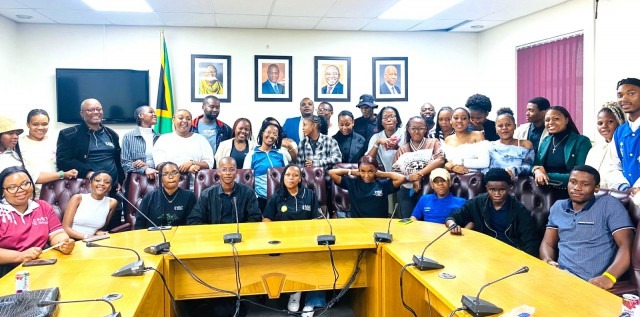
In a powerful display of civic engagement, students from Mangosuthu University of Technology (MUT) stepped out of the lecture halls and into the heart of provincial governance this week. On 3 March 2026, a delegation of 33 students participated in the KwaZulu-Natal State of the Province Address (SOPA) Debate, proving that the youth of Umlazi are far from passive observers in the South African political landscape.
Invited by the Speaker of the KZN Legislature, Honourable Nontembeko Boyce, the group, comprising 18 students from the Faculty of Applied Health Sciences and 15 from Management Sciences represented the University’s Student Volunteer Programme, Peer Helper group, and MUT Radio.
The 2026 SOPA focused on the “big five” of provincial challenges: unemployment, economic recovery, gender-based violence and femicide (GBVF), education, and social cohesion. For MUT, this engagement was not a field trip; it was a practical application of the University’s Anchor Strategy.
Dr Mfanozelwe Shozi, Deputy Director: CEAD, said that through the CEAD’s Ngqayizivele Student Volunteer Programme, MUT aims to produce socially responsive graduates. “By witnessing the debate firsthand, students were able to align their volunteer leadership skills with the pressing socio-economic realities of the province,” said Dr Shozi.
The students did not just listen, they analysed what they heard. Following the proceedings, a wave of critical reflection swept through the chambers. Sthandwasethu Mampuru, a student participant, noted that while the province’s challenges were well-articulated, the “how” was missing. “There was a noticeable gap in presenting clear, implementable solutions,” Mampuru observed, echoing a sentiment shared by many peers who felt that political rhetoric often masks a lack of actionable policy.
Students highlighted the plight of matriculants who pass their exams but find no space in universities or the job market. The economic instability: Concerns were raised regarding the potential liquidation of Tongaat Hulett and its impact on workers. And lastly, the students questioned whether the discourse surrounding the renaming of KwaZulu-Natal would offer any tangible benefits to young people seeking employment.
One of the most poignant critiques to emerge from the session involved the lack of inclusivity. While the Premier highlighted the “Silwa neChilo” campaign against GBVF, a move MUT students strongly affirmed, other sectors felt sidelined. Thobile Mbhele, MUT’s Community Liaison Officer, pointed out a glaring omission in the debate: the rights and inclusion of people living with disabilities. “If we are speaking about social justice and economic inclusion, we must deliberately include persons with disabilities in those conversations,” Mbhele stated. She emphasized that for an institution rooted in Umlazi Township, serving first-generation students, inclusivity is “foundational,” not optional.
As the debate concluded, the consensus was clear: the 2026 SOPA served as a masterclass in public accountability for the MUT delegation. By challenging leadership and demanding concrete steps toward poverty eradication, these students demonstrated that they are critical stakeholders in the province’s future.