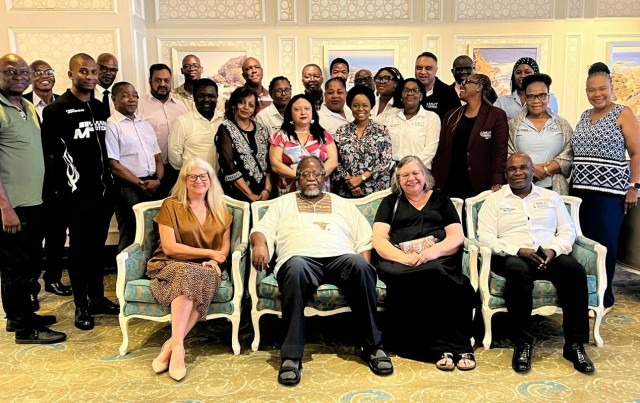
The newly appointed Director of Quality Management at Mangosuthu University of Technology (MUT), Dr Phiwayinkosi Gumede, marked his first major institutional engagement by facilitating a two-day strategic workshop focused on strengthening the University’s quality improvement agenda.
Held on 25 and 26 February 2026 at the Maharani Hotel, Durban, the workshop brought together senior and middle management to review departmental submissions outlining their progress with implementing activities on the MUT’s Institutional Improvement Plan (IIP). The engagement formed part of the University’s preparation of a comprehensive progress report to be submitted to the Council on Higher Education (CHE) on 31 March 2026 for monitoring purposes.
Convened on behalf of the Deputy Vice-Chancellor: Learning and Teaching, Professor Marcus Ramogale, the workshop underscored MUT’s commitment to institutional accountability and continuous improvement.
Opening the session, Professor Ramogale reflected on the origins of the Institutional Improvement Plan. “The implementation of the Institutional Improvement Plan follows the Council on Higher Education’s (CHE) audit of the University in 2021, which made recommendations for the University to improve its quality of provision,” he said.
Professor Ramogale further noted that following the CHE’s approval of the Plan in August 2025, departments and divisions tasked with addressing identified gaps were required to consolidate their progress into a structured institutional report. The two-day engagement was therefore convened by the Quality Management Directorate (QMD) to guide stakeholders in drafting and refining this Progress Report.
Representatives from multiple institutional units presented detailed updates, with robust and solution-driven discussions, with participants interrogating implementation progress, methodology, outcomes and impact. The workshop also created space for both accountability and support, allowing activity owners to share challenges encountered in closing quality gaps, as well as successes achieved thus far.
Dr Gumede emphasised that while the primary objective of the workshop was to draft a Progress Report; the engagement served a broader institutional purpose. “The meeting provided an opportunity to take stock of the University’s remedial actions. It gave activity owners a chance to share their challenges and triumphs in closing quality gaps. The support provided over the two days sets the stage for the University to meet the CHE deadline and reinforces our commitment to accountability as a public institution,” he said.
Participants commended the professional and structured facilitation by Dr Gumede and his team, noting that their guidance helped streamline presentations and sharpen reporting clarity.
Closing the workshop, Professor Ramogale acknowledged the scale and complexity of the exercise. “You can see this is a massive exercise. The weight placed on the shoulders of the Quality Management Directorate is significant. It is not easy to coordinate the work of the entire Institution, but I am pleased that the progress report is beginning to take shape,” he said.
Professor Ramogale encouraged those who had already presented to immediately refine and strengthen their submissions while discussions were still fresh, cautioning against losing momentum. Units yet to present were urged to use the interim period to polish their sections ahead of the next engagement scheduled for the second week of March. “I am happy to see that the progress report is taking shape; we will get there,” Professor Ramogale concluded.