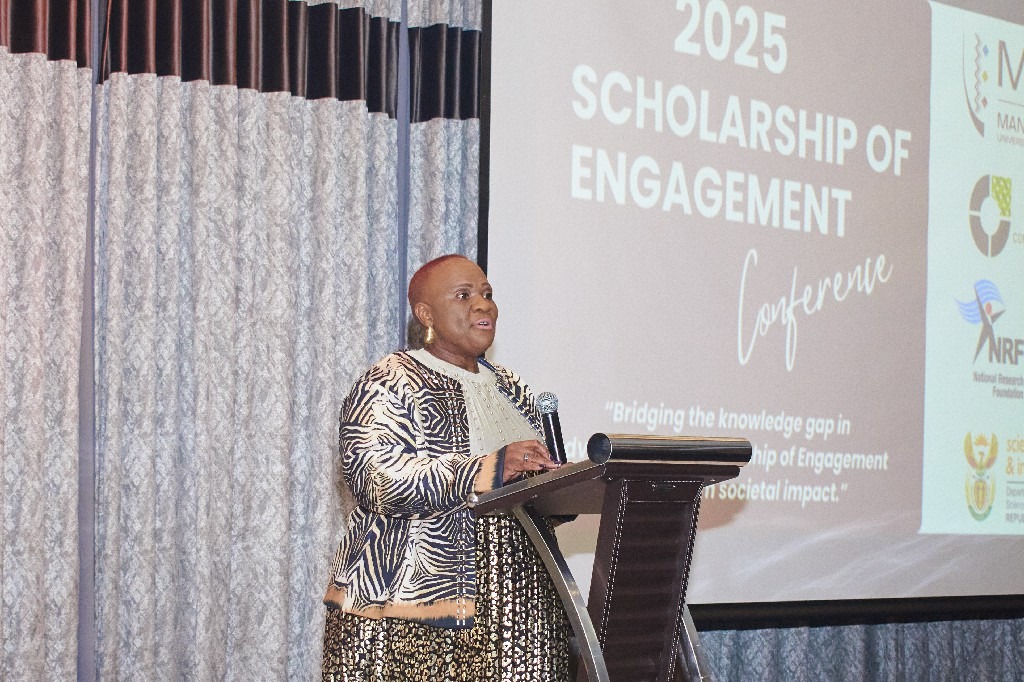
The end of the year is usually seen by most people as the time to start winding down and physically and mentally prepare for the festive season break. At MUT, this is not the case. This is the time when most divisions in the Institution are busier than usual. An event that took place from 18 to 20 November 2025 was one of those busy times. This event was the inaugural Scholarship of Engagement Conference, organised by the University’s CEAD. Opening the conference that was themed: “Bridging the Knowledge Gap in Advancing the Scholarship of Engagement for Maximum Societal Impact,” the University’s Vice-Chancellor and Principal, Professor Nokuthula Sibiya, said the conference provided a crucial platform to reflect on, interrogate, and advance the integration of scholarship and community engagement “within the mission of our university. Today, universities occupy a strategic position in society as hubs of convergence. They are not just centres of learning and research, but catalysts for social transformation, spaces where knowledge from multiple disciplines intersects to address complex societal challenges”. Professor Sibiya said that the Scholarship of Engagement (SoE), “reminds us that the academic mission extends beyond discovery and teaching”. According to Professor Sibiya, this scholarship includes integration, application and crucial engagement with society. She said that by embedding community engagement into teaching, learning, research, and service, “we enhance the relevance of our scholarship, and ensure that our work responds meaningfully to the needs of our communities”.
Addressing a full plenary on the first day of the event, Professor Sibiya said that it was well documented that integrating community engagement into the core functions of a university is not without challenges. “The HEQC Audit of 2012 highlighted that, historically, our university’s community engagement activities were fragmented, inadequately conceptualised, and not fully integrated into our teaching, learning, and research agendas,” Professor Sibiya said. She said the conference was an opportunity to address “these gaps”, to advance scholarship that is “rigorous, socially responsive, and transformative. Let me illustrate what this can look like in practice. MUT has partnered with the government, business, and civil society organisations on various initiatives to address pressing local challenges. The University also provides students with hands-on experience that connects theory to real-world application”.
Professor Sibiya also gave a global perspective on the value of the SoE. She shared that in the United States, the Campus Compact initiative demonstrates the transformative potential when universities align research, teaching, and civic engagement. “It is also important to recognize the broader national context in which our efforts are situated. In South Africa, the South African Higher Education Community Engagement Forum (SAHECEF), which was launched at Mangosuthu University of Technology in 2009, has played an instrumental role in shaping community engagement across the 26 public universities. I wish to express my deep gratitude to the think tanks and dedicated members of SAHECEF who have worked tirelessly to provide a cohesive framework for community engagement, ensuring that our universities can operate in alignment with national priorities while remaining responsive to local community needs.
SAHECEF’s Executive Board member, Dr Cornel Hart, said this first SoE conference “marks a truly historic moment for South Africa, placing community engagement firmly within the context of societal impact. MUT is warmly commended for its leadership in making this vision a reality, and SAHECEF is proud to partner with MUT on this landmark event”.