
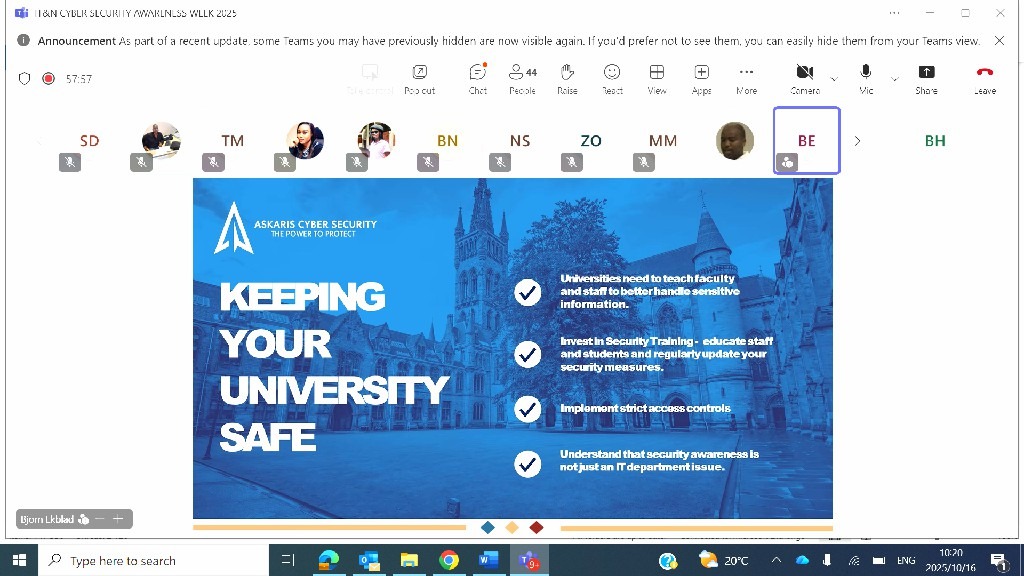
As has been the case over the last seven years, MUT staff have once again been ‘empowered’ with the necessary IT and Network information to continue to be the ‘human firewall’ that protects the University against all threats. Three presenters, over the course of three days, “built” this firewall. Two of these were from external service providers; one was from the University’s Department of Information Technology and Networks. Njabulo Xaba, from IT&N, said they continue to “empower” staff with updates on what is happening in the information technology front and ask staff to play their role. Xaba has always said that end users are the most vulnerable cog in the network chain. Xaba takes his time, explaining the finer details of the
Over three days – 13, 14 and 16 October 2025, the University staff attended the sessions, wherein three presenters empowered them with top-level information. Bjorn Ekblad, Business Development Director at Askaris Cyber Security, delivered an eye-opening presentation to both staff and students. Among others, he explained the types of phishing that staff must be aware of. Some of these are spear phishing, clone phishing, whaling, and pop-up phishing. Ekblad also explained to staff how they could identify a phishing attempt. He said they needed to look for requests that are “urgent” or “threatening language, generic greetings, and poor grammar and spelling.” He advised staff to “scrutinise suspicious sender addresses, links, and attachments, and be wary of requests for personal or financial information or offers that seem ‘too good to be true”.
Ekblad also impressed upon staff the necessity of creating and looking after their passwords. Passwords must be strong to deter cyber criminals.
Johan Booysen, Head of Revenue: Cibecs, a company that keeps copies of its clients’ data, told staff that they could retrieve their data, in case their laptops were lost. This can happen within a very short time to minimise downtime. However, there are still problems with University data falling into the wrong hands. Criminals can force the Institution to pay to retrieve the data. Booysen said that ransom demands increased from 9 million in 2024 to R17 million in 2025. He said they could help staff retrieve data and encrypt it so that scammers wouldn’t be able to use it. Even so, Xaba advised that staff still need to look after their laptops. “These are properties of the University. The data will have been lost. This will be a problem.
Dr Bheka Ntshangase, Interim Deputy Vice-Chancellor: Resources and Planning, highlighted that cybercrimes are “problematic”, and pointed out that questions from staff determine their willingness to protect “our network”. Dr Ntshangase thanked all the presenters and said that he himself learnt a lot from the session.