An academic from the Faculty of Engineering at MUT has discovered a solution to skin cancer. Kavita Behara, a Lecturer in the Department of Electrical Engineering, in her PhD study titled “Optimising Deep Learning Algorithms for Improved Skin Cancer Classification and Detection,” has developed and tested four deep learning models that improve how computers detect and classify skin cancer images. These included a baseline AI (Artificial Intelligence) system with better image preprocessing; a data-generating model to create synthetic images and balance cancer types; an explainable AI model that shows heatmaps to guide doctors; and a hybrid model that both segments and classifies skin lesions more precisely.
Dr Behara’s study was motivated by the fact that current skin cancer diagnoses were not accurate. Dr Behara explains further: “Skin cancer, especially melanoma, is one of the most dangerous cancers, but early detection can save lives. Doctors use dermatoscopic images to examine skin lesions, but diagnosis is still difficult because images vary in quality, some cancer types are underrepresented, and diagnostic tools often lack accuracy or explainability.”
Dr Behara continued: “My research addressed these challenges by developing four deep learning models, which are: baseline DCNN: with advanced preprocessing to reduce image variability; DCGAN-based augmentation: generating synthetic images to balance underrepresented lesion types; GBSD-ECNN: an explainable AI model that produced visual heatmaps to increase clinician trust; and ACSM-CapsNet: a hybrid segmentation-classification model that improved lesion localization and classification accuracy,” Dr Behara said that together, these models improved accuracy, robustness, and interpretability, making AI-driven skin cancer detection more clinically viable.
Dr Behara says that across three major datasets—HAM10000, ISIC 2017, and ISIC 2020 —these models significantly improved accuracy, up to 99.38%, interpretability, and robustness compared to existing approaches. “This makes AI-based skin cancer detection more trustworthy for clinical use,” Dr Behara said.
Dr Behara says that the study shows that AI can support dermatologists in detecting melanoma earlier and more consistently. “This could expand access to reliable cancer screening worldwide. In the future, I aim to improve these models for diverse skin tones and combine image analysis with other patient data for more inclusive and reliable diagnosis,” says Dr Behara.
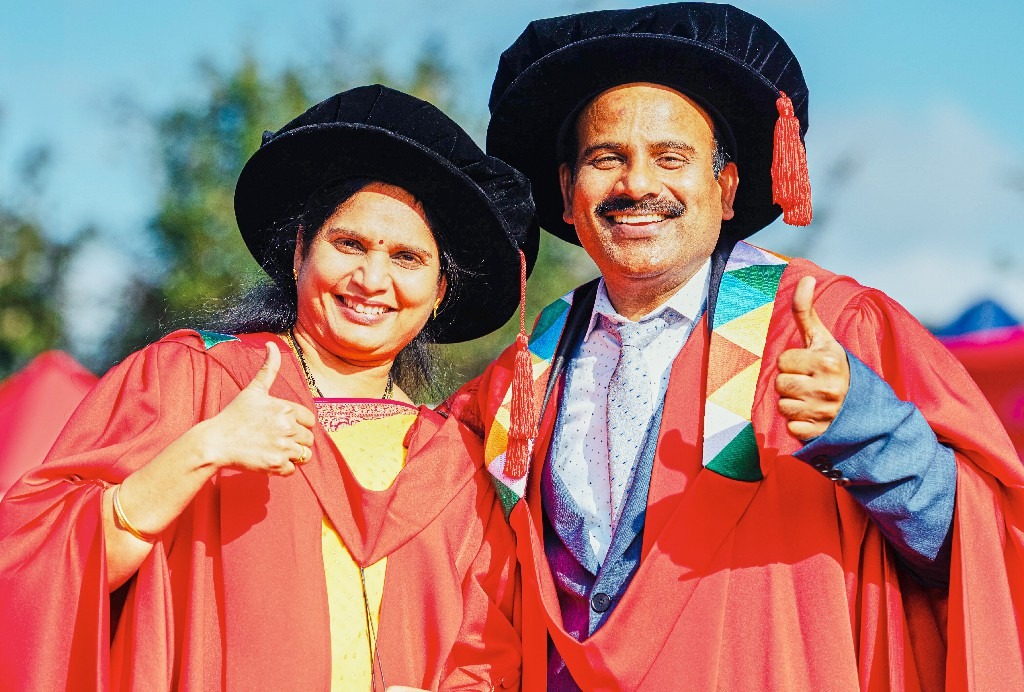
Dr Behara graduated from the University of KwaZulu-Natal on 18 September 2025. Her supervisors were Dr Ernest Bhero and Professor John Terhile Agee, whom she thanked profusely.