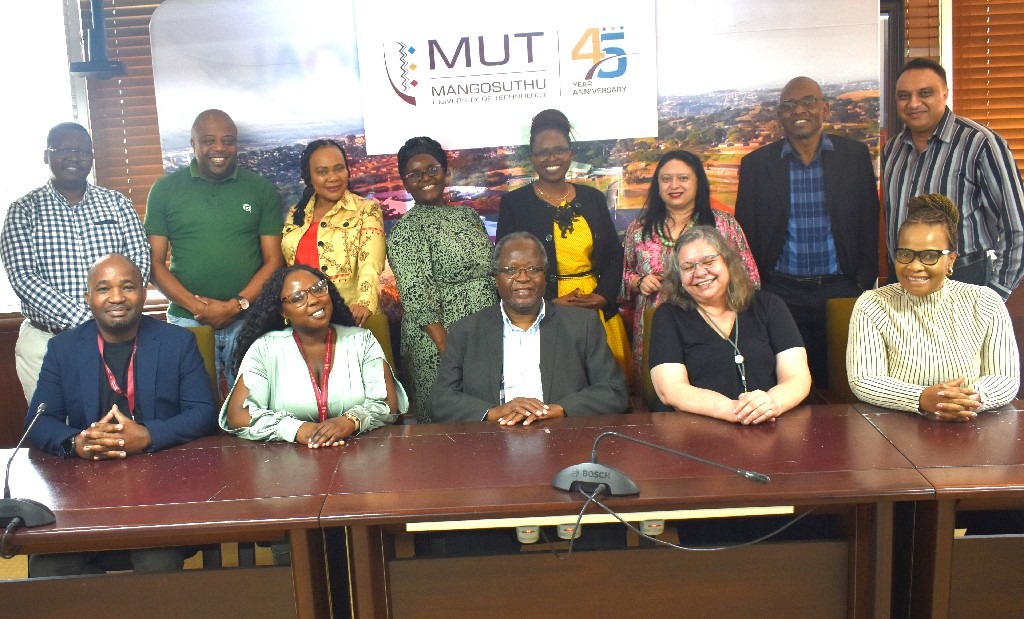
The change at the University in several areas has been highly commended by one of the watchdogs. Two staff members from the South African Human Rights Commission’s KwaZulu-Natal office, who visited the University on 4 April 2025, hailed the University for the strides it is taking to bring about the necessary transformation that affects both staff and students. The transformation at the University is in line with the core mandate of the SAHRC, which, as noted by Ntombi Dube, Human Rights Monitor, is to promote, protect, and monitor the attainment of everyone’s human rights in the country.
Musa Mgenge, Human Rights Officer, commended MUT for focusing on a number of areas that needs transformation of one kind or another. “I commend the University for using sport and creating a Gender Forum, and also for its attitude towards the disabled students,” Mgenge said.
Dube said that they were at MUT to discuss the issues affecting higher education. Dube cited two universities where there were race-related issues which clearly indicated that there was still a long way to go to transform some parts of the country. According to Dube, they wanted to know how far the University had progressed with transformation issues in several areas. “We also want to know if MUT has a transformation charter and policies,” Dube said. Dube and Mgenge also indicated that they were keen to work with the on certain areas, to which some staff members, like Professor Alfred Msomi, the Dean of the Faculty of Applied and Health Sciences, said they were more than willing to.
Earlier in the meeting, MUT staff members had informed Mgenge and his colleague, Dube, that they use sports to bring about transformation and unity among staff and students, and that measures are in place for students with disabilities. Dr Kevin Ramsarghey, the Acting Dean of the Faculty of Management Sciences, said they had gone to the extent of hiring a ‘tutor’ to assist a student with their disability. They ensure that this student gets the privacy that they deserve. The Acting Vice-Chancellor and Principal, Professor Marcus Ramogale, highlighted during his presentation that sport plays a significant role in shaping society. Professor Ramogale reminded the visitors and his MUT colleagues of how President Nelson Mandela used sport to unite a once-divided South African nation. Two MUT divisions, the Sport and Recreation Unit, and the CEAD, are running an annual MUT Schools and Community Cup to create and solidify a relationship between the University and the local communities.
Professor Ramogale, whose substantive position is Deputy Vice-Chancellor: Teaching and Learning, said they were making changes in the curriculum to ensure that their students would have the necessary skills when they graduate. Such skills are communication skills; he highlighted how important this skill is; end user computing, being aware of the background of most of their students; applied learning, since MUT is a university of technology; and most importantly, they have introduced entrepreneurship to all faculties so the graduates would not only be job seekers but also be job creators. “We are changing the thinking of our students, who are nicely taking up the changes,” Professor Ramogale said, adding that they had decided to have two colloquiums a year where they would discuss the necessary changes.
Mbali Mkhize, Senior Director: Department of Marketing and Communications, also highlighted that they viewed sport as having a major role in creating social cohesion at the University, while her colleague in the department, Zama Sishi, said they were caring for the University students with a food and clothing donation programme, from an international charity organisation.
The University is also ushering in changes in other areas. Professor Msomi, who is also an executive member of the Gender Forum, said that when they changed the name of the faculty, they were informed of the changes that are now in place to transform the faculty.
Other members of staff also contributed to the discussion, listing the changes in their divisions. The Interim Deputy Vice-Chancellor: Research, Innovation and Engagement (RIE), Dr Anette Mienie, said they were continuing with their plan to provide favourable conditions for female staff members when conducting research. Dr Paulette Naidoo, the Acting Dean of Students, said they were working with the University of Cape Town and the University of KwaZulu-Natal to improve the infrastructure so the students with disabilities would benefit. Some areas that they were looking to improve were gender-based relationships, which included gender-based violence, on campuses and in student residences.
Institutional Forum (IF) Chair, Lwazi Mthimkhulu, supported what Dr Naidoo said about the student with disabilities, and added that they were advising the University Council accordingly on transformation matters.