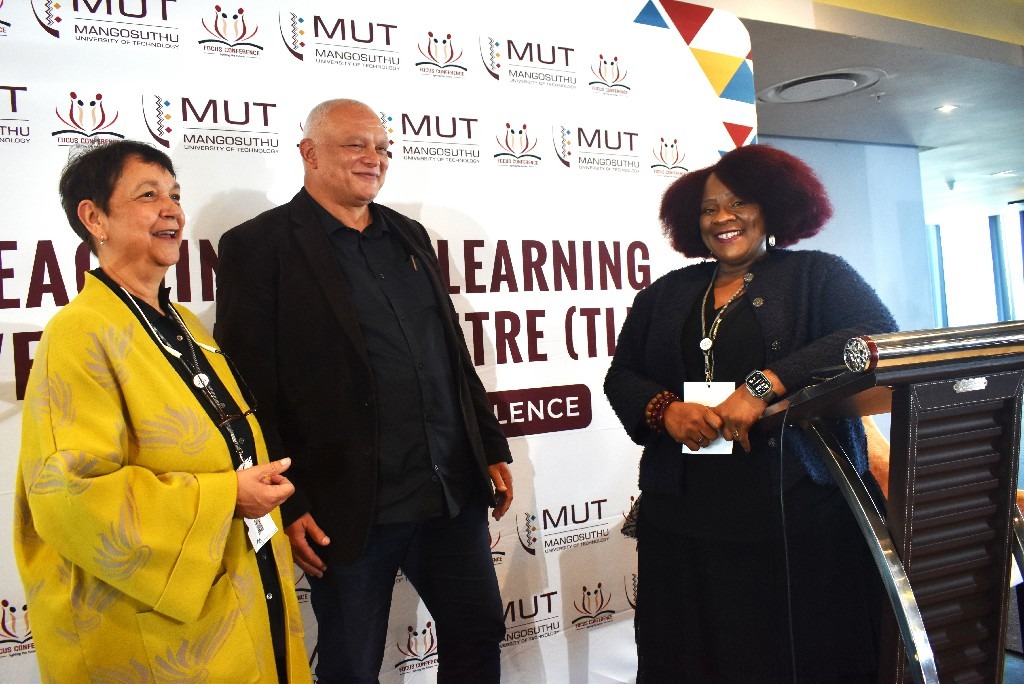
The University’s Teaching and Learning Development Centre (TLDC) continues to put the Scholarship of Teaching and Learning at the fore front of higher education; this is the 12th year the Centre is carrying its mandate to benefit everyone involved in the education sector, particularly the students at all levels of education.
Professor Nokuthula Sibiya, the Vice-Chancellor and Principal of MUT, described the Focus Conference as “a strategic platform; a space where the aspirations of a university like ours, a historically disadvantaged institution, meet the global imperatives of twenty-first century higher education.” Indicating how much the conference has grown over its 12 years of existence, Professor Sibiya said that what began as a modest platform to share teaching and learning practices has grown into a recognised academic event that now draws scholars, practitioners, and innovators from across South Africa and beyond.
Once again, the 2024 edition of the conference exhibited what it has been known for – being attended by delegates from the country’s higher education, and partners from beyond the country’s borders, and the members of the private sector. One of the highlights of the conference was a presentation by Professor Denise Zinn, a seasoned academic from the Nelson Mandela University. Responding to the conference’s theme: ‘Shaping Global Perspectives in Higher Education: Transforming Learning Through Innovation, Digital Equity, and Global Partnerships’, Professor Zinn made a presentation that seems philosophical, but very soon it became clear that what she was driving at was quite simply – she said that while everyone was rightly arguing for the embracing of the artificial intelligence (AI) mainly because of its advantages, Professor Zinn said the speed at which things were happening was too fast; there was a chance that some parts of the communities, among which there are students and learners.
Professor Zinn talked about some fast moving parts of a kaleidoscope, saying that some members of the community might be left behind. She advised that those at the forefront of teaching should hit the pause button, and reconsider their strategy to make sure that it was effective by doing what it is meant to do – benefit those that were meant to benefit from it. Professor Zinn’s presentation was: A Time of Turning: The Shifting Kaleidoscope of Learning & Teaching. A kaleidoscope is an optical toy or instrument containing mirrors and colourful fragments that create symmetrical, ever-changing patterns when viewed through an eyepiece. Many fast-moving parts. Prof Zinn said it is time to slow down, and consider other things that are part of the education and the learning system. “It is time for turning. It is time for a pause,” Professor Zinn said.
How do we go slow with our teaching and learning?, she asked. Professor Zinn said what is happening in the education sector was like fast food slow food, the latter being better; students are able to learn more in the latter situation because it gives the learners a chance. According to Professor Zinn, the learning environment is composed of a number of elements which must all be considered for the benefit of the students, whom she identified as “a community”.
Some of these elements are innovation, transformation, and slow pedagogy. As far as transformation, she said there is need to consider what needs to change. What is our context? Where are we going? What is the effect of the difference between the ages of the teacher and the students? She asked these questions.
She said there was a need to realise that the those in power, the teachers, needed to give control. “We need to seriously consider change. Times are changing. We have to listen, share and learn,” Professor Zinn said. This sounded like some revolution in the way teachers and academics have to conduct their teaching.
Responding to a question from the floor that seemed to suggest that AI would offer solutions to what Professor Zinn was advocating, she said AI should be used to find solutions that would favour both teacher and the learner.
Another distinguished presenter at the conference was Professor Lesley Le Grange Chair: Higher Educationf Quality Committee, and Distinguished Professor: Department of Curriculum Studies, Stellenbosch University. Professor Le Grange’s presentation was “Designing Curricula for a Global Citizen Workshop”.
As usual, MUT staff contributed a lot to the presenters’ line-up. Some that made presentations at the conference are Dr Darlington Hove, who presentation was: Reflections on contextualised Mathematics in an Engineering diploma; and Dr Motheo Tjebane and Nosipho Buhle Faya. Their presentation was “Novel approaches to advancing construction education: a global perspective.