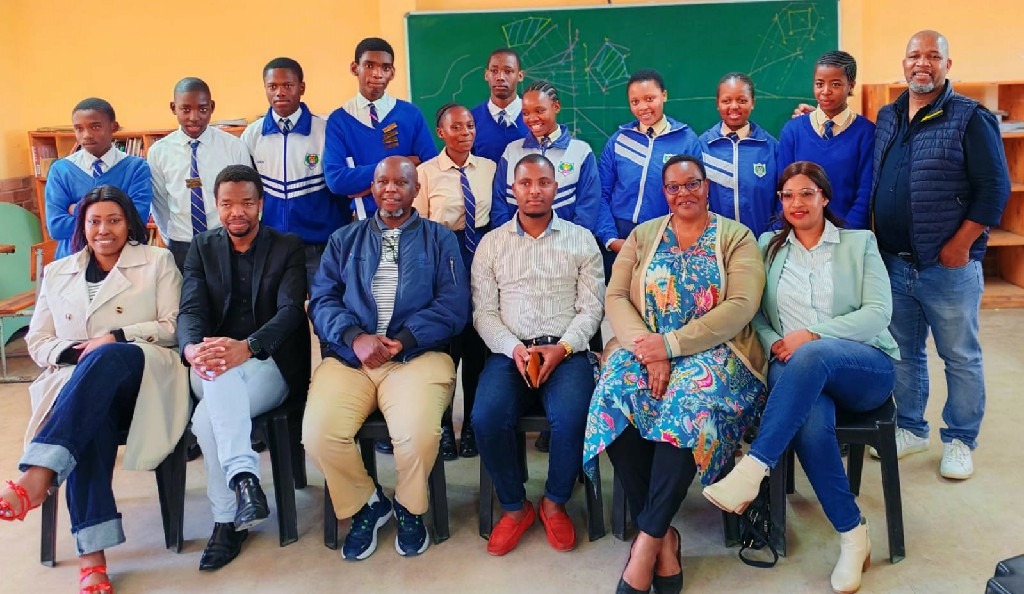
As part of the preparation for the Summer School that will place towards the end of the year, the Research directorate’s Intellectual Property section visited some local schools who are going to part in the event. Dr Mandla Hlongwane, Deputy Director: Intellectual Property, said that they are including the schools in the event so they will have a good understanding of what intellectual property is, but most importantly, its role in the economy. “Although intellectual property is not a new thing, not many of us are aware of it. We want our learners to be aware of it, and that they themselves can create things, and will have the necessary protection for they will have created,” said Dr Hlongwane.
Part of the Summer School will be a competition for the learners of different schools. The Innovation Challenge Competition for learners is bold and exciting sub-event. It is about learners developing innovative solutions that address one or more of the United Nations’ 17 Sustainable Development Goals (SDGs). Whether it is clean energy, sustainable cities, quality education, or zero hunger, the message was clear. This High School Innovation Challenge Competition (HSICC) which will take place on 1 December 2025, is a signature event within the 17th World Intellectual Property Organization (WIPO) South Africa Summer School taking place from 24 November to 5 December 2025.
Over the week, members of the directorate visited the following schools: Sibusisiwe Comp-Tech High School, in Umbumbulu, inner south-west of Durban; Menzi High School, in Umlazi Township; Sidelile High School, in Magabheni Township, south coast of Durban; Qinisani High School, Tongaat, north coast of Durban; and Mqhawe High School, Inanda, north west of Durban.
The directorate’s Makhosi Cebekhulu, who led the team, said that for many learners, the concept of Intellectual Property (IP) was brand new. But as the team explained how ideas could be protected, shared, and turned into opportunities, eyes lit up.
The Innovation Challenge Competition to learners is bold yet exciting. Learners were tasked to develop innovative solutions that address one or more of the United Nations’ 17 Sustainable Development Goals (SDGs). Whether it is clean energy, sustainable cities, quality education, or zero hunger, the message was clear.
Cebekhulu said the visits were more than just talks. “They were lively, interactive conversations about ideas, ownership, and the power of intellectual property. Learners were introduced to the concept of protecting their creations, how innovation links to real-world challenges, and discovered how one spark of creativity can grow into a solution that transforms lives and communities,” Cebekhulu. Cebekhulu also added that the learners had an opportunity to present their own ideas, with the team providing guidance and support. “Through practical examples, question-and-answer segments, and inspiring stories of young innovators, the team encouraged students to think boldly, problem-solve creatively, and see themselves as future inventors and entrepreneurs,” said Cebekhulu.