
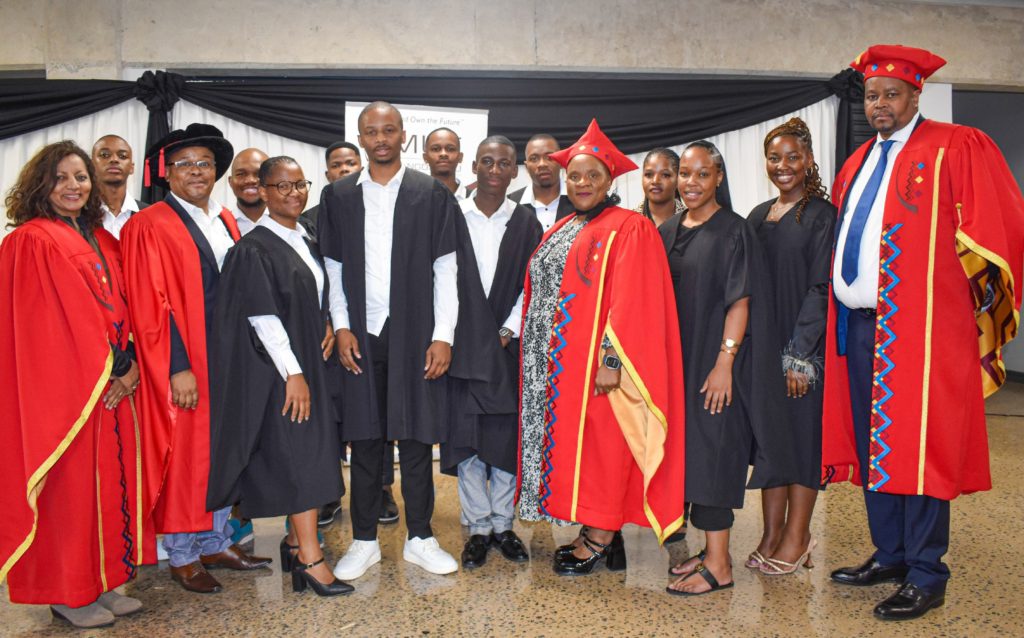
There is every reason to believe that the peaceful and productive atmosphere that is prevailing at the University, will continue. The ingredients of the relationship – which are a proper guidance from management, and the willingness by the student leadership, and the general student body, to adhere to the applicable rules and regulations, are still there, and are renewed all the time. This atmosphere formed a basis for the recent Student Representative Council (Council) annual election that was won by SASCO, with five seats. Four seats went to EFFSC, and two seats went to two independent candidates. After the allocation of the portfolios, what was left was for the SRC to be inaugurated, a process that was done on 1 October 2024, at the University,
Addressing the incoming student leaders, the University Vice-Chancellor and Principal, Professor Nokuthula Sibiya, first thanked the outgoing SRC for having a good working relationship with management. Professor said for a month she was Vice-Chancellor and Principal, she liked working with the outgoing student leaders under the leadership of Thobisa Dalasile, as their President. Professor Sibiya made it clear that the end goals for both management and the student leaders were the same – success of the University in achieving its goals, and that stability and common understanding were the foundations that ensure the success of the relationship. The SRC elections were declared by the Independent Elections Commission as “free and fair”, and this was an indication of a continuing maturity on the part of the students, hence the Vice-Chancellor and Principal’s comment: “This proves the level of maturity and understanding by our students of their democratic rights and confidence in the people they chose to lead them. You are part of millions of young people of South Africa who make us proud and confident about the future of our nation”. Professor Sibiya defined the SRC as a “vital stakeholder” within the University because of what it is suppose to do, as mandated by the University’s regulations.
Turing to the 2024-2025 SRC, Professor Sibiya said it was a “great honour” for her to usher in the new SRC leadership at MUT, and that she was giving them a “motherly” advice. Professor Sibiya said that as the student leadership, they were expected to play a critical role in managing and administering student representation at different levels, advising on the development of academic programmes and student-learning experiences, as well as participating in the development and implementation of institutional and national policies on higher education.
Professor Sibiya went further: “You are the the voice of the students, and therefore represent all students’ views on academic and experience-related issues to the University. This not only gives students the forum to voice their views, but also gives the University valuable feedback when planning for the future. Let this voice be heard through the right channels and at the right time. This brings me to a discussion on how I’d like to keep the channels of communication between my office and yours. As the Vice-Chancellor and Principal, I do commit that I will have regular engagements with the student leadership to discuss matters that affect students. I also have plans to have leadership workshops with the SRC,” said Professor Sibiya.