Monday - Thursday: 8am - 9pm | Friday: 8am - 6pm | Saturday: 8am - 4pm | Sunday & Public holidays - Closed
Applied and Health Sciences Library
Monday - Saturday: 8am - 4pm | Sunday: Closed
Databases
Click here
FaceBook
Click Here
F A Q's
Click here
Printing
Click Here
Research support
Click Here
WhatsAPP
Click Here
New Books


Library guide

The library has created helpful library guides that will introduce you to the best resources for a given assignment, course, subject area, or general topics. We call them library guides, and this is a great place to start your academic work.
Announcements
Mission
To exhibit excellence as a user-centric library, integrating information literacy into the teaching, learning, research and community engagement efforts of MUT.
We plan to achieve our mission by:
- Investing in staff reskilling and upskilling and recruitment of competent personnel
- Partnering with Academic departments, Teaching and Learning Development Centre and Research Office
- Sourcing efficient and effective technology for acquisition and provision of scholarly information
- Establishing conducive and safe learning and research spaces
- Partnering in community engagements efforts of the University
Vision
To be a leading enabler of knowledge creation, providing access to world class information resources, while utilising globally recognized digital content innovations.
Our Libraries

Main Library
The Main Library is located opposite the Student Centre and has three floors designed to support your learning needs.
First Floor:
This floor houses the print book collection, faculty librarians, the circulation desk for borrowing and returns, and quiet study areas.
Ground Floor:
The ground floor has a large computer lab with 100 computers available for undergraduate students. There is also space for students who wish to use their own laptops.
Lower Ground Floor:
This floor includes the Technical Services section, which is not accessible to students. The other wing features a training computer lab, a postgraduate computer lab, and the Learning Commons, which is used for university meetings, workshops, and events.
Applied and Health Sciences Library
The Applied and Health Sciences Library is located on the second floor of the North Campus. The library is currently undergoing renovations, and as a result, only limited services are available at this time.
Information Literacy
So, you have finished your studies.
Maybe you have just wrapped up the semester. You have got time on your hands. Now what? This is the moment real life begins. It is time to figure out who you are, what you can do, and how to show it to the world.
Your personal profile is key. It is how you introduce yourself—on paper, online, and in person. Your profile tells your story. Not just your qualifications, but what matters to you, what excites you, and what makes you stand out.
What do you bring to the table? What’s your story? Do not make it boring. Make it real.
People remember stories, not just facts. Building a strong profile is about more than a polished CV. It is about showing what you believe in and what you are capable of. Think of your favourite movie or book character—they make an impression. You want your profile to do the same. That is what people are looking for—employers, collaborators, mentors. Be clear, confident, and human.
If you do not have a job yet, volunteer. Show the world who you are. What do you care about? Walk into a workplace you admire and offer your time. You are not asking for a salary—you are asking for a chance. A chance to learn, to grow, and to get your name out there.
People notice that kind of effort. Volunteering often leads to more. That kind of initiative stands out more than any qualification. Yes, the job market is tough. But the power to move forward is still in your hands. Use what you have. Learn. Connect. Ask questions. And just as importantly—listen. Reflect. Grow.
In a crowded field, people remember those who are clear about who they are and what they want. So, ask yourself: What makes me different? Then lead with that. Your story is your strength. Do not wait to tell it.
What I Didn’t Expect to Learn from Group Work
By Andiswa Jili
In my first year, group work was one of the hardest things for me. I did not think it would be so tricky, but I ended up learning a lot—about others and about myself.
Stepping Outside My Comfort Zone
At the beginning, I tried to form my own group by asking a few people to join me, but it did not work. I realised about myself that I do not have much patience when people do not take me seriously. In the end, I joined another group that accepted me. That is when I learnt that group work is not always about choosing your friends—you sometimes have to work with new people.
Not Everyone Follows the Rules
I quickly found out that not everyone follows the rules. No one in my group went to the briefing session about how to use Turnitin effectively. This caused problems later. We did not do our plagiarism check properly, and no one wanted to take the blame. I learnt that in a group, one person’s mistake can affect everyone. Some people take shortcuts because they are desperate, they don’t care, or they think no one will notice.
You Might Have to Pick Up the Slack
My group was not well organised, and we ended up submitting our work late because some important parts were left unfinished. When it was time to speak to the lecturer, no one else wanted to do it, so I had to. I made sure our late work was accepted. It was stressful, but I learnt that sometimes you have to take charge when others refuse.
Sometimes You Miss Out on Learning
We were in such a rush to finish that I did not get to type the document myself. This mattered to me because my computer skills are still very weak. I realised it is important to be involved in every part of the work, especially the parts you are not good at. Next time, I do not want to rely on others to finish things for me—I want to improve my skills and do it on my own.
Final Thoughts
Group work is hard, especially when you are new to it. But it taught me a lot about myself, what I expect from others, and what I need to get better at. I am not perfect and still learning, but now I am more prepared to handle it next time.
By Andiswa Jili
– Andiswa Jili is doing her diploma in public finance and accounting.
How Do I Make This Better?
By Sanelisiwe Jali
I often ask myself, how do I make this better? When it comes to my studies though, I am still trying to find the definiteanswer. Here’s why.
I struggle with letting go of control. When I don’t know what to expect, I feel uneasy and unprepared. As a student, you sometimes find that important information is often kept from us, and we are told to just comply and not complain. But I do better when I know the exam scope — what to study and how to tackle the task. Unfortunately, exam details are rarely shared clearly, making it hard to prepare.
Sometimes, I feel like I’m pretending to be someone I am not. I do not like making excuses when things go wrong, but I had a tough time adjusting to teaching styles that do not match how I learn best. Afraid of repeating modules, I chose to cram just enough to pass, even though I knew my understanding of the material was dodgy.
I am also dealing with life outside of campus. A bad incident took place. I was robbed at gunpoint while waiting for the bus home. Two armed men jumped out of a car and demanded my phone — no one was around to help. It was a harsh reminder that to change my situation, I needed to stand up for myself and fight for justice.
So far, I am still figuring it out — how to make this better, in my studies and in life. But I am not giving up.
By Sanelisiwe Jali
– Sanelisiwe Jali is completing her electrical engineering diploma.
Big Dreams, Bad Habits
By Evelina Mbiba
Lots of students dream big—about success, freedom, and helping their families after graduation. That’s inspiring. But what’s frustrating is that those with the biggest dreams often put in the least effort to reach them. I find that problematic.
Skip Class Like It Doesn’t Matter
Some students skip class like it’s nothing—but it is. If you need help understanding the material, missing class makes things much harder. Still, in many classes, online or in-person, half the students don’t show up. Why? It’s not about how smart they are—it is about their habits. And too many are building the wrong ones.
Avoid Campus Like It’s a Trap
Many students do not like coming to campus. But when they stay in their residences or accomodation, they mostly eat, sleep, scroll, and chat—not study. There is not much structure or good study space outside the library. Still, they choose it over campus, where learning actually happens. Why? Maybe it is comfort or routine. But either way, it is a habit that hurts them.
Too Afraid to Speak Up
Many students stay quiet in class—not because they have nothing to say, but because they are afraid. Afraid of making mistakes or looking silly. So even when they are confused, they stay silent and wait for someone else to talk. But staying quiet rarely helps. To learn, you need to ask questions. Confidence comes from trying. And no one can help if you don’t speak up.
Wait Too Long to Ask for Help
Students do not like asking for help. Maybe they do not want to seem weak or feel embarrassed. But the longer they wait, the harder it is to catch up. If no one knows you are having trouble, they cannot help you. Waiting until the last minute—right before tests or deadlines—usually means it is already too late.
Final Thoughts
It is easy to dream about a better future. But dreams do not come true without action. What worries me is not that students struggle—that happens to everyone—but that many choose habits that make things harder. We all need to take responsibility now, not later. Success does not start after graduation—it comes from the small, tough choices you make every day. So show up. Speak up. Ask for help. Change your habits. Because if you do not help yourself now, no one else can do it for you.
By Evelina Mbiba
– Evelina Mbiba is an environmental health student.
Breaking Barriers Together
By Nofezile Jali
This is my journey in helping others become their best. I love helping people overcome whatever it is that is stopping them from becoming the best they can ever be. But honestly? It is easier said than done. Let me share a bit of my own story.
I have my own struggles—everyone does. I was meant to be in my final year of school, but my NSFAS funding was canceled. After that, I could not focus on anything else. Paying for my studies took over my mind. I felt desperate, lonely, and sad. I wanted help but didn’t know where to turn. In the end, I failed.
This experience showed me how many feelings people keep inside. One important lesson I learned is about denial and respect. Sometimes, the best way to help someone is to give them space. Helping does not always mean asking questions or pushing them to open up, and make them say something they feel not ready to share. When someone says, “I’m okay,” even if I feel something is wrong, I do not force them to talk. I respect their need to handle things in their own time. Sometimes, “don’t ask; don’t tell” is the best approach because everyone faces their struggles at their own pace.
Here is an important truth: it is okay to learn from mistakes. People need space to figure out what is right and wrong for themselves. We do not always know what is best for us. But it is not our job — or anyone else’s — to fix someone else’s problems. Our role is to be there, to listen, and offer support when they are ready.
Helping others is a special journey, full of kindness, patience, and understanding. We all have our own struggles, and sometimes just being there and respecting someone’s process is the greatest gift we can offer.
By Nofezile Jali
– Nofezile Jali is an accounting student.
When Being “Me” Didn’t Feel Like Enough
By Ziyanda Mbonambi
I have always been someone who loves meeting new people, learning new things, and trying new experiences. I am active, open-minded, and friendly—that is how I have always seen myself. I enjoy being around others, and I like to think I bring good energy wherever I go.
But this year, I have been asking myself something I never expected: Are my strengths enough to carry me through everything life throws at me? Let me explain.
The Race Against the Clock
Every day feels like a race. I am always in a rush to catch the next bus. Even during class, I find myself checking my watch over and over, calculating how much time I have left before I need to run. There’s usually a tight (sometimes impossible) gap between when my lectures end and when the campus bus departs.
That stress has turned something as ordinary as a timetable into a source of anxiety. It got to the point where the timetable feels like my enemy. As soon as class ends, I run out the door—not because I want to, but because I have no choice. There is no time to talk to classmates, ask a question, or simply breathe.
Drowning in Deadlines
I am not proud of it, but I still panic when deadlines pile up. Then there are the assignments. I’m still learning how to manage pressure without getting terrified. As soon as I turn something in, another assessment shows up—sometimes two, due on the same day. It can feel like a never-ending cycle. I love people, and I do not like being alone, but when I am stressed, it shows. I cannot fake a smile when I am struggling inside. I realised that being honest about how I feel is more important than pretending everything is fine just to make others comfortable. And I definitely do not like pretending to have fun when my mind is racing through a checklist of everything I haven’t finished. I often find myself buried in unfinished work.
Losing My Lifeline
And then there was the heartbreak I didn’t see coming. My laptop died. No warning. One day it was fine, the next day—nothing.
It may sound silly, but I genuinely felt like I lost a trusted friend. That laptop helped me stay on top of everything: classes, deadlines, notes, communication. It gave me freedom. Now I got stuck trying to do my work on a cellphone, and let’s be honest—phones are not built for academic life. It is frustrating. It is limiting. And it made everything feel ten times harder. It was a reminder of how much we rely on certain tools, and how much harder things become without them.
Still the Same Me, Just Growing
I have not changed. I still love people. I still love to learn. I still say yes to both new opportunities and challenges. This year has tested me in ways I did not expect. Even my biggest strengths felt small when life became too much. And that’s okay. It does not make me weak. It just means I am human.
So, I am learning to pause. To breathe. To admit when I’m struggling. To ask for help without guilt. Because maybe real strength isn’t about being cheerful all the time—it is about being honest with yourself and choosing to keep going, even when things are hard. And that is the version of me I am becoming.
Final thoughts
I am learning to balance those strengths with patience, self-compassion, and the ability to say, “I’m struggling” when I need to—because real strength is not about always staying upbeat; it is about being honest with yourself and knowing when to slow down and ask for support.
By Ziyanda Mbonambi
– Ziyanda Mbonambi is doing her local government finance diploma.
I try harder
By Saneliswe Ngcobo
When there is a job to get done, I can never hold back. Maybe it is because I am naturally bubbly. Maybe it is because I have the courage to take on any challenge. But I think it is something else—something simpler: I always try harder.
I tend to take on more tasks than I can comfortably handle. I like to finish my work on time (if not early), so I push myself—sometimes more than I should. When I am working in a group, I often take on the lead role, not because I am asked to, or expected to. But because I want to make sure things get done right and without delay. Before I know it, I am the one running around doing everything while others sit back, seemingly relaxed.
I am also someone who needs reassurance. I do not feel fully satisfied until I have received some kind of feedback or approval. But feedback does not always come quickly. Sometimes I wonder if anyone even reads the work, I put so much effort into. Still, I take every comment and correction seriously. I reflect on what others say, and I use it to grow. I do not mind changing things—especially if it helps me learn.
One thing I really dislike, though, is spending money unnecessarily. It is frustrating to be completely broke just because I had to submit a project. Hard copies are often required for assessments, and printing is not cheap. And yet, it is something I often must do just to meet requirements. Sometimes, it costs me more than I expected just to turn in my work.
So, why do I keep pushing myself so hard? Maybe it’s just who I am. I care. I try. I want to do well. And even when it is exhausting, I never stop giving my best.
Final Thoughts
Pushing myself has never been about showing off or trying to outshine anyone. It is about personal pride—knowing I gave it everything I had, even when it was tough. Yes, I get tired. Yes, I feel overwhelmed. And yes, sometimes I wish things were easier or cheaper or fairer. But in the end, I know that the effort I put in today shapes who I become tomorrow.
Trying harder is not always easy—but it is always worth it.
By Saneliswe Ngcobo
– Saneliswe Ngcobo is a civil engineering student.
I Choose to Show Up
By Mandisa Khumalo
I made a personal decision to be more active on campus, especially by taking part in outreach programmes within both my residence and the university community. What I did not expect was how deeply moving it would be to hear other students open up about the pressures they face — academically and personally. The stories I have encountered have shown me just how much we all carry silently.
“I really have no one to talk to.”
This one hit hard. Many students are going through so much behind closed doors — from family issues to the stress of trying to keep up with academics — yet feel like they have no one they can trust enough to open up to. I consider myself incredibly lucky to have my mother and grandmother. They are my pillars of strength. Even from miles away, my mom is always just a phone call away, ready to listen and give the kind of advice that only she can.
“I am okay.”
We hear this line all the time, but it is often just a mask. Many students downplay their struggles or pretend everything is fine — sometimes to avoid being a burden, sometimes because they do not want to admit they have lost focus. I have noticed that some think their problems are “too small” to matter. But small problems pile up. And often, by the time the deadline pressure hits, it is suddenly too late to fix everything overnight. The truth is, admitting you are not okay does not make you weak — it makes you honest and self-aware. It shows you are being real with yourself.
“I drain my worries down the bottom of a beer bottle.”
It is no secret that some students turn to alcohol to escape. And for a moment, maybe it does feel like the stress disappears. But the truth always comes back — along with the hangover, the regret, the wasted time, and misused money. The worst part? The problems are still there, waiting.
Final thoughts
I have learned that everyone is carrying something. We all have our own mountains to climb. But if being a university student has taught me anything, it is that we do not have to climb them alone. Sometimes, simply being there to listen or show you care can really help someone. So, to anyone struggling: You are not alone. Reach out. Speak up. And if you can, be that person who is willing to listen.
By Mandisa Khumalo
– Mandisa Khumalo is a construction management student.
You have got time on your hands. Now what?
So, you have finished your studies.
Maybe you have just wrapped up the semester. You have got time on your hands. Now what? This is the moment real life begins. It is time to figure out who you are, what you can do, and how to show it to the world.
Your personal profile is key. It is how you introduce yourself—on paper, online, and in person. Your profile tells your story. Not just your qualifications, but what matters to you, what excites you, and what makes you stand out.
What do you bring to the table? What’s your story? Do not make it boring. Make it real.
People remember stories, not just facts. Building a strong profile is about more than a polished CV. It is about showing what you believe in and what you are capable of. Think of your favourite movie or book character—they make an impression. You want your profile to do the same. That is what people are looking for—employers, collaborators, mentors. Be clear, confident, and human.
If you do not have a job yet, volunteer. Show the world who you are. What do you care about? Walk into a workplace you admire and offer your time. You are not asking for a salary—you are asking for a chance. A chance to learn, to grow, and to get your name out there.
People notice that kind of effort. Volunteering often leads to more. That kind of initiative stands out more than any qualification. Yes, the job market is tough. But the power to move forward is still in your hands. Use what you have. Learn. Connect. Ask questions. And just as importantly—listen. Reflect. Grow.
In a crowded field, people remember those who are clear about who they are and what they want. So, ask yourself: What makes me different? Then lead with that. Your story is your strength. Do not wait to tell it.
Link: Knowledge Hub episode, 24 June 2025, https://iono.fm/e/1569189
History is more than just dates and events—it’s a living story that teaches us how to be strong.
This year marks almost 50 years since the Soweto Uprising on 16 June 1976, when brave young people stood up against injustice. They showed us the power of courage, sacrifice, and determination.
Today, we must stay committed and keep growing, even when life is hard. Passion and purpose go together. If you are not happy where you are, ask yourself how you can change and grow into the life you want.
Emotional healing matters. Life and relationships can be messy, and sometimes we won’t get the closure we want. But we can still choose peace—for ourselves.
Finding where we truly belong can be a challenge. Whether it is a place or a state of mind, it takes faith and commitment to feel at home within ourselves.
Life is a beautiful struggle. Even when the world says “no,” we can say “yes” to ourselves. Let’s live with purpose, take care of our health, and stay true to who we are—as we honour Youth Day and Youth Month.
Link: Knowledge Hub episode, 17 June 2025. https://iono.fm/e/1567166
The Stages of Reading: From Motivation to Clarity
Over the past few weeks, we’ve been unpacking something that seems simple but is often misunderstood: reading. Not just reading for the sake of ticking a box, but reading to learn, to grow, and to make sense of the world. Today, we bring that journey together.
Let’s start at the beginning. Before you even open a book, a textbook, or a news article, you need to ask yourself why. That’s your motivation. It’s the first stage, and maybe the most important. When you’re honest about why you’re reading—whether it is to pass an exam, solve a problem, or understand an issue—your whole approach changes. You stop floating through information and start moving with direction.
Once you know your why, the next thing to remember is that words matter. Every word carries weight, tone, and sometimes even danger. A simple “hi” with a smile gets a different response than one without it. And some phrases—especially slang or terms pulled from other cultures—can be unintentionally harmful. Language is powerful. So if you’re ever unsure, consult a dictionary. It is not old-fashioned—it’s a tool that gives you control. Understanding grows when you respect language.
Now, to absorb what you’re reading, you need to familiarise yourself with the subject. You cannot read deeply about something you know nothing about and expect it to stick. Build some background. Search the basics. Ask questions. Get a sense of the landscape before diving in. It is like learning to swim by first getting used to the water.
That brings us to browsing. Browsing is what we do with our eyes and our minds before deep reading begins. You scan headlines, flip through contents, glance at keywords, and check out the index. This is how you learn to navigate big books, dense materials, or new topics. But be careful—browsing is not reading. It is just the entry point. Stopping at browsing is like walking around a building and never going inside.
When you finally get to reading properly, treat it like listening to a story. Every article or academic chapter has a structure. There is a beginning—a clear statement of the topic. There is a middle, where evidence, examples, and arguments build up. And then there is a conclusion, where the writer gives a perspective or opinion. This structure matters because it shows you not just what is being said, but how the writer wants you to feel or respond.
And then comes the skill that separates casual readers from thoughtful ones: reading between the lines. Not everything is said directly. Often, what’s left out is just as important as what is included. Authors choose their words for a reason. Sometimes, one short sentence can carry a whole world of meaning. Think of phrases like “nothing for mahala” or “love triangle.” Those are not just loose ideas—they tell you something about how the speaker sees the world, their values, and even their frustrations. That is why it is important to not only read what is written, but also to ask: what are they really saying? What do they believe? What are they hiding?
Finally, the reason we go through all these steps is to reach clarity. That is the goal. Reading should lead to that moment when you say, “I get it now.” Clarity is not just intellectual—it is emotional. It brings closure. It lets you move on to the next question, the next chapter, or the next conversation.
So to make it simple: you start with motivation. Then you pay attention to the words. You build familiarity. You browse. You read with purpose. You interpret what is between the lines. And finally, you reach clarity.
Reading in this way gives you more than just knowledge. It gives you perspective, confidence, and the ability to engage in meaningful conversations about the world around you. And that is the point. That is what we have been working toward in this series. If you have followed along, thank you. Hopefully, this has shifted something in how you read, how you think, and how you approach information from now on.
Keep reading. Keep seeking. And always, ask better questions.
Series links:
Knowledge Hub episode, 27 May 2025: https://iono.fm/e/1560555
Knowledge Hub, 20 May 2025: https://iono.fm/e/1558243
Knowledge Hub, 13 May 2025: https://iono.fm/e/1555322
Knowledge Hub, 06 May 2025: https://iono.fm/e/1552819
Knowledge Hub, 29 April 2025: https://iono.fm/e/1551204
Knowledge Hub, 15 April 2025: https://iono.fm/e/1546886
How Do You Know When You Do Not Know What You Need to Know?
Knowing when you do not know something is the first step to learning. To do that, you need to be honest with yourself and think carefully. You cannot solve a problem if you do not realise it exists—and that includes not knowing something important. To spot these gaps, you need to understand what knowledge is and how it is different from data and information.
There are Missing Pieces in What You Know
Sometimes you cannot answer questions correctly because the information you have is old, incomplete, or wrong. Other times, the way the information is put together is the problem—it might be messy, unclear, or not useful. This makes it hard to understand things properly or make good decisions.
Silence Can be a Sign of Not Knowing
A clear sign you do not know something is staying quiet. When a topic comes up and you feel lost or unsure, you might avoid looking at others, stay silent, or just nod without really understanding. This is not just missing facts—it means you do not have the basic knowledge needed to follow or join the conversation. Knowing something helps you ask questions, understand, and share your ideas.
Mistakes Show What You Don’t Know
Making a lot of mistakes, especially without realising them, is a sign you might not fully understand something. When you know a topic well, you can usually see what might go wrong and avoid problems. But if you keep making errors and you do not know how to fix them, it means you need to learn more. Many people find it hard to admit they do not know because they think they understand more than they do. Noticing your mistakes is actually a good step toward learning.
Without Evidence, It’s Just a Guess
Another sign you do not know something is when you cannot prove or explain it. Knowing is not just believing—it means having evidence to support your ideas. You should be able to show where your information comes from and why it can be trusted. There is a lot of information out there, and not all of it is true. Sometimes what feels right can be wrong, and what seems wrong can be right. That is why it is important to check facts carefully and trust experts and good evidence.
You Can’t Track Where It Started
If you cannot explain how or where you got your information, you likely do not fully understand it. Real knowledge is traceable. You should be able to recall where the idea came from, what context it was in, and how it connects to another knowledge. Those who know can organise ideas, make comparisons, and understand how concepts relate or build on each other. This ability is what separates informed individuals from those who simply repeat information without understanding.
When Ignorance Meets Wrong Information and Lies
Ignorance does not mean you are stupid—it just means you do not know something. It becomes a problem when it is mixed with wrong or fake information. Misinformation is false information shared by mistake. Disinformation is false information shared on purpose to trick people. This problem gets worse when people think they know more than they do. To avoid this, always ask where your information comes from. Did you learn it by checking facts, from experience, or just hearing it from others? Knowing where your information started helps make sure what you believe is true and useful.
Common Myths That Keep Students from Using Libraries and Library Resources
Many students avoid libraries because of some common misunderstandings. Letus clear up these myths and see why libraries are still important today.
Myth 1: “I can get all the answers on Google.”
Reality:
Google and other search tools can give you lots of information fast. But not everything online is true or complete. Some important information is not online at all. Learning well means more than just finding facts—it means thinking carefully and understanding how things really work. Libraries have reliable resources and experts who can help guide you through tricky or complicated topics.
Myth 2: “There’s too much information—I get information overload.”
Reality:
Having too much information can feel confusing. It is hard to know what to keep or ignore. But having more information does not always mean you understand better. Libraries help by giving you trusted sources and support to learn deeply, not just skim the surface.
Myth 3: “I always just go to ChatGPT when I get stuck.”
Reality:
ChatGPT is great for ideas and quick help, but it is not always right. Libraries have trustworthy information checked by scholars and experts, and librarians can help you find the best sources. Consult librarians and peer-reviewed sources to give yourself better and more accurate answers.
Myth 4: “I’ve made it this far on my own—I don’t need the library.”
Reality:
University work needs more than just memorising or cramming. To do well, you need to think deeply and be open to new ideas. Libraries have great resources and quiet spaces that help you learn more than what is in your textbooks.
Myth 5: “I feel embarrassed or lost when I visit the library.”
Reality:
It is normal to feel confused when you first visit the library. But libraries are there to help you, and librarians can show you how to find what you need. Do not be embarrassed—asking for help is a smart way to learn and do better in school.
Why Libraries Still Matter
Even with great online tools, libraries offer special help like expert advice, trusted books, quiet places to study, and chances to learn deeply. Do not let myths stop you from using these resources that can help you succeed in school.
3 Strategies to Access Information
Why do we access information? Sometimes it is just for fun or curiosity. Other times, it is to discover something new, explore ideas, or add our own thoughts. We ask questions, give feedback, and build on what others have done. In the end, we use what we learn to create, to share, and to leave something meaningful behind.
Ask Your Friends
Use social media, news, trusted websites, and official sources to stay informed. Search online academic databases, use AI tools, and talk to people who know their stuff. Always double-check facts—do not just go with what’s easiest.
Read Books
Learn the key terms, ideas, and methods in your subject. Do not just stick to your textbook—check out the Library online for more resources. Search the catalogue for iLink and Perlego. Read with purpose so you really understand what you are learning.
Follow Journals
Journals help you see what is already known, what is missing, and what people are debating. Use local sources like Sabinet and global ones like Google Scholar. They are great for finding research, expert ideas, and improving your writing.
Services & Facilities
The MUT Computer Lab is a dedicated space for academic work.
Workstations: Equipped with 100 high-performance desktops available for under-graduate students.
Laptop Zone: An open area with connectivity for up to 10 personal laptops.
To ensure fair access for everyone, please follow these entry steps:
Check-In: Present your MUT student card at the reception desk to be assigned a specific computer number.
Authentication: Log in to your assigned device using your standard MUT credentials.
Time Limit: To accommodate all students, usage is limited to a maximum of 2 hours per session.
Lab Rules & Best Practices
Maintain a productive environment by adhering to the following guidelines:
No Food or Drink: Protect our hardware. All snacks and open beverages must stay outside. (Sealable water bottles are permitted).
Quiet Zone: This is a focused study area. Use headphones for audio and keep conversations to a minimum.
Save Your Work: Use the cloud storage or a USB drive to store your work
Security: Protect your privacy. Never share your login credentials with others.
Use your student card to borrow books, DVDs or CDs at the Circulation Desk. Library items borrowed are renewable if no library user has placed a hold on the item and is waiting for the item.
| Library User Category | Loan Limit | Loan Period |
| Undergraduates | 5 | 14 days |
| Postgraduates | 5 | 2 months |
| Staff | 15 | 3 months |
If a required book or book chapter or journal article is not available at MUT Library, it may be requested from other academic libraries through an ILL service. The service is only available for postgraduate students and staff. The loan period is controlled by the lending university library, but it usually ranges between one and two months. Renewal of the loan period is at the discretion of the lending library.
Please send an e-mail to: interlibraryloans@mut.ac.za
There are two Labs, one dedicated for postgraduate students and another for undergraduate students. The Labs have about 20 computers with printing and copying facilities.
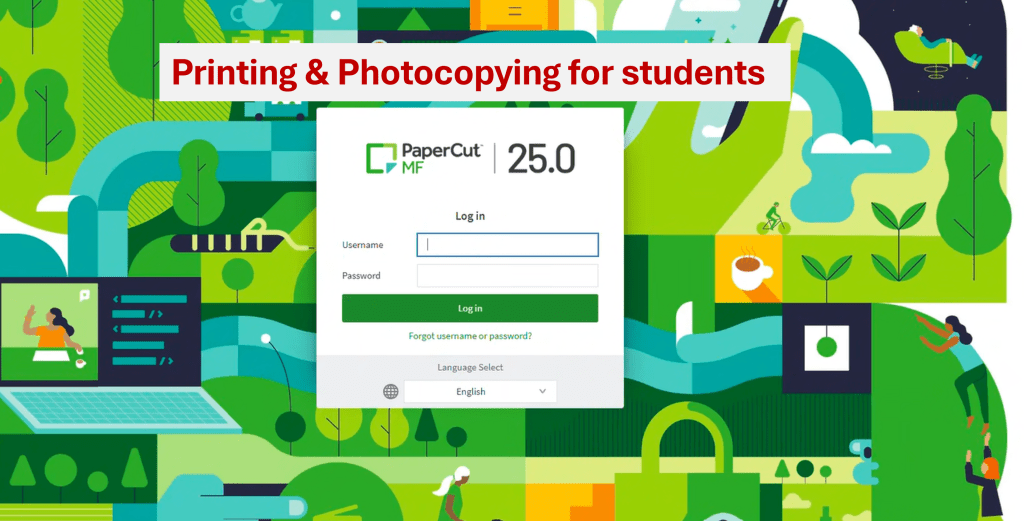
The university is introducing to you printing and photocopying services to the library by using Papercut, which is the system library uses to help you print, copy, and scan your work in an easy and fair way. You can now check your printing balance anytime, print from any computer or your own device, release your print jobs safely using your student login, and reduce waste by only printing what you really need. You may contact you friendly library staff or IT&N for assistance should you require any.
Electronic Resources
Databases
BRITANNICA ACADEMIC Is a global educational source that promotes knowledge and learning which provide timely, relevant, and trustworthy information and instructional products used in schools, universities, homes, libraries, and workplaces throughout the world.
EBSCOHOST Is a worldwide leader in providing information access and management solutions through print and electronic journal subscription services. Ebscohost gives access to more than 150 databases and thousands of journals.
EMERALD INSIGHT Is one of the most important and widely-read journals in the field of marketing and business & management studies. Emerald Engineering showcases practical and theoretical insightful articles, interviews, case studies, viewpoints and more. Emerald Engineering comprises four engineering communities: Advanced Automation; Computational Mathematics; Electronics Manufacture and Packaging; and Materials Science and Engineering.
Hungu is the institutional repository of Mangosuthu University of Technology, designed to collect, preserve, and provide open access to the scholarly and research output of the university. It includes theses, dissertations, research articles, conference papers, and other academic works, making them freely available to a global audience and supporting the visibility and impact of the institution’s intellectual contributions.
IEEE XPLORE Is the world’s largest professional association dedicated to advancing technological innovation and excellence for the benefit of humanity. IEEE and its members inspire a global community through IEEE’s highly cited publications, conferences, technology standards, and professional and educational activities.
JoVE is the world-leading producer and provider of educational videos with the mission to improve scientific research and education. Millions of scientists, educators and students at thousands of universities, colleges, hospitals and biopharmaceutical companies worldwide use JoVE for their research, teaching and learning.
Filmed at the world’s top scientific institutions, JoVE videos bring to life the intricate details of cutting-edge experiments enabling efficient learning and replication of new research methods and technologies. Producing 1,000s new videos every year, JoVE is a must-have resource for scientists in academia and industry. JoVE educational videos empower effective teaching of science concepts and laboratory methods in undergraduate and graduate courses at universities and colleges.
These videos enable quick in-depth comprehension of complex STEM subjects to increase student engagement and learning outcomes and support innovative teaching initiatives such as blended learning and flipped classroom.
Google Scholar is a free search tool for finding academic information. It helps you discover articles, books, theses, and research from many subjects. Some items are freely available, while others may require library access to read the full text.
PERLEGO Is a database that contains hundreds of publishers with thousands of titles of e-books on every subject. This database provides access to the library of knowledge for both students and staff. Please use this links to gain access Student Sign In and Staff Sign In
ProQuest Ebook Central is a platform that gives you access to a wide range of trusted and authoritative eBooks, all provided by your institution. It’s your go-to source for reliable digital books on various topics.
NEWSPAPERS AND MAGAZINES Is a proprietary technology that makes it possible to process thousands of newspapers every single day, extracting text and images and making articles instantly translatable, searchable, and easy to read on mobile devices.
SABINET DISCOVER Sabinet has merged Sabinet Reference with Sabinet Legal for your ease of navigation in a single interface. It facilitates access to full-text online content, addressing diverse information needs. Databases range from items from local and international databases, covering SA legal information, news, engineering, tenders and finding books and articles. This is a growing service with over 500 journal titles in 10 collections are available for individuals, corporates, universities, government departments, research institutions and law firms.
SABINET AFRICAN JOURNALS Is a service that has been available online to clients with great success since 2001. This service is the most comprehensive, searchable collection of full-text African electronic journals available on one platform which focuses on information originating from or pertaining to Africa.
SABINET LEGAL Encompasses the breadth and depth of African research content by offering the most comprehensive, searchable collection of full-text African electronic journals available on one platform. This service, which is easy to use and accessible anytime and anywhere, is a growing service — over 500 journal titles in 10 collections are available for individuals, corporates, universities, government departments, research institutions and law firms. Sabinet African Journals offers a user-friendly platform and encourages research efficacy. All international journal standards and statistics are adhered to and various business models are available.
SCIENCE DIRECT Is one of the largest online collections of published scientific research in the world. Produced by Elsevier, it contains over 8.5 million articles from over 2500 journals, including titles such as The Lancet and Cell , and over 6,000 e-books, reference works, book series and handbooks.
SCOPUS Is an Elsevier’s abstract and citation database that was launched in 2004 to improve institutions’ and professionals’ progress in sciences and healthcare. It is known to be the best abstraction and citation database for peer-reviewed journals. Scopus uniquely combines a comprehensive, expertly curated abstract and citation database with enriched data and linked scholarly literature across a wide variety of disciplines. It quickly finds relevant and authoritative research, identifies experts and provides access to reliable data, metrics and analytical tools. Be confident in progressing research, teaching or research direction and priorities — all from one database and with one subscription.
TAYLOR & FRANCIS GROUP Publishes quality peer-reviewed journals under the Routledge and Taylor & Francis imprints. Our journal content is hosted on Taylor & Francis Online, our content platform, where you can browse by subject, drill down to journal level to find the aims, scope and editorial board for each individual title and benefit from saved searching functionality.
WEB OF SCIENCE Provides you access to the most reliable, integrated, multidisciplinary research connected through linked content citation metrics from multiple sources within a single interface.
Wiley Online Library is Wiley’s platform for journals, books, and reference sources in a wide range of subject areas, including agriculture and aquaculture, business, chemistry, computer science, earth and environmental sciences, education, engineering, law, life sciences, mathematics and statistics, medicine and healthcare, physics and astronomy, physical sciences, psychology, social sciences, and veterinary medicine. It contains indexing, abstracts, and tables of contents for over 1,500 journals and over 20,000 eBooks.
WORLDCAT Is a webscale discovery solution that delivers single-search-box access to more than 1.138 billion items from MUT libraries and the world’s library collections i.e. Articles; digital items; eBooks; books and evaluative content (Table of content, summaries, cover art, etc.)
Research support
Accredited journals
Communiqué Number 1: April 2026
ZAPublication Monitor and the Journal Finder
To all University Research Offices
The Department of Higher Education and Training (the Department) wishes to bring to your attention an important development and improvement to the process underlying the submission of publications for subsidy under the Department’s Research Outputs Policy.
One of the ongoing challenges in the past has been that universities have submitted journal articles for subsidy which have contained various errors, including the following:
➢ Submitting articles in journals that were not on any of the approved lists that the Department had distributed to universities
➢ Authors submitting articles in journals where the journal name was wrongly spelt or where a journal spelling variant was used, which made it difficult for the Department to identify which journal was the correct one (journals change their names quite often)
➢ Authors from different universities who co-authored to publish an article in the same journal would often submit journal names that were different
➢ Articles were submitted to journals that were deemed by the major journal lists and indexes (Web of Science, Scopus and DOAJ) as already having been ‘delisted’ because of evidence of unethical or questionable ethical practices.
Population and Samples
When conducting research, one must often use a sample of the population as opposed to using the entire population. Before we go further into the reasons why, let us first discuss what differentiates between a population and a sample.
A population can be defined as any set of persons/subjects having a common observable characteristic. For example, all individuals who reside in the United States make up a population. Also, all pregnant women make up a population. The characteristics of a population are called a parameter. A statistic can be defined as any subset of the population. The characteristics of a sample are called a statistic.
Why Sample?
This brings us to the question of why sample. Why should we not use the population as the focus of study. There are a few major reasons to sample.
One of the reasons to sample is that testing the entire population often produces error. Thus, sampling may be more accurate. Perhaps an example will help clarify this point. Say researchers wanted to examine the effectiveness of a new drug on Alzheimer’s disease. One dependent variable that could be used is an Activities of Daily Living Checklist. In other words, it is a measure of functioning o a day to day basis. In this experiment, it would make sense to have as few of people rating the patients as possible. If one individual rates the entire sample, there will be some measure of consistency from one patient to the next. If many raters are used, this introduces a source of error. These raters may all use some slightly different criteria for judging Activities of Daily Living. Thus, as in this example, it would be problematic to study an entire population.
Another reason to sample is that testing may be destructive. It makes no sense to lesion the lateral hypothalamus of all rats to determine if it has an effect on food intake. We can get that information from operating on a small sample of rats. Also, you probably would not want to buy a car that had the door slammed five hundred thousand time or had been crash tested. Rather, you probably would want to purchase the car that did not make it into either of those samples.
Types of Sampling Procedures
As stated above, a sample consists of a subset of the population. Any member of the defined population can be included in a sample. A theoretical list (an actual list may not exist) of individuals or elements who make up a population is called a sampling frame. There are five major sampling procedures.
The first sampling procedure is convenience. Volunteers, members of a class, individuals in the hospital with the specific diagnosis being studied are examples of often used convenience samples. This is by far the most often used sample procedure. It is also by far the most biases sampling procedure as it is not random (not everyone in the population has an equal chance of being selected to participate in the study). Thus, individuals who volunteer to participate in an exersise study may be different that individuals who do not volunteer.
Another form of sampling is the simple random sample. In this method, all subject or elements have an equal probability of being selected. There are two major ways of conducting a random sample. The first is to consult a random number table, and the second is to have the computer select a random sample.
A systematic sample is conducted by randomly selecting a first case on a list of the population and then proceeding every Nth case until your sample is selected. This is particularly useful if your list of the population is long. For example, if your list was the phone book, it would be easiest to start at perhaps the 17th person, and then select every 50th person from that point on.
Stratified sampling makes up the fourth sampling strategy. In a stratified sample, we sample either proportionately or equally to represent various strata or subpopulations. For example if our strata were states we would make sure and sample from each of the fifty states. If our strata were religious affiliation, stratified sampling would ensure sampling from every religious block or grouping. If our strata were gender, we would sample both men and women.
Cluster sampling makes up the final sampling procedure. In cluster sampling we take a random sample of strata and then survey every member of the group. For example, if our strata were individuals schools in the St. Louis Public School System, we would randomly select perhaps 20 schools and then test all of the students within those schools.
Sampling Problems
There are several potential sampling problems. When designing a study, a sampling procedure is also developed including the potential sampling frame. Several problems may exist within the sampling frame. First, there may be missing elements – individuals who should be on your list but for some reason are not on the list. For example, if my population consists of all individuals living in a particular city and I use the phone directory as my sampling frame or list, I will miss individuals with unlisted numbers or who can not afford a phone.
Foreign elements make up my second sampling problem. Elements which should not be included in my population and sample appear on my sampling list. Thus, if I were to use property records to create my list of individuals living within a particular city, landlords who live elsewhere would be foreign elements. In this case, renters would be missing elements.
Duplicates represent the third sampling problem. These are elements who appear more than once on the sampling frame. For example, if I am a researcher studying patient satisfaction with emergency room care, I may potentially include the same patient more than once in my study. If the patients are completing a patient satisfaction questionnaire, I need to make sure that patients are aware that if they have completed the questionnaire previously, they should not complete it again. If they complete it more that once, their second set of data respresents a duplicate
Questionnaire design
Preliminary decisions in questionnaire design
There are nine steps involved in the development of a questionnaire:
- Decide the information required.
- Define the target respondents.
- Choose the method(s) of reaching your target respondents.
- Decide on question content.
- Develop the question wording.
- Put questions into a meaningful order and format.
- Check the length of the questionnaire.
- Pre-test the questionnaire.
- Develop the final survey form.
Referencing tools
Simplify your research workflow! Use these tools to record, organize, and cite your bibliographic sources automatically.
MUT officially supports two powerful referencing tools:
Mendeley Reference Manager
Mendeley is a reference management software and academic social network platform that helps you manage, organize, and share your research papers and references, simplifying the research workflow for students and academics.
ScienceDirect Integration: Discover new research directly within the app.
Web Importer: A browser extension to save references instantly as you browse.
Mendeley Cite: Insert citations into your document without switching tabs.
Collaborate: Create private groups to share papers with peers.
Click Here to install Mendeley
EndNote Reference Manager
EndNote is a reference management software and a powerful tool designed to streamline the process of collecting, organizing, and citing research materials when writing papers, theses, and articles.
Database Power: Direct imports from PubMed, Web of Science, and more.
Cite While You Write: Automatically generates your bibliography as you type.
Custom Organisation: Use subgroups to keep complex references easily identifiable .
Cloud Sync: Access your library across desktop, web, and
Click Here to install Endnote and Contact the Reference Librarian for a product key, and any assistance or training you may require.
Research journey
Introduction
Dear student,
You will be expected to use the library and its resources extensively for your research. In order to assist you with using information resources effectively and succeed in your studies, the librarians have designed a course call information literacy (IL).
What is IL?
Have a look at the diagram below:
Selecting a research topic
Choosing a unique dissertation topic is a lengthy and important process. Getting it right will mean you enjoy writing this key piece of work and are well on your way to obtaining a great grade. However, rushing into a title simply because it flows well, or seems unusual, can result in a lacklustre essay and many sleepless nights. Start planning your dissertation well in advance, giving you plenty of time for each stage in the process. For most postgraduate qualifications, students need to submit a comprehensive proposal that demonstrates not only original thought, but a sound foundation and the beginnings of thorough research.
How do you think of a unique idea?
Initially, unique dissertation ideas are often the result of a verbal collaboration; this could be between the student and either a friend or tutor. It’s rare that the ideal topic will just turn up in your head – choosing which path to follow is matter of identifying which question can develop your passion for the subject. It should also have further study potential, possibly encompassing a number of sub-questions. A good unique dissertation idea should be enjoyable to write, whilst also giving you a chance to show off your powers of argument and breadth of understanding. The themes covered by your postgraduate course maybe many and varied, so be open to a variety of topics, without losing sight of the ideas which appeal to you personally.
Be realistic in your goals
Next, consider whether you are expert enough in the field to write at the level required. Always set yourself realistic goals, ambition is commendable, but so is handing in a completed piece of work. Spend plenty of time deciding if you have the motivation and time to acquire any new skills, and if this can be done within an allotted timeframe. If not, stick to a topic you feel comfortable and confident with. Remember, the dissertation is an extremely long work, there is always potential for widening or deepening your exploration of the question. So do not be afraid to start with a unique dissertation idea that seems small scale or conventional, so long as the subject has scope, you can diversify and the ideas can be extended.
Do you have the resources to make it a success?
Before committing to a question, consider whether you can research this topic to the necessary standard. You should check what sources are available and how much data can be obtained; starting to write prior to gathering background information may lead to a frustrating dead end. However, finding a few good quality sources is different to having none at all. Try not to let your interest in a marginal topic be dampened by scarcity of information, with enough drive and determination almost any subject can become a success. Past students have investigated ideas as diverse and unusual as the possible existence of unicorns and the significance of Acid House culture, going on to receive a favourable grade from their tutor. Obviously you don’t have to go to those lengths to find a unique dissertation idea, but try to find an interesting topic with the right balance between innovation and workability. Originality is significant so long as you can formulate an effective thesis around your idea.
Don’t be daunted
Although you have written countless essays and participated in many debates, the final dissertation may still be the most daunting aspect of obtaining your postgraduate qualification. Frequently, students will feel overwhelmed at the task ahead, producing 20,000 words of tightly structured, expertly researched academic writing, is undoubtedly a demanding process. However, bear in mind that you earned your place on a postgraduate course and have confidence in your opinions. If you find a unique dissertation idea that gets you thinking and inspires you, this will be obvious in the finished work.
Useful links:
How to edit your own postgraduate writing
Selecting a research topic
Choosing a unique dissertation topic is a lengthy and important process. Getting it right will mean you enjoy writing this key piece of work and are well on your way to obtaining a great grade. However, rushing into a title simply because it flows well, or seems unusual, can result in a lacklustre essay and many sleepless nights. Start planning your dissertation well in advance, giving you plenty of time for each stage in the process. For most postgraduate qualifications, students need to submit a comprehensive proposal that demonstrates not only original thought, but a sound foundation and the beginnings of thorough research.
How do you think of a unique idea?
Initially, unique dissertation ideas are often the result of a verbal collaboration; this could be between the student and either a friend or tutor. It’s rare that the ideal topic will just turn up in your head – choosing which path to follow is matter of identifying which question can develop your passion for the subject. It should also have further study potential, possibly encompassing a number of sub-questions. A good unique dissertation idea should be enjoyable to write, whilst also giving you a chance to show off your powers of argument and breadth of understanding. The themes covered by your postgraduate course maybe many and varied, so be open to a variety of topics, without losing sight of the ideas which appeal to you personally.
Be realistic in your goals
Next, consider whether you are expert enough in the field to write at the level required. Always set yourself realistic goals, ambition is commendable, but so is handing in a completed piece of work. Spend plenty of time deciding if you have the motivation and time to acquire any new skills, and if this can be done within an allotted timeframe. If not, stick to a topic you feel comfortable and confident with. Remember, the dissertation is an extremely long work, there is always potential for widening or deepening your exploration of the question. So do not be afraid to start with a unique dissertation idea that seems small scale or conventional, so long as the subject has scope, you can diversify and the ideas can be extended.
Do you have the resources to make it a success?
Before committing to a question, consider whether you can research this topic to the necessary standard. You should check what sources are available and how much data can be obtained; starting to write prior to gathering background information may lead to a frustrating dead end. However, finding a few good quality sources is different to having none at all. Try not to let your interest in a marginal topic be dampened by scarcity of information, with enough drive and determination almost any subject can become a success. Past students have investigated ideas as diverse and unusual as the possible existence of unicorns and the significance of Acid House culture, going on to receive a favourable grade from their tutor. Obviously you don’t have to go to those lengths to find a unique dissertation idea, but try to find an interesting topic with the right balance between innovation and workability. Originality is significant so long as you can formulate an effective thesis around your idea.
Don’t be daunted
Although you have written countless essays and participated in many debates, the final dissertation may still be the most daunting aspect of obtaining your postgraduate qualification. Frequently, students will feel overwhelmed at the task ahead, producing 20,000 words of tightly structured, expertly researched academic writing, is undoubtedly a demanding process. However, bear in mind that you earned your place on a postgraduate course and have confidence in your opinions. If you find a unique dissertation idea that gets you thinking and inspires you, this will be obvious in the finished work.
Useful links:
How to edit your own postgraduate writing
Writing a literature review
A literature review is an account of what has been published on a topic by accredited scholars and researchers. Occasionally you will be asked to write one as a separate assignment (sometimes in the form of an annotated bibliography—see the bottom of the next page), but more often it is part of the introduction to an essay, research report, or thesis. In writing the literature review, your purpose is to convey to your reader what knowledge and ideas have been established on a topic, and what their strengths and weaknesses are. As a piece of writing, the literature review must be defined by a guiding concept (e.g., your research objective, the problem or issue you are discussing, or your argumentative thesis). It is not just a descriptive list of the material available or a set of summaries
Besides enlarging your knowledge about the topic, writing a literature review lets you gain and demonstrate skills in two areas
Information seeking: the ability to scan the literature efficiently, using manual or computerized methods, to identify a set of useful articles and books
Critical appraisal: the ability to apply principles of analysis to identify unbiased and valid studies.
A literature review must do these things:
- Be organized around and related directly to the thesis or research question you are developing
- Synthesize results into a summary of what is and is not known
- Identify areas of controversy in the literature
- Formulate questions that need further research
Frequently Asked Questions
Undergraduates: 5 books.
Postgraduate: 7 books.
Under graduates: 14 days, and 1 month for post-graduates.
By calling Main Campus Library 031 907 7203 or Natural Sciences Library 031 9077676
By https://shorturl.at/2Mff5 and Login to E- Library.
The library has three Faculty Librarians, an Information Literacy Librarian, and a Reference Librarian readily available to assist you.
Engineering:
Noxolo Mpungose
Mpungose.noxolo@mut.ac.za
Applied and Health Science:
Ziningi Mngadi
sitholezt@mut.ac.za
Mrs Lindiwe Eileen Gumede Gumede.lindi@mut.ac.za
Management Sciences:
Masande Mafanga mafanga.masande@mut.ac.za
Information Literacy:
Zolile Machi
zmachi@mut.ac.za
Reference Librarian:
Masande Mafanga mafanga.masande@mut.ac.za
Please go to https://www.mut.ac.za/student-portal/ and click Email login.
Email or phone: Enter your MUT student email address (student number@live.mut.ac.za).
Password: @Mut followed by the last seven digits of you SA ID number (no spaces).
Visit https://hungu-mut.figshare.com/groups and click on Past Year Examination Papers
There are various styles of referencing of which author/date style is the most popular. Verify with your Lecturers which style/s they accept and the Librarians will assist with your training.
It is recommended that students use Reference Management Tools (Endnote 21 or Mendeley Reference Manager) to ensure consistency when citing and referencing sources. Mendeley Download or EndNote Download
NB: Contact the Reference Librarian for assistance with these tools
Connect to MUT-WIFI
Identity: Student number
Password: @Mut followed by the last seven digits of your SA ID number (no spaces).
Domain: mut.ac.za
CA Certificate: Do not validate
System Certificate: Do not validate and click Connect
Start your search on the library homepage https://www.mut.ac.za/library-services/ type your search in the EDS Search box.
Consult https://mut-za.libguides.com/E-resources for further information on database and e-books search.
Visit https://mut-za.libguides.com/c.php?g=1031511&p=7476420 for a step-by-step guide.
Please use the same credentials you use for Wi-Fi connection, alternatively magocoba.andisiwe@mut.ac.za should you encounter any difficulties.
Library Staff List
Library Management | |||
| Mosala-Bryant, Nthabiseng | Senior Director: Library Services | Nthabiseng@mut.ac.za | 031 907 7298 |
| Nyide, Bongiwe | Deputy Director: Library Services | Bnyide@mut.ac.za | 031 907 7123 |
| Gumede, Lindiwe (Malindy) | Senior Librarian: Technical Services | gumede.lindiwe@mut.ac.za | 031 907 7205 |
| Ncwane, Siyabonga | Senior Librarian: User Services | siyab@mut.ac.za | 031 907 7368 |
Library Administration | |||
| Govender, Ronelle | Senior Secretary: Library Services | Ronelle@mut.ac.za | 031 907 7286 |
Technical Services | |||
| Biyela, Phumlani | Research and Scholarly Communications Librarian | biyela.phumlani@mut.ac.za | 031 907 7479 |
| Khoza, Judge | Librarian: Cataloguing. | Khoza.judgement@mut.ac.za | 031 907 7480 |
| Mchunu, Mnelisi | Library Assistant | mchunu.mnelisi@mut.a.c.za | 031 907 7531 |
| Myeza, Zamokuhle | Assistant Librarian: Acquisitions | myezazf@mut.ac.za | 031 907 7156 |
| Naidoo, Indrani | E-Resources Librarian | naidoo.indrani@mut.ac.za | 0319077529 |
| Zondi, Mhlengi | Senior Library Assistant | Mhlengi.zondi@mut.ac.za | 031 907 7292 |
User Services | |||
| Machi, Zolile | Librarian | zmachi@mut.ac.za | 031 907 7202 |
| Mafanga, Masande | Reference Librarian: After Hours | mafanga.masande@mut.ac.za | 031 907 7431 |
| Manqele, Sindisiwe | Library Assistant | Manqele.sindisiwe@mut.ac.za | 031 907 7676 |
| Mazibuko, Mpho | Library Assistant | Mazibukome@mut.ac.za | 031 907 7203 |
| Mhlongo, Khulekani | Messenger/Shelver | Mhlongo.khulekani@mut.ac.za | 031 907 7200 |
| Mkhithi, Siyabonga | Library Assistant | mkhithis@mut.ac.za | 031 907 7203 |
| Mpungose, Noxolo | Subject Librarian: Engineering | Mpungose.noxolo@mut.ac.za | 031 907 7424 |
| Mthembu, Israel | Senior Library Assistant | israelm@mut.ac.za | 031 907 7442 |
| Gumede, Lindiwe E | Subject Librarian: Applied and Health Sciences | gumede.lindi@mut.ac.za | 031 907 7295 |
| Ngiba, Nokuthula | Library Assistant | ngiba@mut.ac.za | 031 907 7676 |
| Mngadi, Ziningi | Senior Library Assistant | sitholezt@mut.ac.za | 031 907 7203 |
| Zulu, Nhlakanipho | Library Assistant | zulun@mut.ac.za | 031 907 7676 |
| Zulu, Portia | Library Assistant | Vumile.zulu@mut.ac.za | 031 907 7200 |
| Biyase, Thandeka | Library Assistant | biyase.thandeka@mut.ac.za | 031 907 7200 |
| Dlamini, Sandile | Library Assistant | dlaminism@mut.ac.za | 031 907 7200 |
| Buthelezi, Samuel | Library Assistant | buthelezis@mut.ac.za | 031 907 7200 |
| Dlamini, Mbali | Librarian: Circulation | mbalid@mut.ac.za | 031 907 7369 |